Edge-Aware EfficientViT-FPN for Target Association in Low-Altitude Surveillance
Authors
Files
Key Information
Journal
Published in Vol. 4 No. 3 (2026) of Journal of Data‑Centric Engineering Science.
Journal of Data‑Centric Engineering Science eISSN 3136-814X is an international, peer‑reviewed open‑access journal. It publishes high‑quality original research, methodological advances, comprehensive reviews, dataset papers and short communications concerning fundamental theories, scientific methodologies and cross‑domain engineering applications under the data‑centric paradigm. This journal focuses on underlying scientific problems of data‑driven engineering, promotes the integration of data science and physical‑mechanism‑based engineering science, and builds an interdisciplinary platform for academic researchers and industrial scientists.
About the JournalAbstract
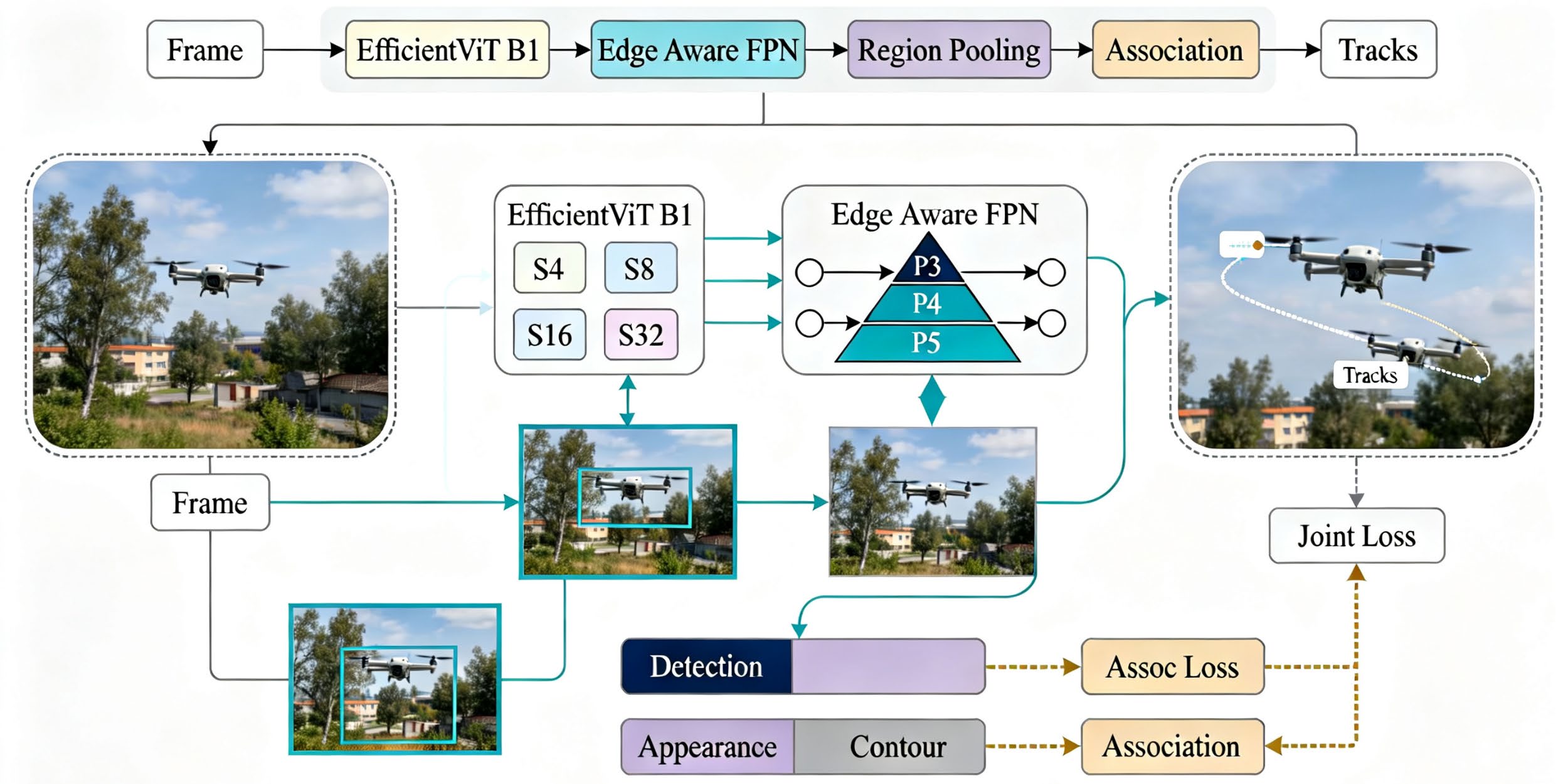
Maintaining target identity in low-altitude surveillance is challenging because small aircraft occupy few pixels, background structures introduce strong edges, and temporary occlusion interrupts appearance continuity. This paper develops an edge- aware EfficientViT feature pyramid model that connects boundary-sensitive representation learning with reliability- controlled temporal association. A shallow boundary branch modulates multiscale features, and separate projections produce appearance and contour descriptors from a shared region representation. Motion gating restricts candidate matches, while an uncertainty-dependent rejection rule defers ambiguous assignments and protects descriptor memory. The evaluation compares six configurations and examines detection-related effects through a frozen-detection control. The complete model records an identity F1 score of 78.6%, higher-order tracking accuracy of 64.8%, and association accuracy of 65.9%, compared with 72.4%, 59.1%, and 58.7% for the pyramid reference. Identity switches decrease from 168 to 109, while median processing time increases from 24.8 to 28.6 milliseconds per frame. Under frozen detections, the identity F1 advantage is 4.6 percentage points. Relative to edge fusion, reliability-controlled acceptance reduces switches but increases trajectory fragments from 77 to 80, exposing a continuity tradeoff. Target-size, interruption, perturbation, and calibration analyses examine conditions affecting the available identity evidence. The framework provides a compact mechanism for studying boundary-informed association, with deployment suitability dependent on acquisition conditions, calibration quality, and processing demand at different target densities.
Details
License
Copyright (c) 2026 Shamsa Al-Shamsi, Maryam Al-Jabri, Jawaher Al-Sharqi

This work is licensed under a Creative Commons Attribution-NonCommercial-ShareAlike 4.0 International License.