Multiangle Roadside Video Driven School Zone Traffic Conflict Recognition Using a PatchTST Informer Model
Authors
Files
Key Information
Journal

Published in Vol. 4 No. 3 (2026) of Journal of Data‑Centric Engineering Science.
Journal of Data‑Centric Engineering Science eISSN 3136-814X is an international, peer‑reviewed open‑access journal. It publishes high‑quality original research, methodological advances, comprehensive reviews, dataset papers and short communications concerning fundamental theories, scientific methodologies and cross‑domain engineering applications under the data‑centric paradigm. This journal focuses on underlying scientific problems of data‑driven engineering, promotes the integration of data science and physical‑mechanism‑based engineering science, and builds an interdisciplinary platform for academic researchers and industrial scientists.
About the JournalAbstract
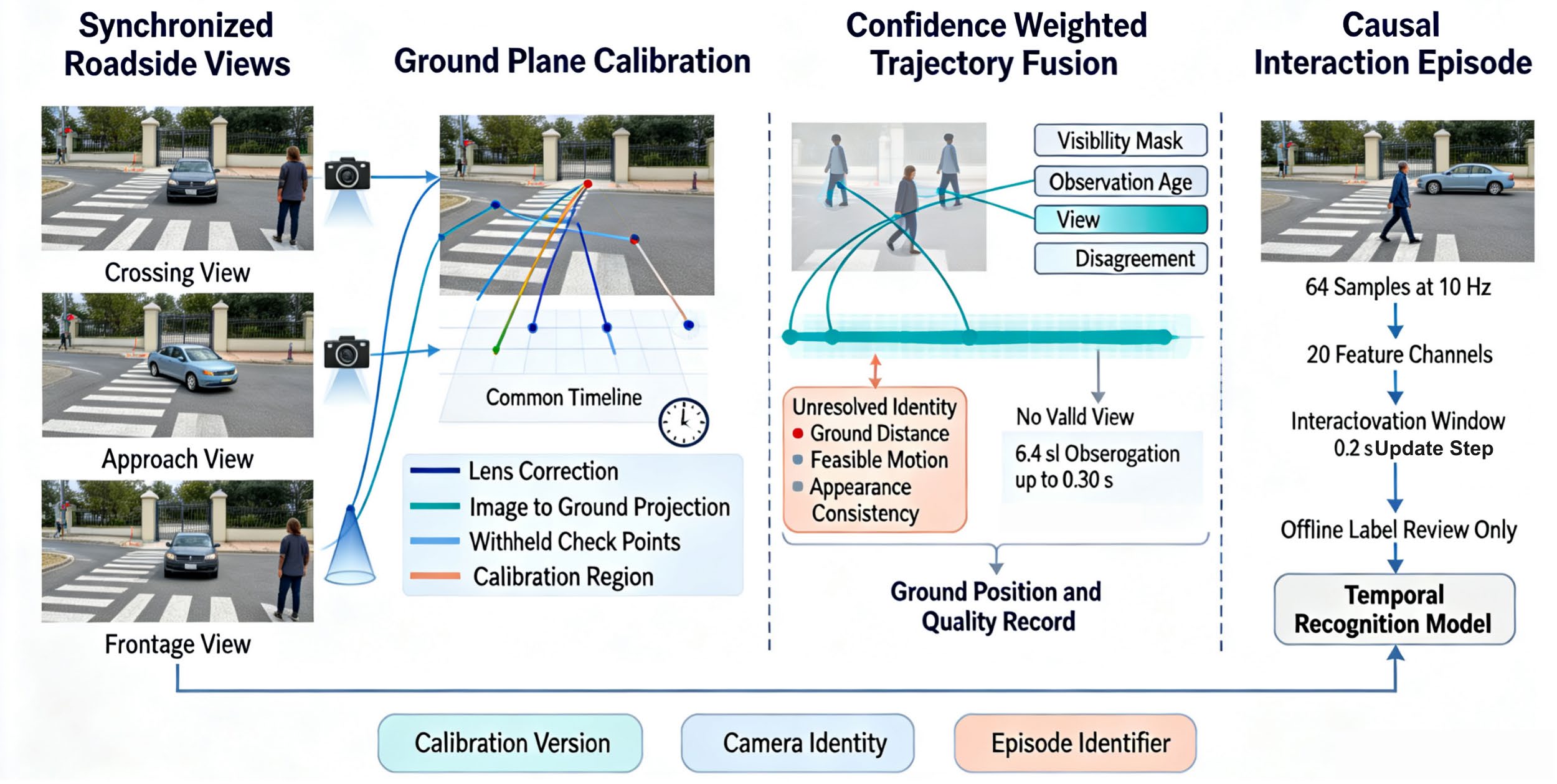
School entrances concentrate pedestrian crossings, vehicle turning movements, and temporary stopping within a restricted observation area. Reliable conflict recognition requires complementary camera coverage and timely representation of changing interactions. This paper proposes a trajectory-based framework combining confidence weighted multiview fusion, a patch time series Transformer, and an Informer context encoder. Synchronized roadside observations are projected onto a common ground plane, associated across views, and represented through motion, separation, visibility, and crossing context. A local branch encodes overlapping temporal patches, while a sparse attention branch represents longer interaction histories. A gated classifier combines these representations to provide calibrated event probabilities. The evaluation protocol specifies 12,000 interaction episodes across twelve school settings, including a school disjoint test partition containing 3,000 episodes. At the selected operating point, the test counts comprise 819 true positives, 81 false negatives, 105 false positives, and 1,995 true negatives, corresponding to 88.64% precision, 91.00% recall, and 89.80% F1. Additional diagnostics examine occlusion, patch length, calibration, selective prediction, and processing budgets. The numerical assessment connects recognition performance with observation quality and the operational requirements of the proposed pipeline. The contribution concerns their integration for event-level recognition; the reported classification metrics quantify agreement with the conflict annotation rule. Processing budgets and calibration diagnostics require separate verification before operational deployment. The framework provides a methodological specification for school zone conflict recognition by separating trajectory uncertainty, temporal representation, and alert decisions. Independent field validation is required to assess generalizability and operational performance.
Details
License
Copyright (c) 2026 Nikola Šarić, Bruno Kraljević, Valentin Živković

This work is licensed under a Creative Commons Attribution-NonCommercial-ShareAlike 4.0 International License.