Improved SwinV2-Adapter Model for UAV Icing Accumulation Estimation from Motor Current and Atmospheric Data
Authors
Files
Key Information
Journal

Published in Vol. 4 No. 3 (2026) of Journal of Data‑Centric Engineering Science.
Journal of Data‑Centric Engineering Science eISSN 3136-814X is an international, peer‑reviewed open‑access journal. It publishes high‑quality original research, methodological advances, comprehensive reviews, dataset papers and short communications concerning fundamental theories, scientific methodologies and cross‑domain engineering applications under the data‑centric paradigm. This journal focuses on underlying scientific problems of data‑driven engineering, promotes the integration of data science and physical‑mechanism‑based engineering science, and builds an interdisciplinary platform for academic researchers and industrial scientists.
About the JournalAbstract
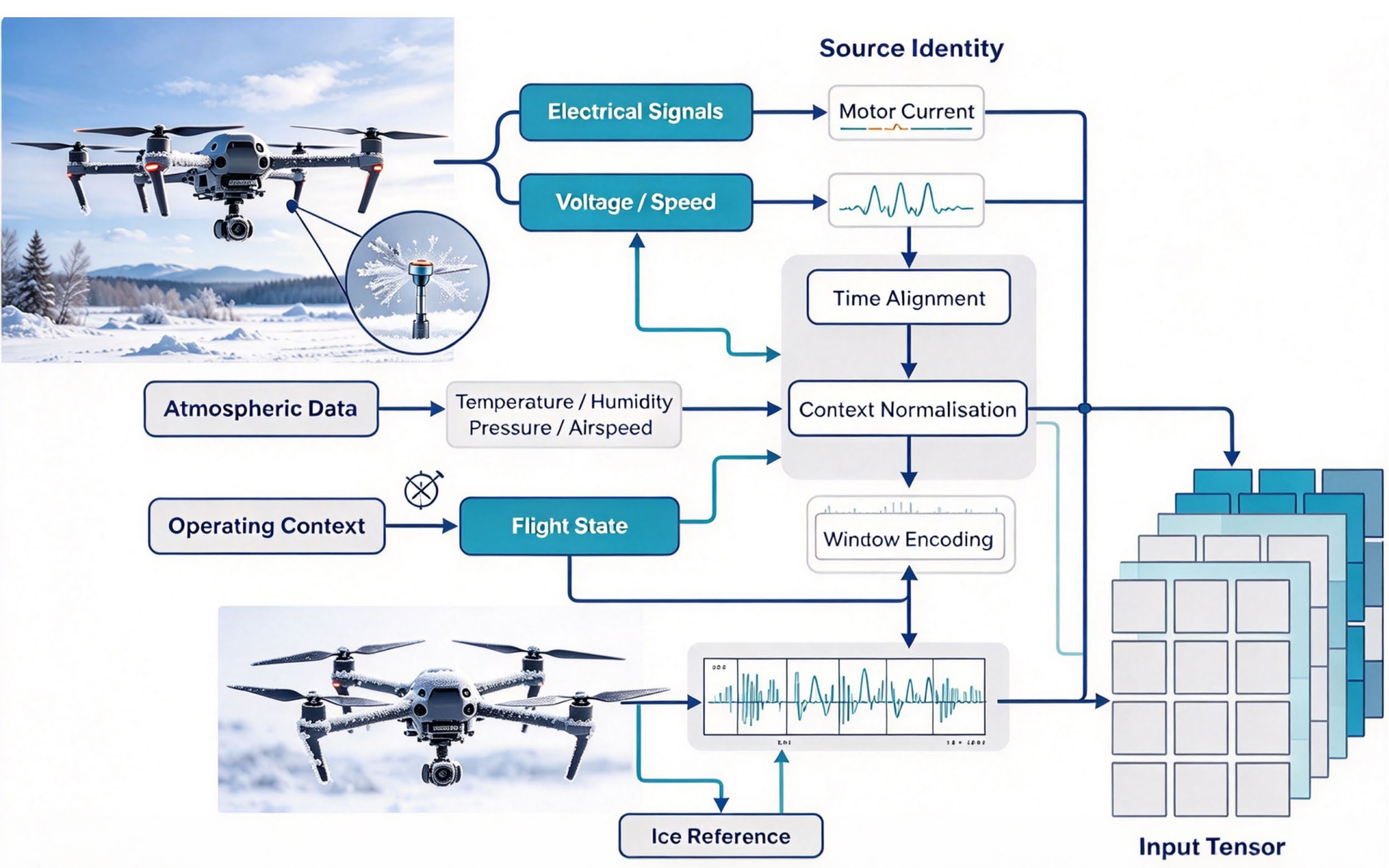
Ice accumulation alters the aerodynamics and propulsion of unmanned aerial vehicles, and changes in motor current are also due to manoeuvring, battery status and atmospheric disturbances. Therefore, a reliable estimate needs to keep the operating context and electrical and environmental data. This paper introduces an improved SwinV2-Adapter framework for continuous icing accumulation estimation. Motor-current windows are organised according to temperature, relative humidity, static pressure, airspeed and flight-state data. Context-conditioned Normalisation reduces the expected operational fluctuations, and shifted-window attention extracts localised and distributed patterns from a structured time- feature tensor. Lightweight Adapters contain atmospheric exposure and sensor quality data at various backbone levels. The source attribution head connects each estimate to electrical, atmospheric and operating-state evidence, and a separate calibration stage produces prediction intervals for review scheduling. The design of the experiment has a 10s input window, a 100Hz common sampling grid, four physical accumulation categories and four observation-quality conditions. Whole- flight partitions are used for training (60%), validation (20%) and testing (20%) independently. Comparison: Estimation Error, Interval Coverage, Computational Cost and Sensitivity to Maneuver and Gust Confounding. The numerical configuration table and six evaluation figures define the comparative assessment. At present, the three main directions of research are computing architecture, leakage-controlled evaluation protocol and engineering interpretation framework. The evaluation protocol specifies independent flight or icing-tunnel reference labels for quantitative assessment. The framework connects hierarchical feature learning with atmospheric conditioning to provide a reproducible basis for research on when current-derived evidence can support icing assessment under various UAV operating conditions.
Details
License
Copyright (c) 2026 Markos Raptis, Odyssefs Tsakiris, Rigas Anagnostis

This work is licensed under a Creative Commons Attribution-NonCommercial-ShareAlike 4.0 International License.