Data Driven Mesh Adaptation Using an Explainable Res2Net SE Model
Authors
Files
Key Information
Journal

Published in Vol. 4 No. 3 (2026) of Journal of Data‑Centric Engineering Science.
Journal of Data‑Centric Engineering Science eISSN 3136-814X is an international, peer‑reviewed open‑access journal. It publishes high‑quality original research, methodological advances, comprehensive reviews, dataset papers and short communications concerning fundamental theories, scientific methodologies and cross‑domain engineering applications under the data‑centric paradigm. This journal focuses on underlying scientific problems of data‑driven engineering, promotes the integration of data science and physical‑mechanism‑based engineering science, and builds an interdisciplinary platform for academic researchers and industrial scientists.
About the JournalAbstract
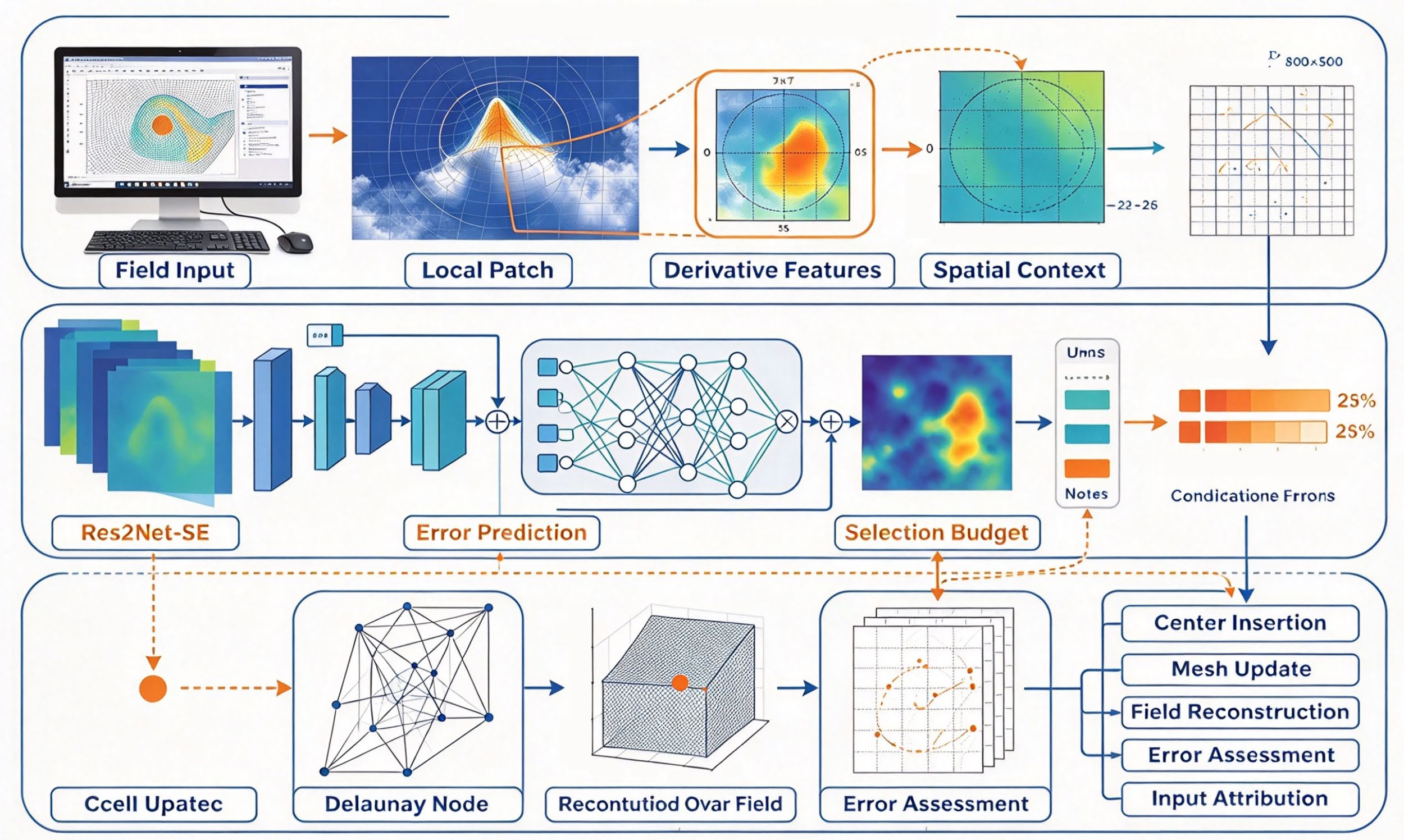
Adaptive mesh selection requires a local error indicator, a fixed resource rule and a separate assessment of the reconstructed field. This study evaluates a Res2Net-SE predictor with sensitivity-based diagnostics for one-round center insertion in generated scalar fields. Each candidate cell supplies a 7-by-7 patch with seven channels: coarse field values, two directional gradients, a Laplacian, two coordinates and mesh spacing. Hierarchical residual groups and squeeze-and-excitation gates form a local error estimate; a prediction-consistency term regularizes the fitted mapping. One hundred fields are divided by whole field into 60 training, 15 validation, 15 held-out and 10 transfer cases. The first three groups use 8, 10 or 12 cells per direction, whereas the transfer group uses 14 cells and narrower local structures. The top quarter of candidate cells receives reference-evaluated center samples, followed by Delaunay triangulation and piecewise-linear reconstruction. On held-out fields, the full model has local mean absolute error of 0.00503 and 70.96% overlap with the evaluated-error top- quarter ranking. Its adjusted mean relative reconstruction error is 4.08%, with a 31.22% mean per-field reduction from initial grids. Plain CNN and context-removal variants achieve lower local errors of 0.00468 and 0.00442 and slightly lower adjusted reconstruction errors of 4.04% and 4.03%, respectively. The ten-field combined transfer setting gives full-model local error 0.00421 and adjusted reconstruction error 3.22%, against 4.99% for its initial grids. Small-perturbation attribution cosine similarity is 0.999993, while seven-channel agreement with replacement responses is 0.9643. These diagnostics describe local sensitivity and ranking consistency under specified standardized interventions. The results support a traceable prediction-to-reconstruction workflow, while the tested simplified variants limit claims of an accuracy advantage for the complete architecture.
Details
License
Copyright (c) 2026 Vedat Akça, Galip Kahraman, Faruk İskender

This work is licensed under a Creative Commons Attribution-NonCommercial-ShareAlike 4.0 International License.