Mamba2-UNet Model for Microdrill Wear Evolution Modeling Using Acoustic Emission and Spindle Load Data
Authors
Files
Key Information
Journal
Published in Vol. 4 No. 2 (2026) of Journal of Data‑Centric Engineering Science.
Journal of Data‑Centric Engineering Science eISSN 3136-814X is an international, peer‑reviewed open‑access journal. It publishes high‑quality original research, methodological advances, comprehensive reviews, dataset papers and short communications concerning fundamental theories, scientific methodologies and cross‑domain engineering applications under the data‑centric paradigm. This journal focuses on underlying scientific problems of data‑driven engineering, promotes the integration of data science and physical‑mechanism‑based engineering science, and builds an interdisciplinary platform for academic researchers and industrial scientists.
About the JournalAbstract
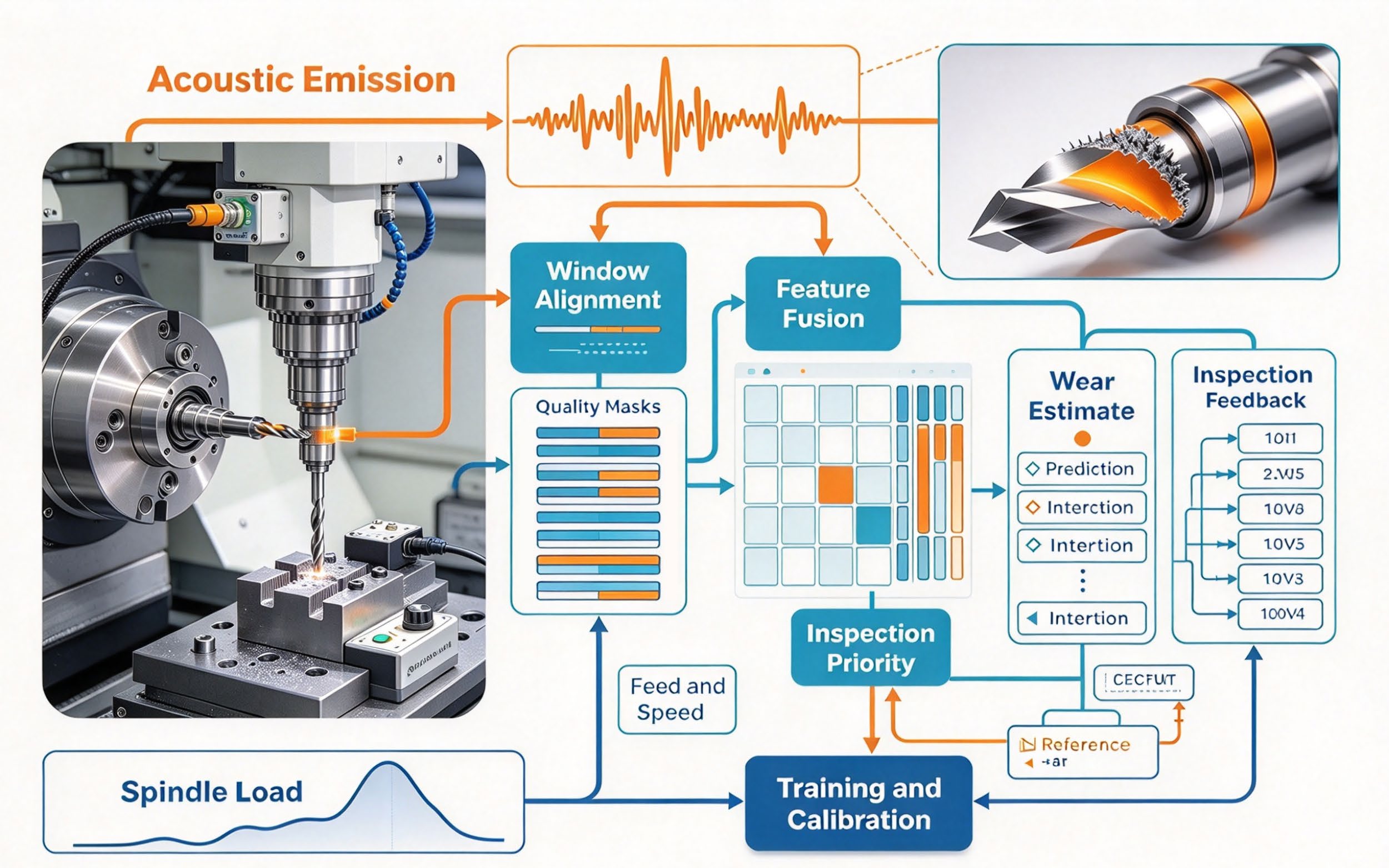
Microdrill-wear estimation requires temporal interpretation of acoustic-emission activity, spindle loading, operating conditions and observation quality. This study evaluates a reliability-aware Mamba2-UNet that estimates normalized endpoint wear from 32-record histories of eight synchronized descriptors. Eight availability masks accompany standardized acoustic energy, event activity, impulsiveness, load level, load variation, feed, speed and coupled response. Temporal compression and selective state propagation summarize historical evidence, while a high-resolution skip connection restores local response information for endpoint regression. Sixty complete tool trajectories yield 1,020 overlapping windows; disjoint groups of 36, six, six and twelve tools provide 612 training, 102 checkpoint-selection, 102 residual-calibration and 204 assessment windows. On assessment windows, the full model attains mean absolute error 0.04928 and root-mean-square error 0.06335. Selective-state replacement and skip removal increase mean absolute error to 0.05176 and 0.05286. Acoustic-only and load-only retrained models yield 0.05455 and 0.06657, respectively. The GRU comparator performs better at mean absolute error 0.04759 and root-mean-square error 0.05920; Temporal CNN reaches 0.04936 and 0.06159. A nominal 90% symmetric residual interval has radius 0.04659 and width 0.09318, yet covers only 58.33% of independent assessment endpoints. Severe-wear recall at normalized threshold 0.60 is 75.56% for the full model, compared with 77.78% for GRU and Temporal CNN. A top-quarter review budget selects 51 of 204 windows and shares 45 with the reference-wear top quarter, giving 88.24% overlap. Inference-time acoustic and load interruptions increase full-model error to 0.07275 and 0.06866 and reduce severe-wear recall to 26.67% and 40.00%. These results distinguish architectural component effects, baseline regression performance, interval undercoverage and inspection-ranking behavior within twelve assessed tools.
Details
License
Copyright (c) 2026 Sara Mlakar, Mark Božič, Urška Hočevar, Mojca Klemenčič

This work is licensed under a Creative Commons Attribution-NonCommercial-ShareAlike 4.0 International License.