Improved TabM LightGBM Model for Construction Hoist Vibration Diagnosis Using Motor Current and Acceleration Data
Authors
Files
Key Information
Journal
Published in Vol. 4 No. 2 (2026) of Journal of Data‑Centric Engineering Science.
Journal of Data‑Centric Engineering Science eISSN 3136-814X is an international, peer‑reviewed open‑access journal. It publishes high‑quality original research, methodological advances, comprehensive reviews, dataset papers and short communications concerning fundamental theories, scientific methodologies and cross‑domain engineering applications under the data‑centric paradigm. This journal focuses on underlying scientific problems of data‑driven engineering, promotes the integration of data science and physical‑mechanism‑based engineering science, and builds an interdisciplinary platform for academic researchers and industrial scientists.
About the JournalAbstract
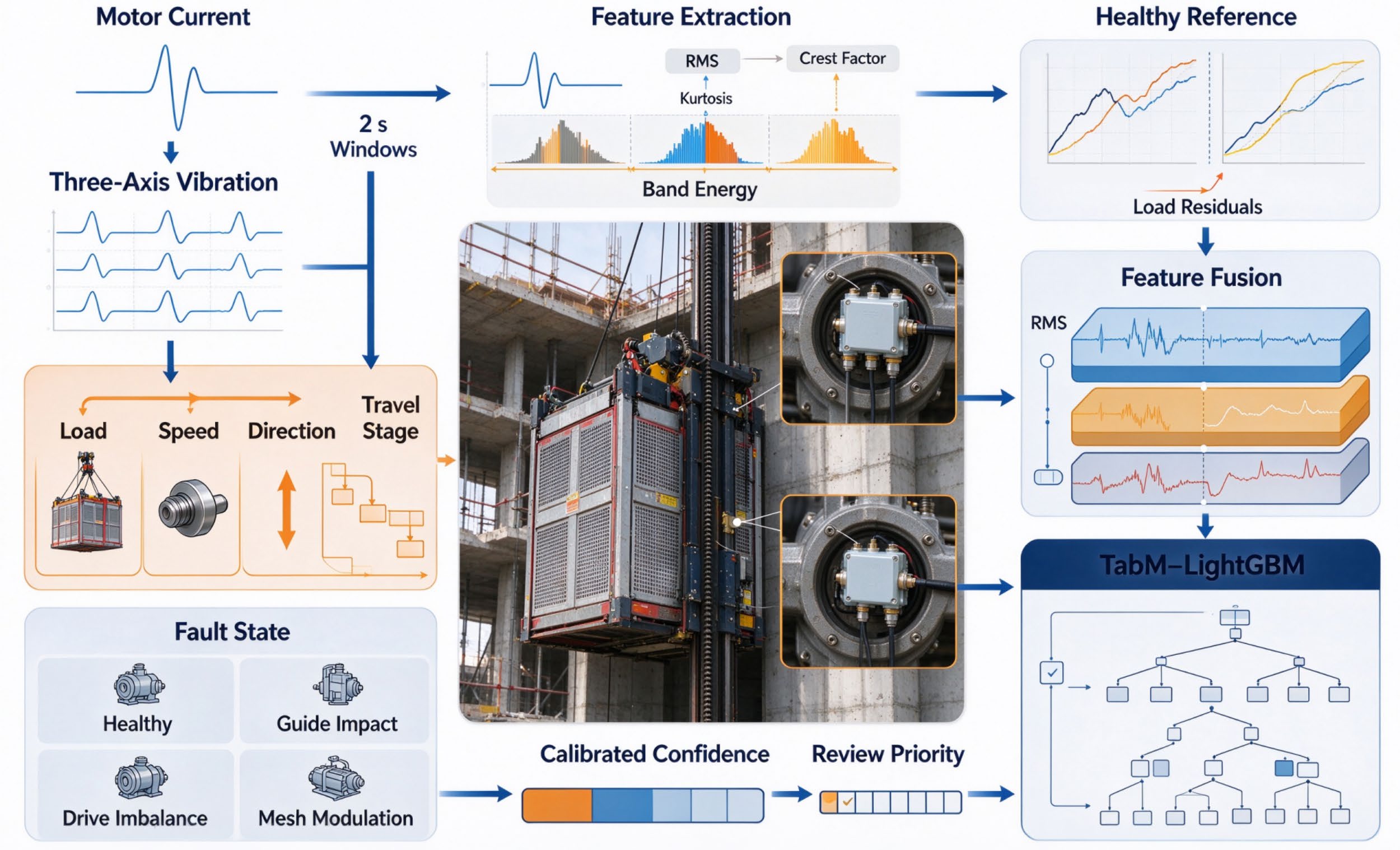
Construction-hoist vibration diagnosis must distinguish mechanical abnormalities from electrical demand and directional motion changes caused by payload and travel conditions. This study evaluates a load-coupled TabM-LightGBM pipeline using motor current, three acceleration directions and operating metadata. Two-second windows sampled at 512 Hz yield 24 engineered signal descriptors and four context descriptors. A healthy-state regression fitted on training episodes supplies 24 condition-adjusted residuals; eight parameter-sharing TabM members transform the resulting 52 features. Their hidden- state mean and dispersion join the original descriptors in a 116-feature LightGBM input. A separate calibration partition selects probability temperature before confidence-ranked review. The controlled numerical reference contains 288 independent episodes across six load-centered groups and four diagnostic states, giving 1,728 windows. Two held-out groups supply 576 test windows. The complete pipeline attains 98.09% accuracy, macro-F1 0.9809, abnormal-state recall 97.92% and healthy-state false-alarm rate 1.39%; its median descriptor-to-probability inference time is 0.551 ms. Random forest and standalone TabM obtain higher reported macro-F1 values of 0.9965 and 0.9913, respectively, and a separately trained acceleration-only pipeline obtains 0.9879. At the selected full checkpoint, axial-feature interruption reduces macro- F1 to 0.6048, while descriptor noise and load-metadata bias yield 0.9281 and 0.9390. A 115-window confidence-priority list captures nine of eleven test errors. These results characterize source dependence, calibration and review yield in a controlled signal generator, with independent operating data needed to establish field applicability.
Details
License
Copyright (c) 2026 Somogyi Zénó, Vincze Kolos

This work is licensed under a Creative Commons Attribution-NonCommercial-ShareAlike 4.0 International License.