Emergency Corridor Planning for UAV Swarms Using a TabM–LightGBM Model with Dynamic Obstacle and Airspace Data
Authors
Files
Key Information
Journal

Published in Vol. 4 No. 2 (2026) of Journal of Data‑Centric Engineering Science.
Journal of Data‑Centric Engineering Science eISSN 3136-814X is an international, peer‑reviewed open‑access journal. It publishes high‑quality original research, methodological advances, comprehensive reviews, dataset papers and short communications concerning fundamental theories, scientific methodologies and cross‑domain engineering applications under the data‑centric paradigm. This journal focuses on underlying scientific problems of data‑driven engineering, promotes the integration of data science and physical‑mechanism‑based engineering science, and builds an interdisciplinary platform for academic researchers and industrial scientists.
About the JournalAbstract
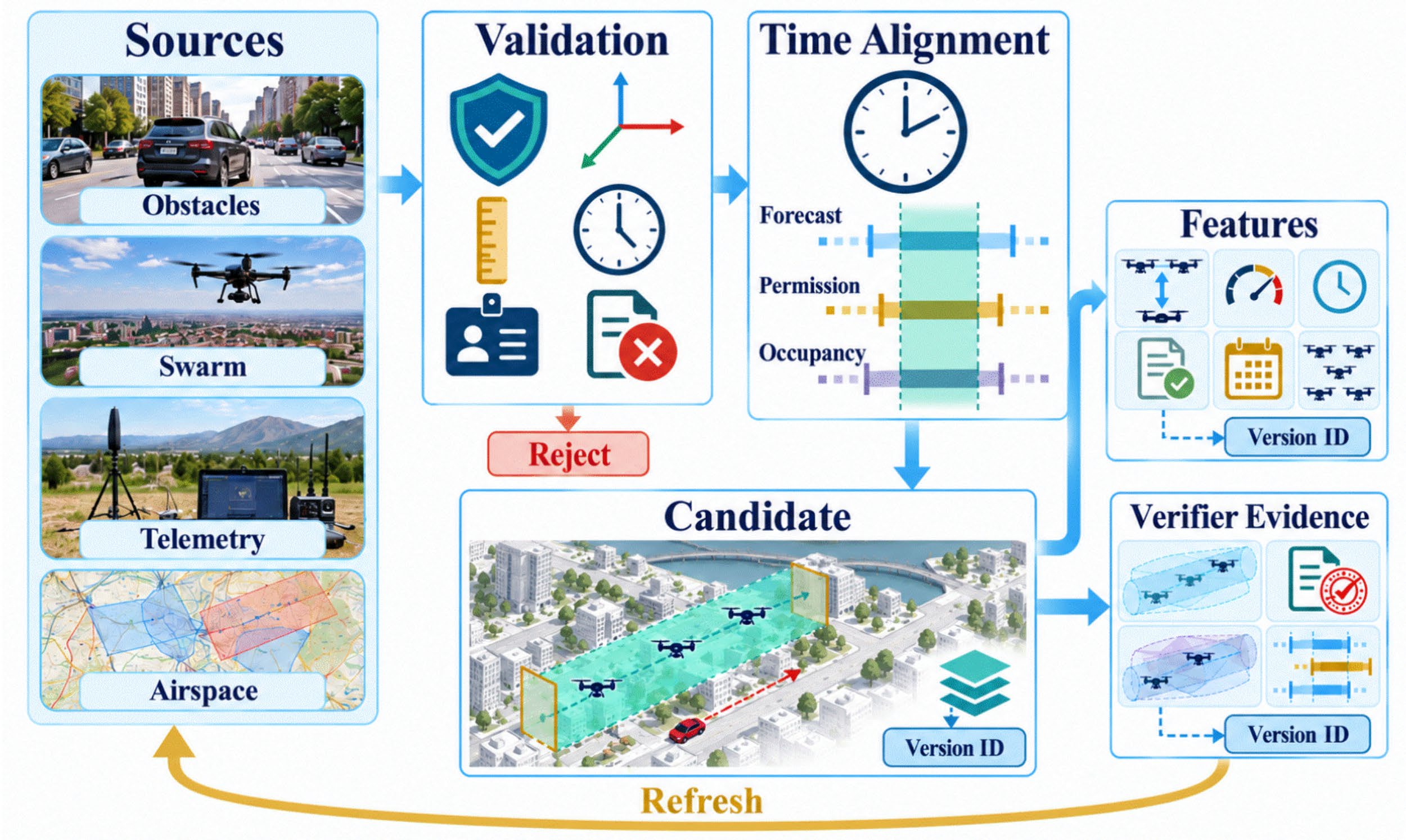
Emergency operations require unmanned aerial vehicle swarms to traverse airspace whose accessibility changes with obstacle motion, temporary restrictions, and uneven information freshness. This paper develops a corridor planning architecture that combines parameter efficient tabular neural ensembling with gradient boosted decision trees. The proposed TabM–LightGBM model assigns calibrated risk scores to candidate corridor segments using obstacle forecasts, airspace validity intervals, communication age, and swarm geometry. A separate geometric verifier rejects inadmissible segments, while a rolling reservation mechanism coordinates entry times and preserves an executable fallback. The evaluation considers six operating conditions that combine obstacle density, information age, and restriction update frequency. Across these conditions, the hybrid configuration has a mean completion rate of 93.5%, compared with 87.2% for a tree only configuration, and a mean planning latency of 80.3 ms. Its mean minimum separation is 14.3 m, above the specified 10 m threshold. Removing freshness features reduces mean completion to 90.0%, whereas removing independent verification increases the separation violation rate to 2.8%. The comparisons identify a completion–latency tradeoff and characterize how freshness handling, calibration, and constraint checks affect corridor admission. The architecture offers an auditable way to integrate heterogeneous airspace information into swarm corridor decisions, and the accompanying evaluation specification identifies the training, timing, and flight evidence required for subsequent engineering validation. The contribution concerns the integration of evidence management, predictive ranking, and independent verification. The reported averages characterize the specified operating conditions; deadline compliance and separation violations remain separate criteria for assessing operational readiness.
Details
License
Copyright (c) 2026 Kristina Radojčić, Jovanka Krstić, Ratka Marjanović

This work is licensed under a Creative Commons Attribution-NonCommercial-ShareAlike 4.0 International License.