Graphormer-CRF Model for Vortex-Induced Vibration Prediction of Marine Risers Driven by Strain Gauge and Current Profile Data
Authors
Files
Key Information
Journal
Published in Vol. 4 No. 2 (2026) of Journal of Data‑Centric Engineering Science.
Journal of Data‑Centric Engineering Science eISSN 3136-814X is an international, peer‑reviewed open‑access journal. It publishes high‑quality original research, methodological advances, comprehensive reviews, dataset papers and short communications concerning fundamental theories, scientific methodologies and cross‑domain engineering applications under the data‑centric paradigm. This journal focuses on underlying scientific problems of data‑driven engineering, promotes the integration of data science and physical‑mechanism‑based engineering science, and builds an interdisciplinary platform for academic researchers and industrial scientists.
About the JournalAbstract
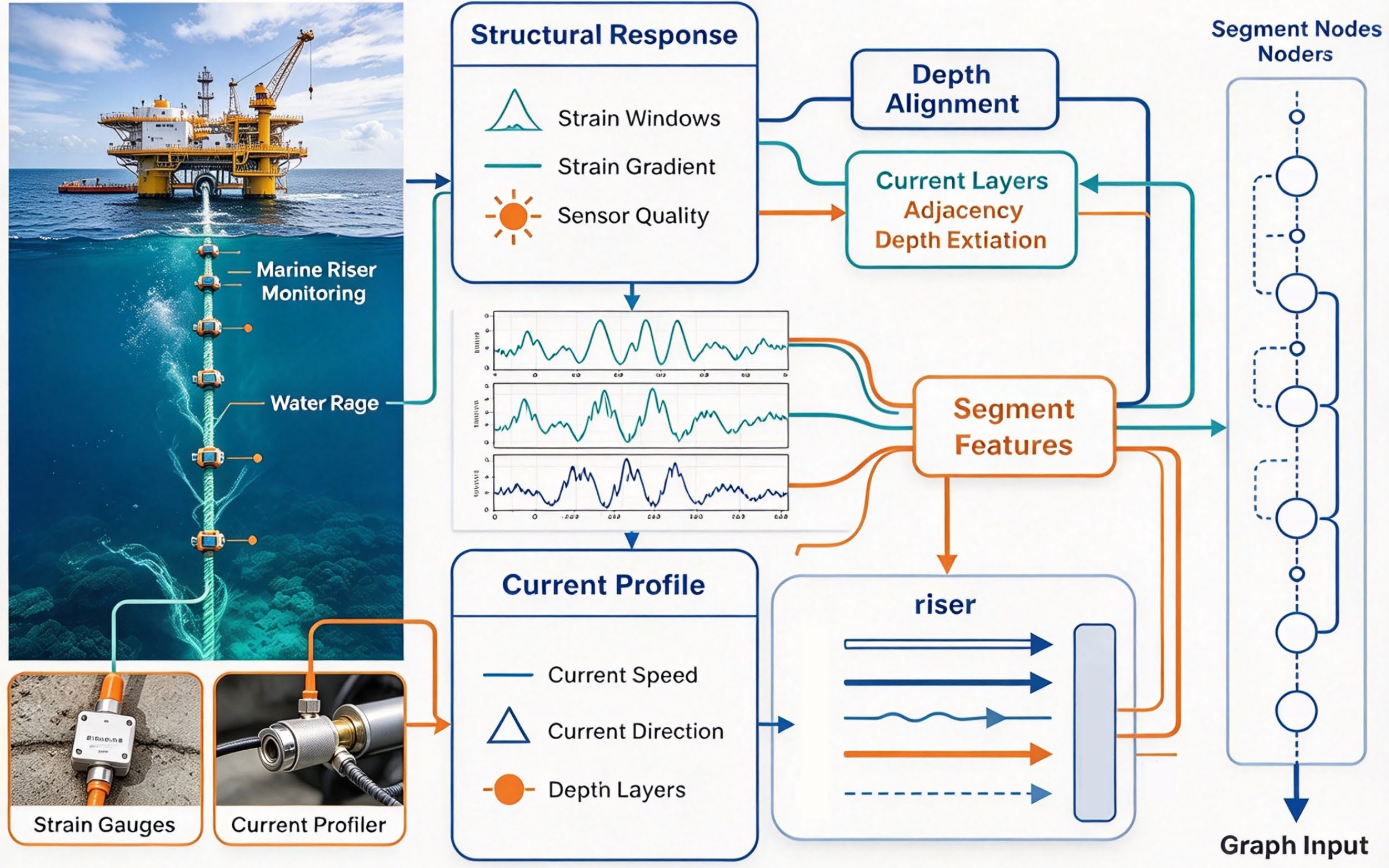
Marine riser vortex-induced vibration (VIV) is a coupled fluid-structure response governed by the ocean current profile, riser geometry, tension, boundary conditions and distributed strain. Depth-varying current excitation can produce localized vibration regions, while sparse current layers and noisy strain channels complicate state interpretation. This paper proposes a Graphormer-CRF model for VIV prediction from strain gauge and current profile data. A segment-level riser graph aligns distributed strain gauges with depth coordinates, modal-position tags and acoustic Doppler current profiler measurements. Graphormer encoding represents long-range relationships among riser segments under sheared current; physical bias terms describe current velocity, reduced velocity, strain-gradient response and curvature-related local vibration evidence. A conditional random field (CRF) layer decodes coherent VIV states along the riser by considering adjacent segment transitions. Evaluation uses a synthetic offshore monitoring dataset with 4,800 segment-window samples. The proposed model reaches 91.8% VIV-state accuracy, 88.6% high-amplitude recall and a fatigue-sensitive warning F1-score of 0.873, exceeding LSTM, TCN, GAT and Transformer baselines. Ablation experiments associate segment-graph encoding, physical bias and CRF state decoding with improved prediction stability. The resulting segment states, warning confidence and fatigue-sensitive priorities provide interpretable evidence for offshore riser monitoring and inspection planning. The framework also records the depth of the predicted warning region and the current and strain information that support engineering review.
Details
License
Copyright (c) 2026 Isa Al-Mazrouei, Waleed Al-Attar, Najeeba Al-Amer, Umar Al-Bahri

This work is licensed under a Creative Commons Attribution-NonCommercial-ShareAlike 4.0 International License.