Koopman-GRU Model for Cap Sealing Pressure Anomaly Detection Using Filling-line Torque and Vision Data
Authors
Files
Key Information
Journal
Published in Vol. 4 No. 2 (2026) of Journal of Data‑Centric Engineering Science.
Journal of Data‑Centric Engineering Science eISSN 3136-814X is an international, peer‑reviewed open‑access journal. It publishes high‑quality original research, methodological advances, comprehensive reviews, dataset papers and short communications concerning fundamental theories, scientific methodologies and cross‑domain engineering applications under the data‑centric paradigm. This journal focuses on underlying scientific problems of data‑driven engineering, promotes the integration of data science and physical‑mechanism‑based engineering science, and builds an interdisciplinary platform for academic researchers and industrial scientists.
About the JournalAbstract
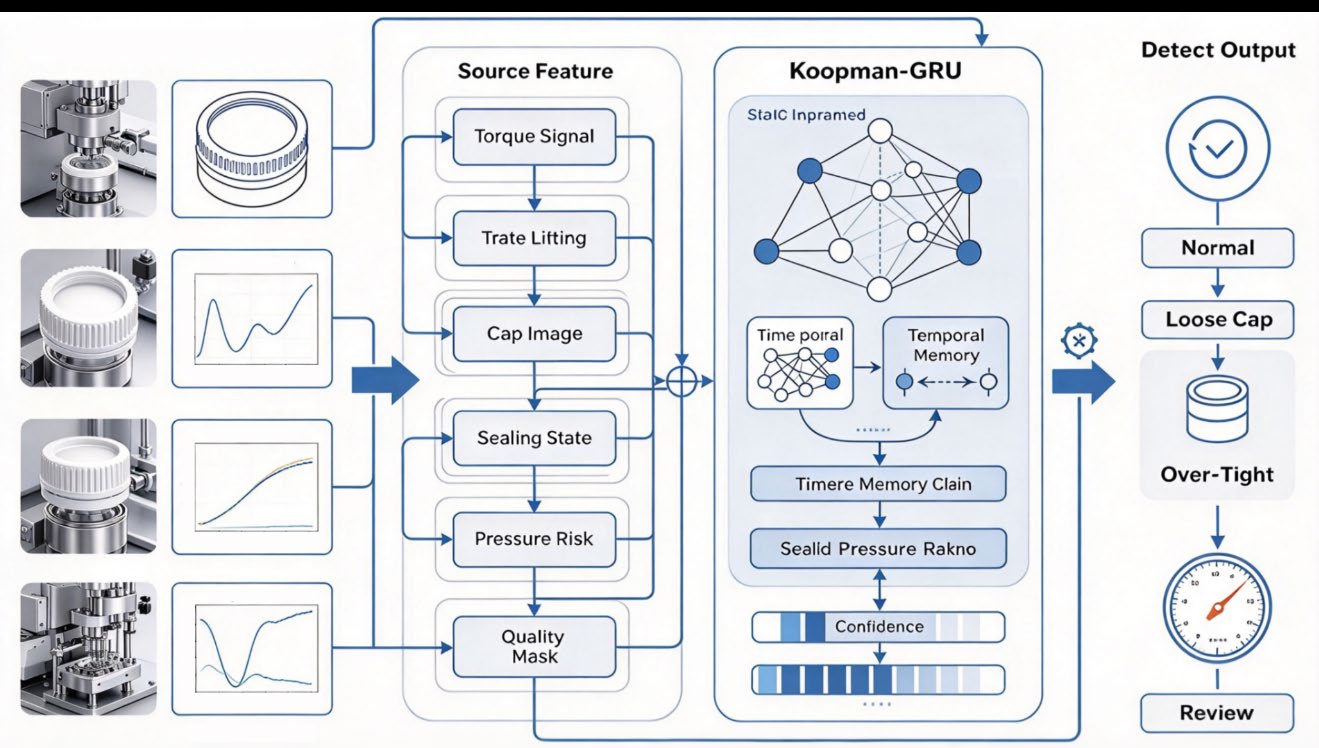
Cap sealing quality directly affects leakage control, product stability and downstream packaging reliability in filling lines. This paper proposes a Koopman-GRU multi-source model for cap sealing pressure anomaly detection based on torque curves, rotation-angle sequences, visual cap-state images, cap-height measurements and station-quality tags. A synchronous sealing window is first constructed from torque and vision data; Koopman lifting then represents nonlinear sealing dynamics in a stable latent space; finally, GRU-based temporal modelling identifies abnormal sealing pressure, confidence and review priority. The simulated filling-line dataset contains 5,200 sealing windows, including normal caps, under-tightened caps, over-compressed seals, tilted caps, thread mismatch and uncertain visual cases. Compared with the rule-threshold baseline, the proposed model improves anomaly recall from 80.7% to 92.1%, increases macro-F1 to 0.895 and reduces manual inspection by 29.4%. The model remains stable under partial image blur, torque-sensor drift and short-term line-speed fluctuations. Calibrated evidence output supports station-level maintenance decisions and product- level rejection review under different production batches and inspection conditions. It also separates product-level rejection, station-level maintenance and low-confidence secondary review so that uncertain visual or torque evidence is not treated as a confirmed pressure defect. These results indicate that Koopman-GRU fusion can support reliable online cap inspection and traceable pressure-anomaly analysis in high-speed filling production, while low-confidence cases still require operator confirmation or secondary inspection.
Details
License
Copyright (c) 2026 Tommaso Greco, Massimo Fontana, Valerio Galli

This work is licensed under a Creative Commons Attribution-NonCommercial-ShareAlike 4.0 International License.