WaveletKAN-GRU Model for Mountain Flood Sediment Yield Estimation Based on Rainfall-runoff and Terrain Data
Authors
Files
Key Information
Journal
Published in Vol. 4 No. 2 (2026) of Journal of Data‑Centric Engineering Science.
Journal of Data‑Centric Engineering Science eISSN 3136-814X is an international, peer‑reviewed open‑access journal. It publishes high‑quality original research, methodological advances, comprehensive reviews, dataset papers and short communications concerning fundamental theories, scientific methodologies and cross‑domain engineering applications under the data‑centric paradigm. This journal focuses on underlying scientific problems of data‑driven engineering, promotes the integration of data science and physical‑mechanism‑based engineering science, and builds an interdisciplinary platform for academic researchers and industrial scientists.
About the JournalAbstract
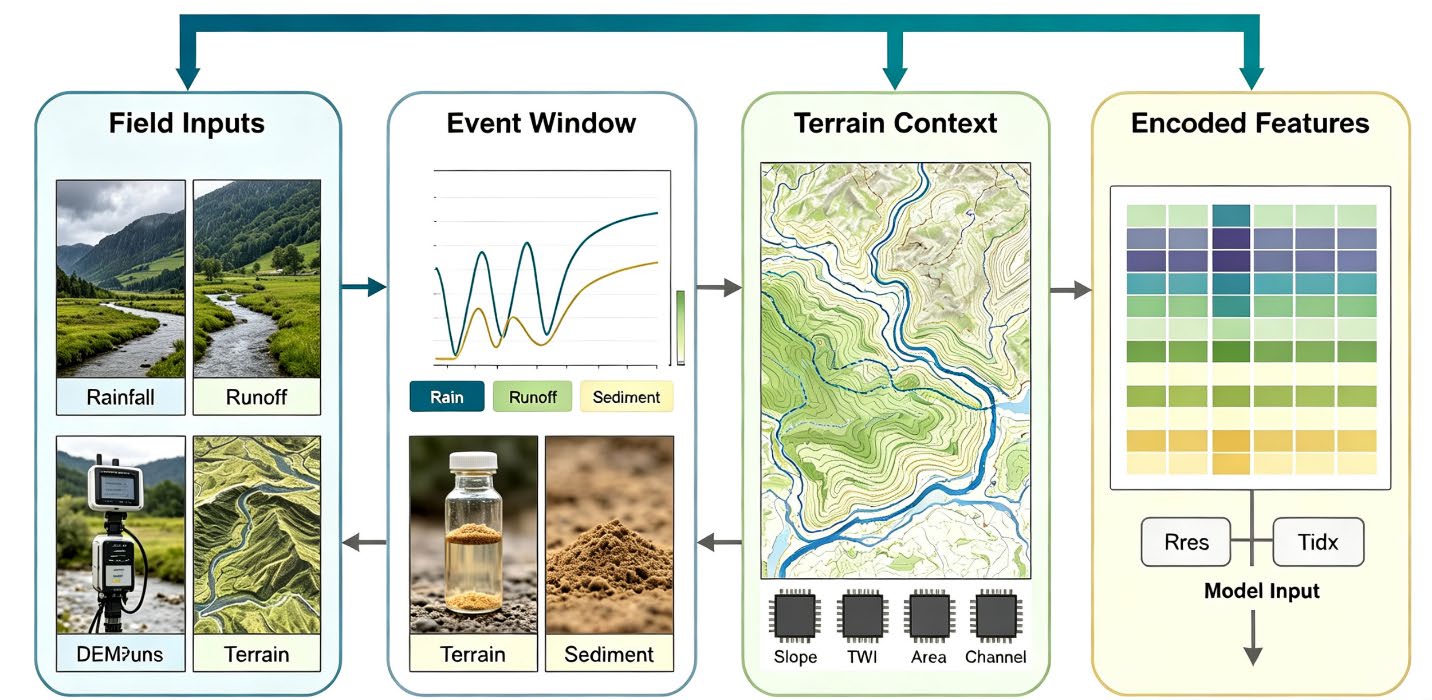
Short-duration Mountain floods can mobilize a large amount of sediment in a short time, but estimating the released sediment is still difficult because rainfall intensity, runoff concentration, slope connectivity, antecedent wetness and channel storage all interact nonlinearly. Propose a WaveletKAN-GRU model for mountain-flood sediment yield prediction based on rainfall-runoff and terrain data in this paper. Rainfall intensity, cumulative rainfall, antecedent moisture, runoff depth, discharge change rate, slope, relief, drainage density, topographic wetness index, land-cover stability and channel-connectivity indicators are all aligned into event windows. Wavelet decomposition is used to separate short storm pulses, recession components and low-frequency catchment memory, and thus abrupt rainfall-runoff changes are not smoothed out in the hydrograph. The KAN layer learns non-linear terrain-conditioned hydrological effects and shows that the same runoff signal can result in different sediment responses under different slope, wetness and channel-connectivity conditions. The GRU module then learns the delayed response of sediment in the event window, such as sediment release in rising limbs and continuous transport during recession. A simulated multi-watershed dataset with event-separated training, validation and test sets is used for the experiment. The model is compared to tree- based, convolutional, recurrent and wavelet-recurrent baselines. The results are shown as sediment-yield error, high-risk warning recall, confidence calibration and cross-event robustness. The output is the estimated sediment yield, confidence, warning level, dominant evidence and suggested watershed review action. The proposed framework is an explainable and mechanism-aware tool for the short-term sediment risk assessment of mountain watersheds.
Details
License
Copyright (c) 2026 Thanos Hadjis, Ilias Matsas

This work is licensed under a Creative Commons Attribution-NonCommercial-ShareAlike 4.0 International License.