Sparse Mixture-of-Experts Model for Turnover-Oriented Urban Curbside Parking Forecasting with Meter-Transaction and Camera-Event Fusion
Authors
Files
Key Information
Journal

Published in Vol. 2 No. 1 (2024) of Journal of Data‑Centric Engineering Science.
Journal of Data‑Centric Engineering Science eISSN 3136-814X is an international, peer‑reviewed open‑access journal. It publishes high‑quality original research, methodological advances, comprehensive reviews, dataset papers and short communications concerning fundamental theories, scientific methodologies and cross‑domain engineering applications under the data‑centric paradigm. This journal focuses on underlying scientific problems of data‑driven engineering, promotes the integration of data science and physical‑mechanism‑based engineering science, and builds an interdisciplinary platform for academic researchers and industrial scientists.
About the JournalAbstract
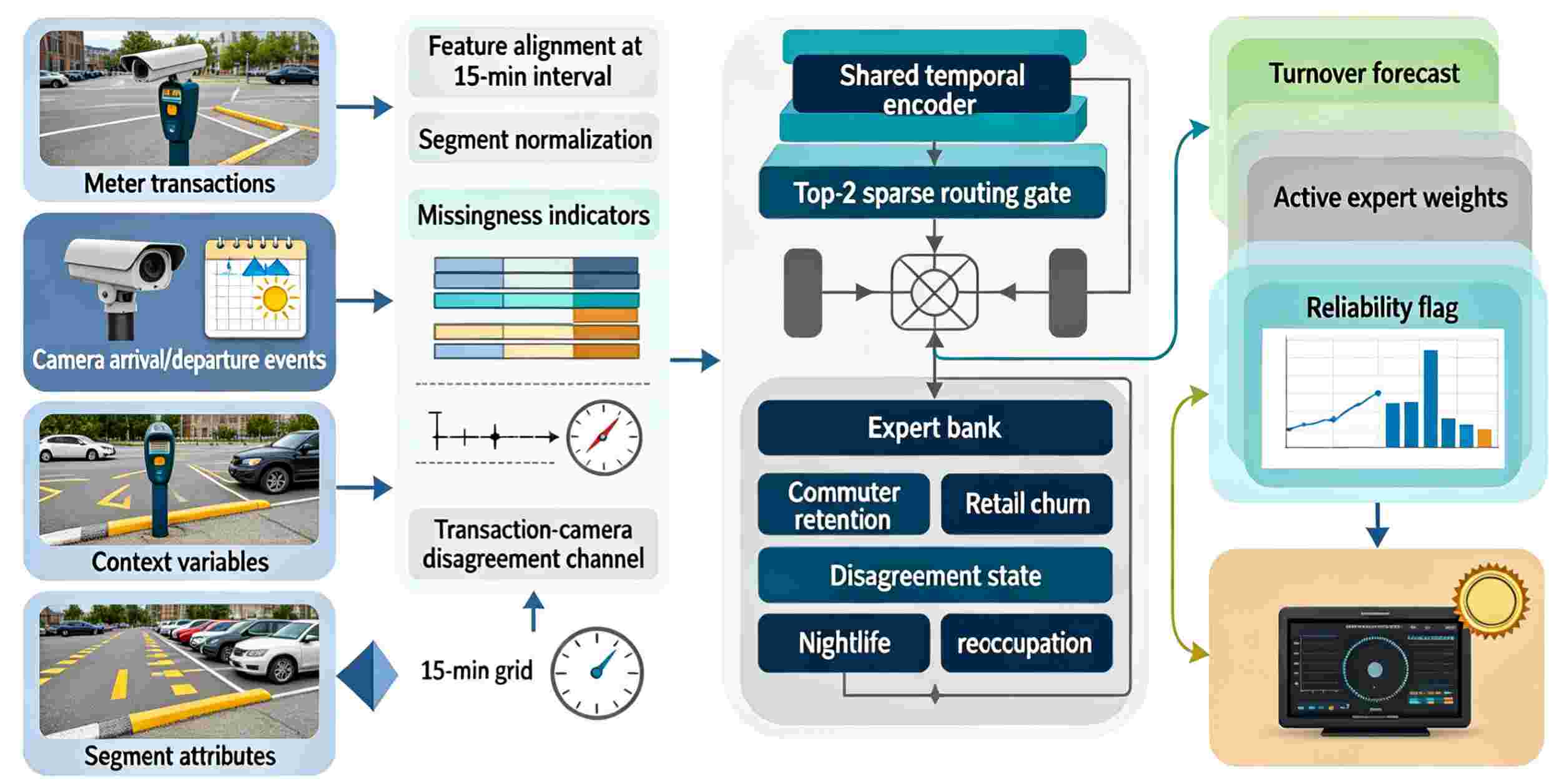
Curbside parking turnover is increasingly shaped by short transactions, uneven payment compliance, camera-observed dwell events, and policy-sensitive curb uses that conventional occupancy forecasting models do not represent well. This paper proposes a sparse mixture-of-experts model for predicting urban roadside parking turnover by fusing meter transaction logs and camera-derived stall events. The method constructs segment-time tokens from paid arrivals, purchased duration, expiration gap, physical occupancy, reoccupation delay, camera confidence, weather state, and calendar variables, and routes each token to sparse specialized experts. A synthetic but engineering-calibrated experiment covering 86 curb segments, 41,280 fifteen-minute intervals, 2.36-million-meter transactions, and 4.91 million camera events was designed to reflect commuter, retail, nightlife, civic, and mixed-use regimes. Compared with temporal convolution, recurrent, transformer, and dense expert baselines, the model reduced mean absolute error from 5.74 to 4.31 turnovers per segment-day and improved peak-period F1 from 0.781 to 0.846. Sparse routing activated 2.1 experts on average, lowering inference cost by 37.8% while preserving route-level interpretability. Ablation analysis showed that removing camera features increased error to 5.18, removing meter features increased error to 5.47, and removing the disagreement channel increased error to 4.86. The results indicate that meter-camera fusion is most valuable during payment noncompliance and rapid reoccupation periods, where single-source models underestimate turnover volatility.
Details
License
Copyright (c) 2024 Mishaal Al-Tunaiji, Najeeb Al-Amer, Fatima Al-Maktoum

This work is licensed under a Creative Commons Attribution-NonCommercial-ShareAlike 4.0 International License.