Underwater Binocular Video Data-driven SparseFormer-V2 Model for Fish-school Biomass Estimation in Marine Ranches
Authors
Files
Key Information
Journal
Published in Vol. 4 No. 1 (2026) of Journal of Data‑Centric Engineering Science.
Journal of Data‑Centric Engineering Science eISSN 3136-814X is an international, peer‑reviewed open‑access journal. It publishes high‑quality original research, methodological advances, comprehensive reviews, dataset papers and short communications concerning fundamental theories, scientific methodologies and cross‑domain engineering applications under the data‑centric paradigm. This journal focuses on underlying scientific problems of data‑driven engineering, promotes the integration of data science and physical‑mechanism‑based engineering science, and builds an interdisciplinary platform for academic researchers and industrial scientists.
About the JournalAbstract
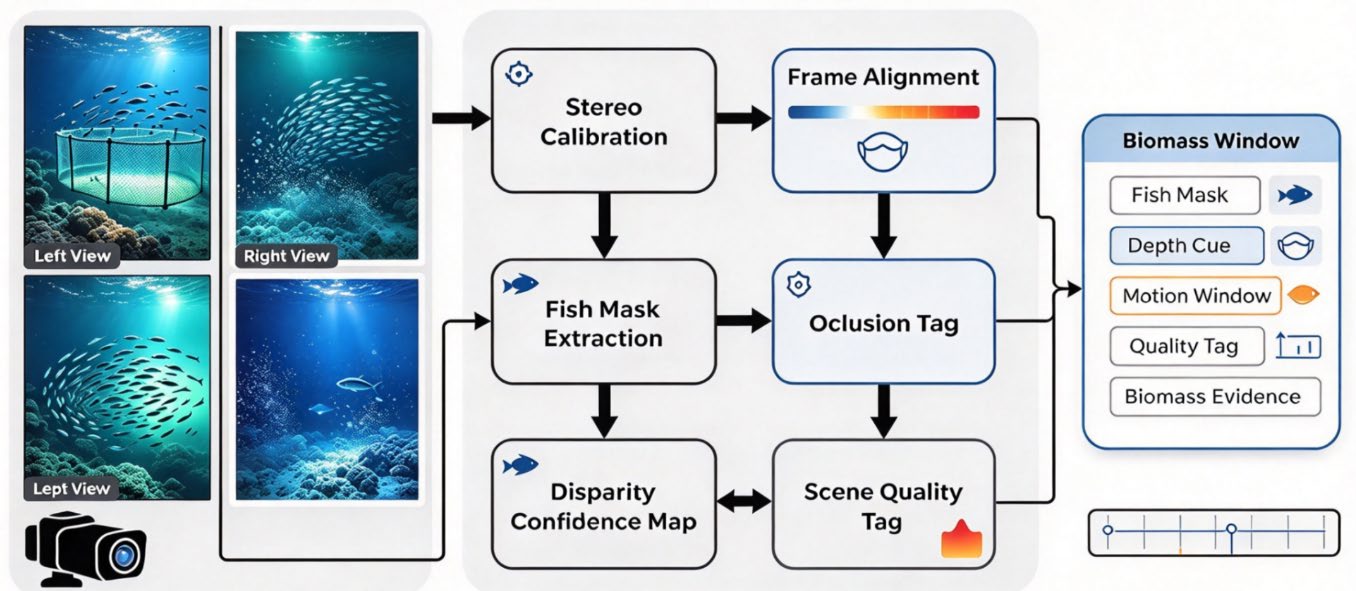
Accurate biomass estimation is required for feeding regulation, stock management and ecological risk assessment in marine ranches, but underwater turbidity, uneven illumination, target occlusion and unstable stereo matching interfere with reliable visual observation. This paper proposes a SparseFormer-V2 model driven by underwater binocular video data for fish-school biomass estimation. Short observation windows align left- and right-camera frames, disparity maps, fish-instance masks, apparent body length, depth confidence, school-density indicators and water-quality tags. The sparse attention backbone preserves long-range relations among visible fish bodies and suppresses redundant background-water tokens. Cross-scale feature fusion connects single-fish geometry, local cluster density and global school distribution, and the output layer reports biomass value, confidence level, dominant evidence and review priority. A simulated marine- ranch dataset containing 18,000 binocular windows is constructed with five visibility conditions and six stocking-density levels. Compared with a convolutional baseline, the proposed model reduces biomass MAPE from 14.8% to 8.9%, increases R2 from 0.82 to 0.93 and decreases high-density underestimation by 31.6%. Under high turbidity, the confidence-aware output reduces unreliable automatic decisions by 24.5%. These results indicate that stereo geometry and sparse long-range visual modelling can improve biomass regression stability while routing visually unreliable windows to manual review.
Details
License
Copyright (c) 2026 Emanuele Barone, Samuele Caruso

This work is licensed under a Creative Commons Attribution-NonCommercial-ShareAlike 4.0 International License.