TD3-MPC Model for Mineral Dust Concentration Estimation Based on Hot-Air Flow and Particle Sensors
Authors
Ivan Kovačević, Mirko NovakovićFiles
Key Information
Journal
Published in Vol. 4 No. 1 (2026) of Journal of Applied Computational Intelligence.
The Journal of Applied Computational Intelligence (JACI) eISSN:3136-6937 is a peer-reviewed, international, open-access journal dedicated to the advancement of computational intelligence methodologies and their real-world applications across diverse engineering and scientific domains. The journal aims to bridge the gap between theoretical development and practical deployment of intelligent systems by providing a scholarly platform for researchers, practitioners, and industry innovators.
JACI encourages high-quality original research, review articles, and technical reports that explore the design, implementation, and optimization of intelligent algorithms for solving complex problems in fields such as manufacturing, energy, healthcare, transportation, and information systems.
Abstract
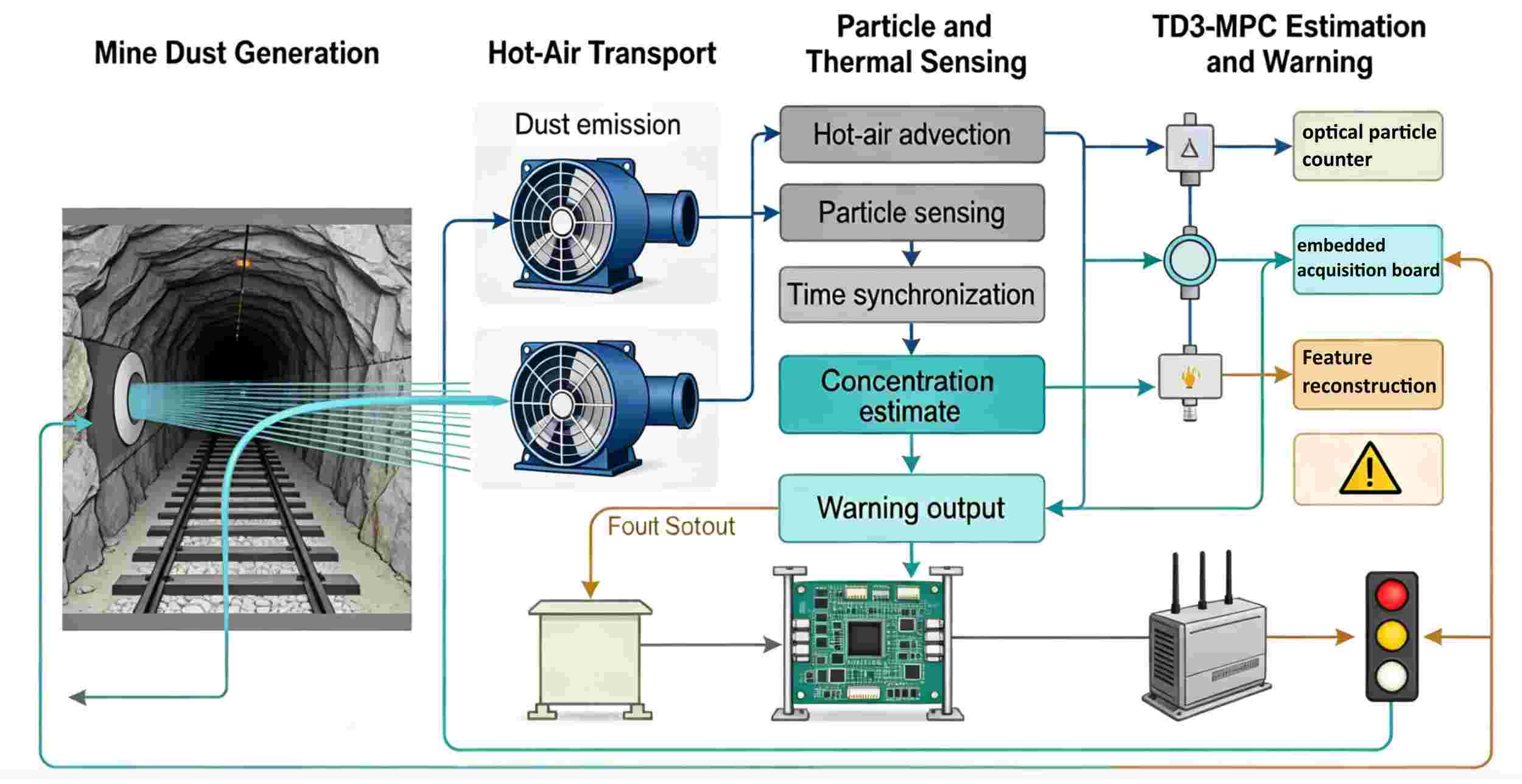
Real-time estimation of mineral dust concentration in thermally disturbed mine roadways remains difficult because hot-air ventilation changes particle trajectories, delays emission-measurement coupling, and slows optical sensor recovery. This paper develops a twin delayed deep deterministic policy gradient and a model predictive control model for concentration estimation based on coupled hot-air flow and particle-sensor streams. The method introduces delay-compensated feature reconstruction, a physics-guided state transition layer, twin critic learning and receding-horizon correction. A 42-hour laboratory and pilot-gallery dataset was organised into 151,200 synchronous samples of thermal anemometers, particle counters, humidity probes and gravimetric reference instruments. Compared with support vector regression, long short-term memory, temporal convolution and soft actor-critic baselines, the proposed model reduced the mean absolute error under rapidly varying hot-air velocity from 2.91-4.76 mg/m³ to 1.68 mg/m³ and improved R² from 0.914 to 0.972. During high-load cutting episodes above 80 mg/m³, the 95th percentile error was still 4.9 mg/m³, and the best learning baseline reached 7.8 mg/m³. Based on the above results, the two can work together to reduce thermal-flow drift and transient sensor lag, especially when dust plumes evolve faster than conventional particle sensors can recover. Therefore, the above estimator is suitable for warning-oriented monitoring, calibration transfer and ventilation coordination in underground mining areas with considerable thermal disturbance.