UniFormerV2 Model for Robotic Deburring Force Control Oriented to Six-Dimensional Force and Surface Profile Data Streams
Authors
Waldemar Brzozowski, Bronisław Kaczor, Arkadiusz SadowskiFiles
Key Information
Journal

Published in Vol. 4 No. 1 (2026) of Journal of Applied Computational Intelligence.
The Journal of Applied Computational Intelligence (JACI) eISSN:3136-6937 is a peer-reviewed, international, open-access journal dedicated to the advancement of computational intelligence methodologies and their real-world applications across diverse engineering and scientific domains. The journal aims to bridge the gap between theoretical development and practical deployment of intelligent systems by providing a scholarly platform for researchers, practitioners, and industry innovators.
JACI encourages high-quality original research, review articles, and technical reports that explore the design, implementation, and optimization of intelligent algorithms for solving complex problems in fields such as manufacturing, energy, healthcare, transportation, and information systems.
Abstract
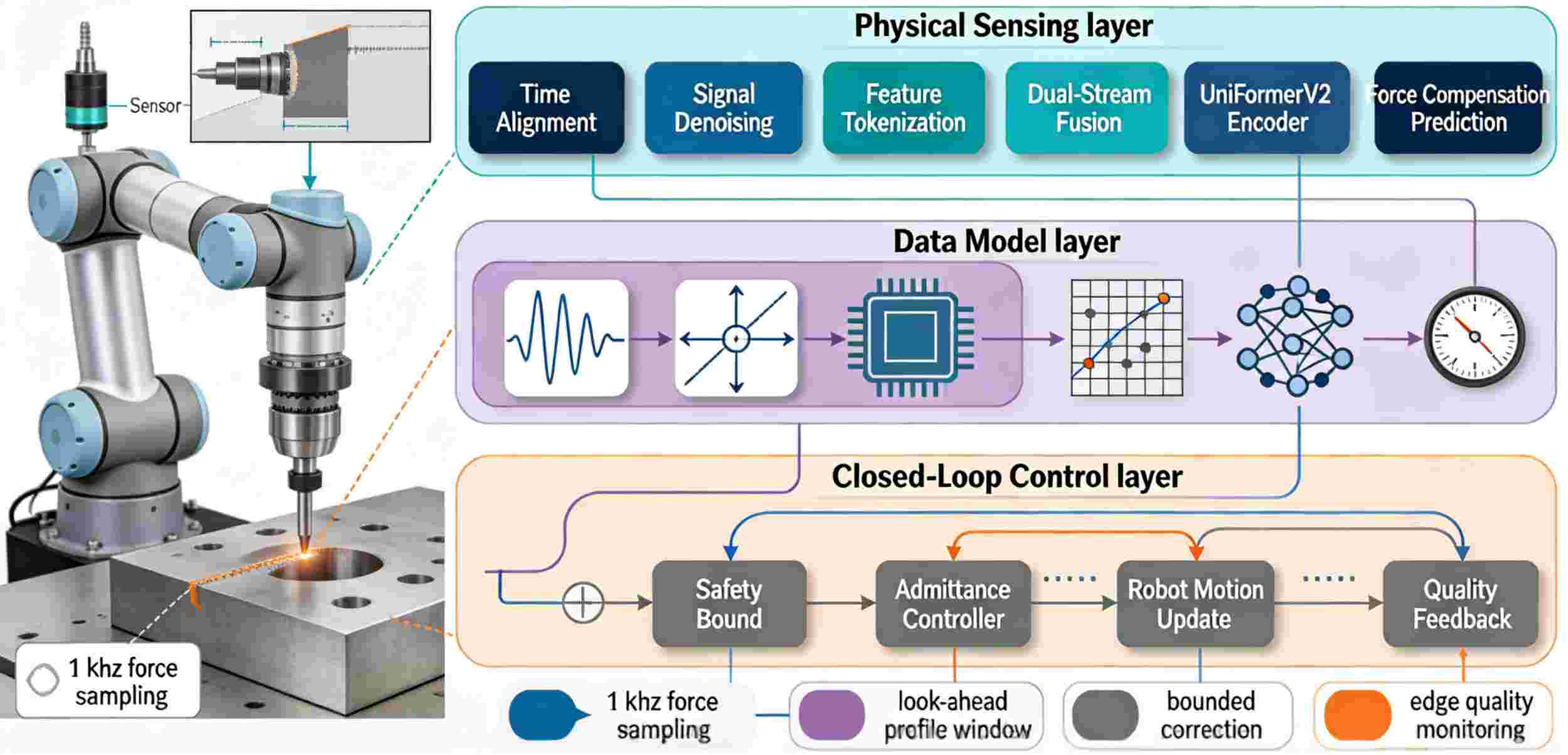
Robotic deburring remains difficult when burr geometry, local stiffness, and tool contact conditions change faster than a conventional force controller can interpret them. This paper proposes a UniFormerV2-based force-control model that fuses six-dimensional wrist force signals with streaming surface profile features for adaptive deburring of machined aluminum alloy edges. The method constructs synchronized force-profile tokens from heterogeneous sensor streams, separates short contact impulses from longer surface-trend cues, and predicts a bounded normal-force compensation command for an admittance-controlled spindle end-effector. To improve deployability in industrial finishing cells, the model includes confidence-weighted fusion and latency-aware inference so that surface look-ahead can be reduced when profile measurements become unreliable. Experiments were conducted on 420 edge segments covering straight, convex, concave, and interrupted burrs, with six feed speeds and four nominal contact-force levels. Compared with PID admittance control, LSTM fusion, and a compact Transformer baseline, the proposed model reduced normal-force RMSE to 1.18 N, improved burr removal rate to 96.4%, lowered post-process Ra to 0.81 micrometer, and decreased force overshoot by 37.8% under profile discontinuity. The inference latency was 8.7 ms on an industrial GPU and remained below the 20 ms control-cycle limit. These results indicate that coupled force and surface streams provide a practical basis for learning contact-sensitive control policies without sacrificing the interpretability required in robotic finishing cells.