Improved PointNeXt for Acoustic Recognition of Stored-Grain Insects under Granary Monitoring Conditions
Authors
Rasmus Sepp, Jaan MägiFiles
Key Information
Journal

Published in Vol. 4 No. 1 (2026) of Journal of Applied Computational Intelligence.
The Journal of Applied Computational Intelligence (JACI) eISSN:3136-6937 is a peer-reviewed, international, open-access journal dedicated to the advancement of computational intelligence methodologies and their real-world applications across diverse engineering and scientific domains. The journal aims to bridge the gap between theoretical development and practical deployment of intelligent systems by providing a scholarly platform for researchers, practitioners, and industry innovators.
JACI encourages high-quality original research, review articles, and technical reports that explore the design, implementation, and optimization of intelligent algorithms for solving complex problems in fields such as manufacturing, energy, healthcare, transportation, and information systems.
Abstract
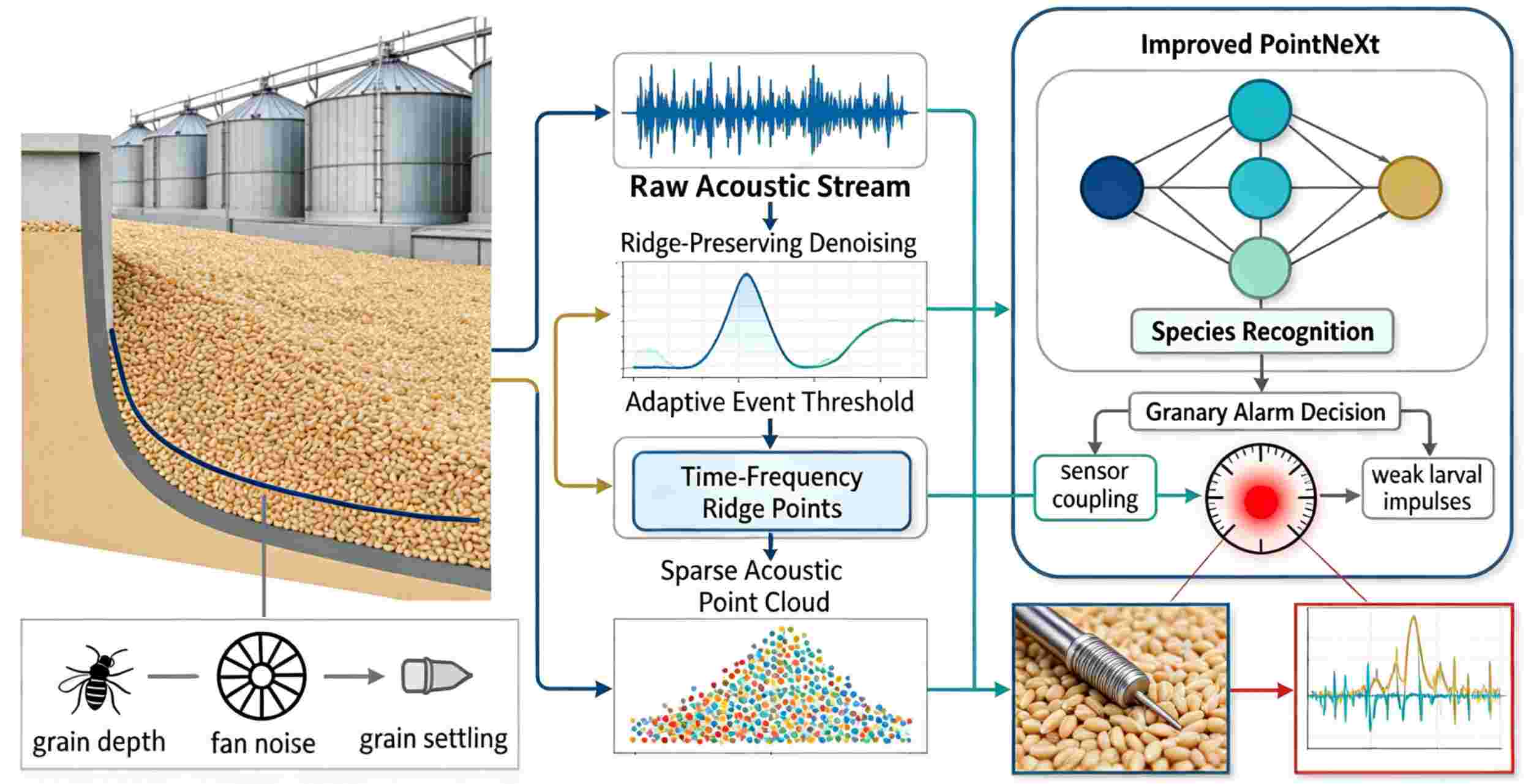
Acoustic monitoring provides a non-destructive route for detecting stored-grain insects, yet field granary recordings are usually affected by grain-bed attenuation, sensor coupling variation, fan noise, grain-settling interference, and short-duration biological impulses. This study proposes an improved PointNeXt model for insect acoustic recognition under practical granary monitoring data conditions. Candidate acoustic events are transformed into sparse time-frequency point clouds through ridge-preserving denoising, adaptive thresholding, local saliency estimation, and multi-scale point sampling. A residual acoustic PointNeXt backbone is modified with density-aware neighborhood aggregation, channel recalibration, and a lightweight temporal voting head to strengthen weak-event representation and suppress isolated mechanical disturbances. Experiments are organized on a simulated granary acoustic dataset containing five target classes and background events, with grain depths from 0.4 m to 2.0 m, 1.0 s windows with 50% overlap, and signal-to-noise ratios from -5 dB to 20 dB. The proposed model reaches 96.8% accuracy, 95.9% macro-F1, and a 2.8% false-alarm rate, improving macro-F1 by 4.7 percentage points over the original PointNeXt and by 7.6 percentage points over a ResNet spectrogram baseline. Under low-SNR recordings, the method maintains 92.6% macro-F1 and reduces missed detections of weak larval feeding bursts by 38.4%. The results indicate that point-cloud modeling of acoustic events can preserve sparse discriminative structures while limiting redundant spectral background, although broader field validation remains necessary before commercial deployment.