Energy Penalty Prediction for Post-Combustion Carbon Capture Driven by Process Measurements Using a Neural Hawkes Transformer Model
Authors
Andrei Popescu, Rareș Ciobanu, Cătălin EnacheFiles
Key Information
Journal

Published in Vol. 4 No. 1 (2026) of Journal of Applied Computational Intelligence.
The Journal of Applied Computational Intelligence (JACI) eISSN:3136-6937 is a peer-reviewed, international, open-access journal dedicated to the advancement of computational intelligence methodologies and their real-world applications across diverse engineering and scientific domains. The journal aims to bridge the gap between theoretical development and practical deployment of intelligent systems by providing a scholarly platform for researchers, practitioners, and industry innovators.
JACI encourages high-quality original research, review articles, and technical reports that explore the design, implementation, and optimization of intelligent algorithms for solving complex problems in fields such as manufacturing, energy, healthcare, transportation, and information systems.
Abstract
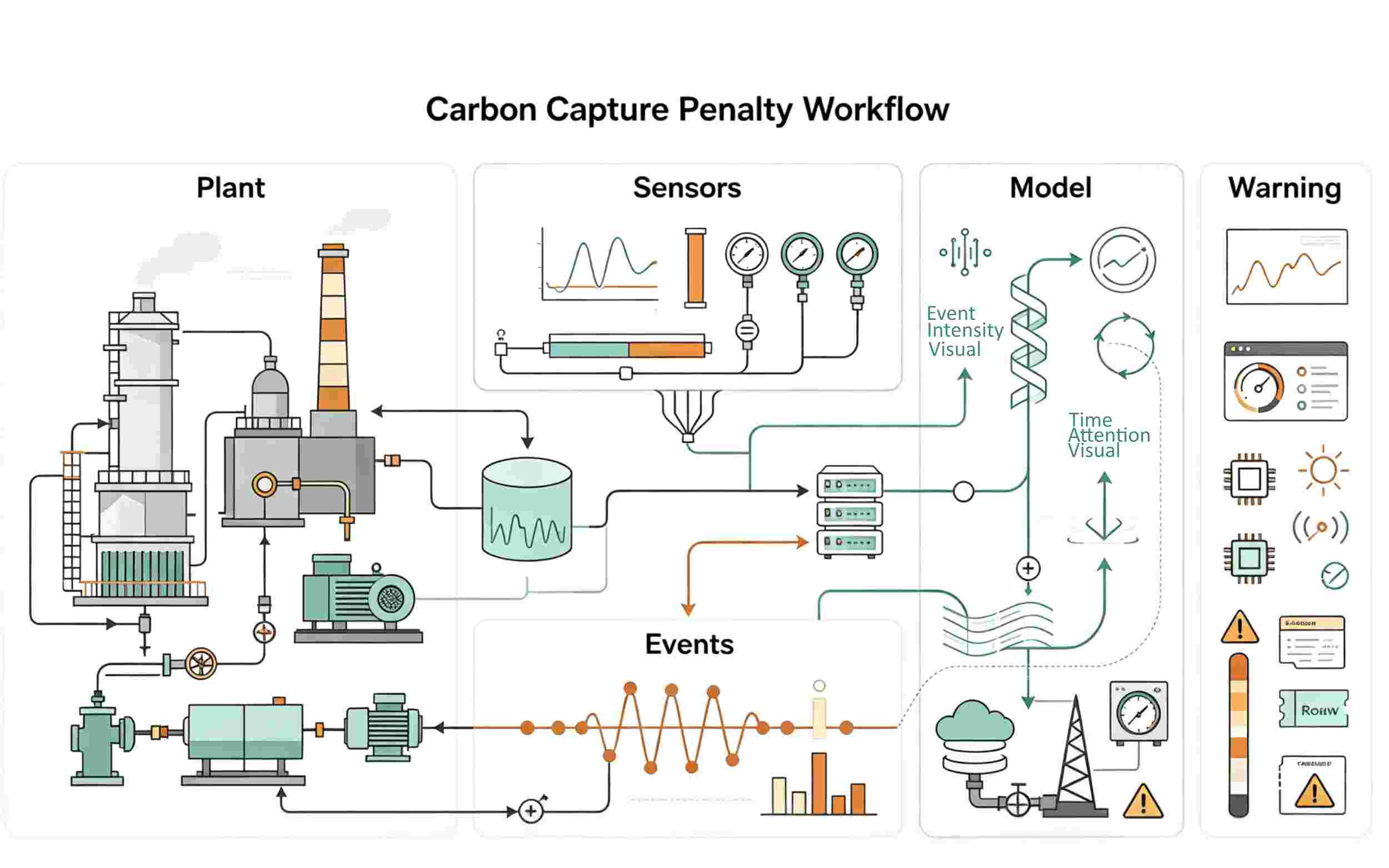
Develop a Neural Hawkes Transformer model in this paper to predict the energy penalty of post-combustion carbon capture based on process data. The aim is to find high-energy operating periods where asynchronous changes in flue-gas load, inlet CO2 concentration, solvent circulation, absorber temperature, reboiler steam pressure, analyser delay and capture-rate targets reduce efficiency. First, normalise the process records, add load-ramp and solvent-regeneration intervals, and set up a measurement-event sequence to save both the continuous operating trend and irregular disturbance time. A Transformer branch models long-range dependencies among capture load, solvent state, heat duty, cooling demand, and product-gas quality, and a Neural Hawkes branch estimates the intensity of penalty-relevant process disturbances, such as delayed analyser response, sudden steam fluctuation, and abnormal solvent recovery. The fused representation predicts a short-term energy penalty and outputs an operator-review warning score with interpretable process evidence. A simulated dataset of 21,600 hourly records from 10 post-combustion capture units includes stable capture, load ramp, solvent deviation, steam disturbance, cooling mismatch, and sensor-noise states. Compared with LSTM, temporal convolution, Transformer-only and Hawkes-only baselines, the proposed model has reduced MAE by 0.0231 percentage points, improved high-penalty recall to 0.872, and kept the false-alarm rate at 5.7%. Based on the above experiments, combining long-range sequence representation with event-intensity model can better identify inefficient capture intervals. The model will prioritise alarms, support operator review and process diagnosis, but will not automatically change the control.