Rotationally Equivariant Fourier Neural Operator for Grain Orientation Evolution during Solidification
Authors
Zdravka Stamenković, Arsenija Mitrović, Gojka Vasiljev, Kraljevka NovčićFiles
Key Information
Journal

Published in Vol. 4 No. 2 (2026) of Journal of Applied Computational Intelligence.
The Journal of Applied Computational Intelligence (JACI) eISSN:3136-6937 is a peer-reviewed, international, open-access journal dedicated to the advancement of computational intelligence methodologies and their real-world applications across diverse engineering and scientific domains. The journal aims to bridge the gap between theoretical development and practical deployment of intelligent systems by providing a scholarly platform for researchers, practitioners, and industry innovators.
JACI encourages high-quality original research, review articles, and technical reports that explore the design, implementation, and optimization of intelligent algorithms for solving complex problems in fields such as manufacturing, energy, healthcare, transportation, and information systems.
Abstract
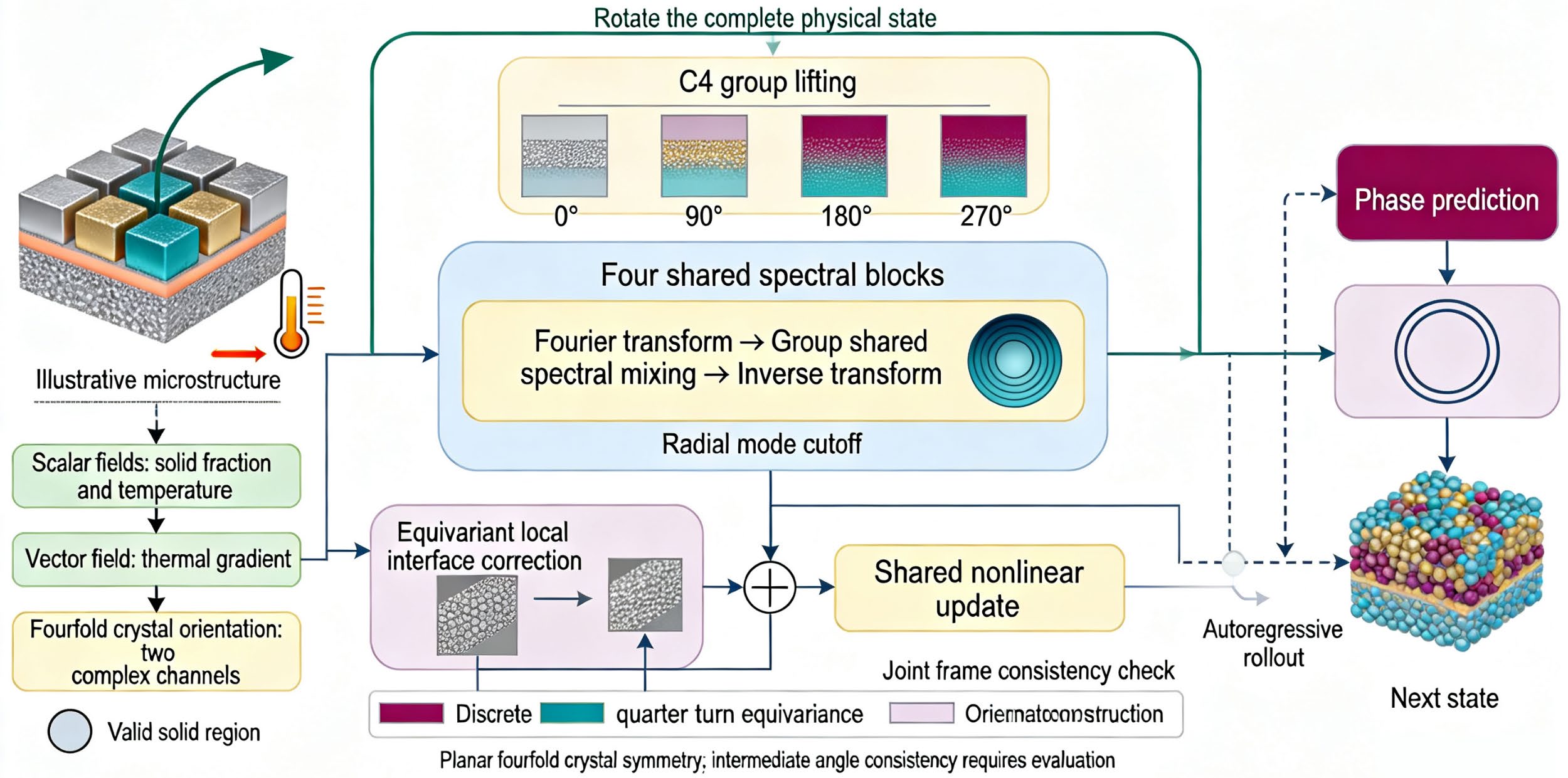
Predicting grain orientation evolution during solidification requires a surrogate that distinguishes changes in the observation frame from changes in the physical microstructure. This paper develops a rotationally equivariant Fourier neural operator for two-dimensional solidification fields with fourfold crystal symmetry. Crystal orientation is represented by a symmetry-compatible complex field, while thermal gradients transform jointly with the spatial coordinates. Group- shared spectral layers are employed for long-range interaction and local interface correction, and a masked angular objective is used to avoid arbitrary orientation targets in the liquid region. The benchmark integrates orientation prediction, geometric consistency, and temporal evaluation within a common protocol. The benchmark comprises 1200 training trajectories, 150 validation trajectories, and 150 test trajectories, with rotation and thermal-shift evaluations. Across the five model configurations, the mean angular error of the proposed configuration is 2.8 degrees; that of the conventional spectral baseline is 6.8 degrees, and the late rollout error has been reduced from 10.8 to 4.7 degrees. As a result, the corresponding interface overlap rose to 0.934 and the normalized rotation inconsistency dropped to 0.014. The comparison jointly assesses angular fidelity, geometric consistency, interface reconstruction, and computational cost. The formulation provides a framework for evaluating symmetry-aware solidification surrogates through independent simulations and experiments. The prediction target describes planar grain selection and boundary motion, with crystallographic orientation retained within established grain interiors.
References
Herbeaux, A., Aboleinein, H., Villani, A., Maurice, C., Bergheau, J.-M., & Klöcker, H. (2024). Combining phase field modeling and deep learning for accurate modeling of grain structure in solidification. Additive Manufacturing, 81, Article 103994. https://doi.org/10.1016/j.addma.2024.103994
Boukellal, A. K., Sarebanzadeh, M., Orozco-Caballero, A., Sket, F., LLorca, J., & Tourret, D. (2024). Grain growth competition and formation of grain boundaries during solidification of hcp alloys. Acta Materialia, 269, Article 119830. https://doi.org/10.1016/j.actamat.2024.119830
Secer, R. O., Hossein Nedjad, S., & Yildiz, M. (2024). Extending a phase field model of polycrystalline solidification for simulating grain evolution in metal additive manufacturing. Computational Materials Science, 240, Article 112997. https://doi.org/10.1016/j.commatsci.2024.112997
Ciesielski, D., Li, Y., Hu, S., King, E., Corbey, J., & Stinis, P. (2025). Deep operator network surrogate for phase-field modeling of metal grain growth during solidification. Computational Materials Science, 246, Article 113417. https://doi.org/10.1016/j.commatsci.2024.113417
Azizzadenesheli, K., Kovachki, N., Li, Z., Liu-Schiaffini, M., Kossaifi, J., & Anandkumar, A. (2024). Neural operators for accelerating scientific simulations and design. Nature Reviews Physics, 6(5), 320–328. https://doi.org/10.1038/s42254-024-00712-5
Liu, X., Xu, B., Cao, S., & Zhang, L. (2024). Mitigating spectral bias for the multiscale operator learning. Journal of Computational Physics, 506, Article 112944. https://doi.org/10.1016/j.jcp.2024.112944
Harder, H., Nüske, F., Philipp, F. M., Schaller, M., Worthmann, K., & Peitz, S. (2025). Group-convolutional extended dynamic mode decomposition. Physica D: Nonlinear Phenomena, 480, Article 134725. https://doi.org/10.1016/j.physd.2025.134725
Jangid, D. K., Brodnik, N. R., Echlin, M. P., Gudavalli, C., Levenson, C., Pollock, T. M., Daly, S. H., & Manjunath, B. S. (2024). Q-RBSA: High-resolution 3D EBSD map generation using an efficient quaternion transformer network. npj Computational Materials, 10(1), Article 27. https://doi.org/10.1038/s41524-024-01209-6
Meilán-Vila, A., Crujeiras, R. M., & Francisco-Fernández, M. (2024). Nonparametric estimation for a functional-circular regression model. Statistical Papers, 65(2), 945–974. https://doi.org/10.1007/s00362-023-01420-5
Diab, W., & Al Kobaisi, M. (2025). Temporal neural operator for modeling time-dependent physical phenomena. Scientific Reports, 15(1), Article 32791. https://doi.org/10.1038/s41598-025-16922-5
Kim, G., Takaki, T., Shibuta, Y., Ko, H., & Ohno, M. (2024). Morphological diversity in directionally-solidified microstructures with varying anisotropy of solid-liquid interfacial free energy. Journal of Materials Research and Technology, 30, 4044–4052. https://doi.org/10.1016/j.jmrt.2024.04.126
Zhu, C., Liu, S., Gao, Z., Wang, L., & Miao, J. (2024). Spatiotemporal evolution of grain microstructure: A CNN perspective. Materials Today Communications, 40, Article 110005. https://doi.org/10.1016/j.mtcomm.2024.110005
Liu, S., Yu, Y., Zhang, T., Liu, H., Liu, X., & Meng, D. (2025). Architectures, variants, and performance of neural operators: A comparative review. Neurocomputing, 648, Article 130518. https://doi.org/10.1016/j.neucom.2025.130518
Erzmann, D., & Dittmer, S. (2024). Equivariant neural operators for gradient-consistent topology optimization. Journal of Computational Design and Engineering, 11(3), 91–100. https://doi.org/10.1093/jcde/qwae039
Alsammani, A., Stacey, W. C., & Gliske, S. V. (2024). Estimation of circular statistics in the presence of measurement bias. IEEE Journal of Biomedical and Health Informatics, 28(2), 1089–1100. https://doi.org/10.1109/jbhi.2023.3334684
Maier-Hein, L., Reinke, A., Godau, P., Tizabi, M. D., Buettner, F., Christodoulou, E., Glocker, B., Isensee, F., Kleesiek, J., Kozubek, M., Reyes, M., Riegler, M. A., Wiesenfarth, M., Kavur, A. E., Sudre, C. H., Baumgartner, M., Eisenmann, M., Heckmann-Nötzel, D., Rädsch, T., … Jäger, P. F. (2024). Metrics Reloaded: Recommendations for image analysis validation. Nature Methods, 21(2), 195–212. https://doi.org/10.1038/s41592-023-02151-z
Guo, L., Wu, H., Wang, Y., Zhou, W., & Zhou, T. (2024). IB-UQ: Information bottleneck based uncertainty quantification for neural function regression and neural operator learning. Journal of Computational Physics, 510, Article 113089. https://doi.org/10.1016/j.jcp.2024.113089
Zhang, K., Li, Y., Wang, Z., Song, Y., Du, Y., Liu, L., & Zhang, Y. (2026). Accelerating phase-field prediction of grain growth in strongly anisotropic systems using a CNN-transformer surrogate model. Computational Materials Science, 274, Article 115020. https://doi.org/10.1016/j.commatsci.2026.115020
Uddagiri, M., Tegeler, M., & Steinbach, I. (2024). Interface stabilization and propagation in phase field models of solidification: Resolving the issue of large driving forces. Modelling and Simulation in Materials Science and Engineering, 32(6), Article 065034. https://doi.org/10.1088/1361-651x/ad691d
Reinke, A., Tizabi, M. D., Baumgartner, M., Eisenmann, M., Heckmann-Nötzel, D., Kavur, A. E., Rädsch, T., Sudre, C. H., Acion, L., Antonelli, M., Arbel, T., Bakas, S., Benis, A., Buettner, F., Cardoso, M. J., Cheplygina, V., Chen, J., Christodoulou, E., Cimini, B. A., … Maier-Hein, L. (2024). Understanding metric-related pitfalls in image analysis validation. Nature Methods, 21(2), 182–194. https://doi.org/10.1038/s41592-023-02150-0
Arteche, J. (2025). Frequency domain local bootstrap in short and long memory time series. Econometric Reviews, 44(2), 163–191. https://doi.org/10.1080/07474938.2024.2401719
Gregory, W. G., Hogg, D. W., Blum-Smith, B., Arias, M. T., Wong, K. W. K., & Villar, S. (2025). Equivariant geometric convolutions for dynamical systems on vector and tensor images. Philosophical Transactions of the Royal Society A: Mathematical, Physical and Engineering Sciences, 383(2298), Article 20240247. https://doi.org/10.1098/rsta.2024.0247
Kontolati, K., Goswami, S., Karniadakis, G. E., & Shields, M. D. (2024). Learning nonlinear operators in latent spaces for real-time predictions of complex dynamics in physical systems. Nature Communications, 15(1), Article 5101. https://doi.org/10.1038/s41467-024-49411-w
Xu, R., Xu, C., Li, Z., Zheng, T., Yu, W., & Yang, C. (2024). Boundary guidance network for medical image segmentation. Scientific Reports, 14(1), Article 17345. https://doi.org/10.1038/s41598-024-67554-0
Ghiotto, M. (2026). HyperNOs: Automated and parallel library for neural operators research. Bollettino dell'Unione Matematica Italiana, 19(3), 709–743. https://doi.org/10.1007/s40574-025-00516-0
Barberis, A., Aerts, H. J. W. L., & Buffa, F. M. (2024). Robustness and reproducibility for AI learning in biomedical sciences: RENOIR. Scientific Reports, 14(1), Article 1933. https://doi.org/10.1038/s41598-024-51381-4
Lara Benitez, J. A., Furuya, T., Faucher, F., Kratsios, A., Tricoche, X., & de Hoop, M. V. (2024). Out-of-distributional risk bounds for neural operators with applications to the Helmholtz equation. Journal of Computational Physics, 513, Article 113168. https://doi.org/10.1016/j.jcp.2024.113168
Castaño, J., Bustillo, J., Franch, X., & Martínez-Fernández, S. (2026). Data-driven multi-objective optimization of ML inference hardware configurations for energy, performance and cost. Sustainable Computing: Informatics and Systems, 50, Article 101347. https://doi.org/10.1016/j.suscom.2026.101347