Rain and Snow Phase Classification with Wet Bulb Profile Encoding and Elevation Adaptive CatBoost
Authors
Rigos Balaskas, Giannis Koris, Dimos ChatzisFiles
Key Information
Journal

Published in Vol. 4 No. 2 (2026) of Journal of Applied Computational Intelligence.
The Journal of Applied Computational Intelligence (JACI) eISSN:3136-6937 is a peer-reviewed, international, open-access journal dedicated to the advancement of computational intelligence methodologies and their real-world applications across diverse engineering and scientific domains. The journal aims to bridge the gap between theoretical development and practical deployment of intelligent systems by providing a scholarly platform for researchers, practitioners, and industry innovators.
JACI encourages high-quality original research, review articles, and technical reports that explore the design, implementation, and optimization of intelligent algorithms for solving complex problems in fields such as manufacturing, energy, healthcare, transportation, and information systems.
Abstract
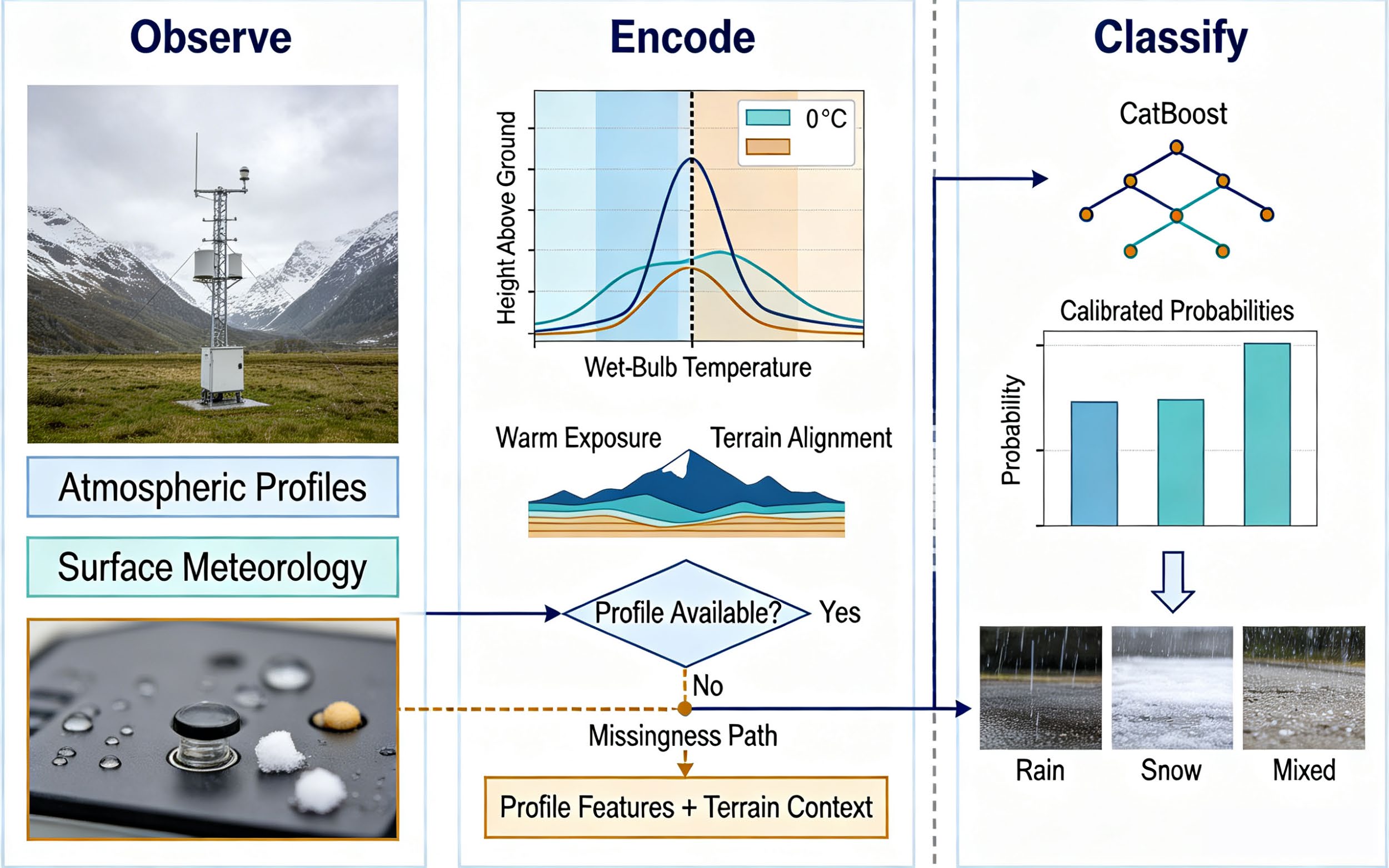
Reliable precipitation phase classification requires information about the atmospheric column and underlying terrain. This paper proposes an elevation-adaptive CatBoost framework that combines compact wet-bulb profile encoding, terrain- relative descriptors, and calibrated class probabilities. The encoder represents warm-layer depth, integrated positive thermal exposure, near-surface cooling, zero-crossing height, and profile availability through terrain-relative thermal descriptors. Continuous elevation interactions and density-controlled training weights address uneven sampling support between lowlands and uplands. The evaluation examines classification performance, terrain transfer, and probability reliability under different input conditions. There are 24,000 precipitation cases and five elevation bands in the benchmark. In the performance comparison, the proposed configuration has a macro F1 score of 0.910 and a balanced accuracy of 0.914, while surface-only CatBoost achieved 0.867 and 0.871, respectively. After removing profile encoding, the macro F1 score is 0.880; after removing elevation adaptation, it is 0.891. The Brier score and expected calibration error decrease from 0.168 and 0.061 to 0.122 and 0.024, respectively. These contrasts describe the reported aggregate comparison rather than a test of statistical significance. The reliability-bin definition and the relationship between pooled and fold-averaged diagnostics require reconciliation before the probability scores support operational calibration claims. The contribution is a compact representation and evaluation framework whose transferability remains conditional on independent geographic testing, documented observation labels, and consistent prediction records.
References
Wang, Z., Vivoni, E. R., Whitney, K. M., Xiao, M., & Mascaro, G. (2024). On the sensitivity of future hydrology in the Colorado River to the selection of the precipitation partitioning method. Water Resources Research, 60(6), Article e2023WR035801. https://doi.org/10.1029/2023WR035801
Pan, G., Zhou, X., Zheng, W., Liu, Z., & Zhang, A. (2025). RSSD: A regional-level resource-saving snow detection model for winter road surface maintenance. Expert Systems with Applications, 277, Article 127155. https://doi.org/10.1016/j.eswa.2025.127155
Wolvin, S., Strong, C., Rupper, S., & Steenburgh, W. J. (2024). Climatology of orographic precipitation gradients over High Mountain Asia derived from dynamical downscaling. Journal of Geophysical Research: Atmospheres, 129(20), Article e2024JD041010. https://doi.org/10.1029/2024JD041010
Liu, L., Zhang, L., Zhang, Q., Wang, G., Zhou, Z., Li, X., & Tang, Z. (2025). A non‐sigmoidal‐curve‐dependent dynamic threshold method improves precipitation phase partitioning in the Northern Hemisphere. Water Resources Research, 61(4), Article e2024WR038636. https://doi.org/10.1029/2024WR038636
Shi, S., & Liu, G. (2024). Improvements on phase classification using atmospheric melting and refreezing energy based on soundings. Journal of Geophysical Research: Atmospheres, 129(10), Article e2023JD040030. https://doi.org/10.1029/2023JD040030
Simonet, G., Rotach, M. W., & Lehner, M. (2026). Physically consistent mesoscale model evaluation in complex terrain. Quarterly Journal of the Royal Meteorological Society, 152(775), Article e70063. https://doi.org/10.1002/qj.70063
Koldasbayeva, D., Tregubova, P., Gasanov, M., Zaytsev, A., Petrovskaia, A., & Burnaev, E. (2024). Challenges in data-driven geospatial modeling for environmental research and practice. Nature Communications, 15(1), Article 10700. https://doi.org/10.1038/s41467-024-55240-8
Xu, X., Chen, F., Wang, B., Harrison, M. T., Chen, Y., Liu, K., Zhang, C., Zhang, M., Zhang, X., Feng, P., & Hu, K. (2024). Unleashing the power of machine learning and remote sensing for robust seasonal drought monitoring: A stacking ensemble approach. Journal of Hydrology, 634, Article 131102. https://doi.org/10.1016/j.jhydrol.2024.131102
Muftuoglu, T. D. (2026). High-accuracy day-ahead precipitation forecasting with an interpretable CatBoost regressor and a LightGBM-based extreme-event alerting pipeline. Water Science, 40(1), Article 32. https://doi.org/10.1007/s44533-026-00033-
Van Calster, B., Collins, G. S., Vickers, A. J., Wynants, L., Kerr, K. F., Barreñada, L., Varoquaux, G., Singh, K., Moons, K. G. M., Hernandez-Boussard, T., Timmerman, D., McLernon, D. J., van Smeden, M., & Steyerberg, E. W. (2025). Evaluation of performance measures in predictive artificial intelligence models to support medical decisions: Overview and guidance. The Lancet Digital Health, 7(12), Article 100916. https://doi.org/10.1016/j.landig.2025.100916
Yu, G., Jennings, K. S., Hatchett, B. J., Nolin, A. W., Hur, N., Collins, M., Heggli, A., Tonino, S., & Arienzo, M. M. (2024). Crowdsourced data reveal shortcomings in precipitation phase products for rain and snow partitioning. Geophysical Research Letters, 51(24), Article e2024GL112853. https://doi.org/10.1029/2024GL112853
Stock, A. (2025). Choosing blocks for spatial cross-validation: Lessons from a marine remote sensing case study. Frontiers in Remote Sensing, 6, Article 1531097. https://doi.org/10.3389/frsen.2025.1531097
Hu, J., Che, T., He, Y., Huang, W., & Yang, X. (2024). An intercomparison of empirical schemes for partitioning precipitation phase. Journal of Hydrology: Regional Studies, 53, Article 101757. https://doi.org/10.1016/j.ejrh.2024.101757
Singh, B., Liu, M., Abatzoglou, J. T., Adam, J. C., & Rajagopalan, K. (2025). Incorporating relative humidity in precipitation phase partitioning reduces model bias for some snow and streamflow metrics across the Northwest US. Journal of Hydrology, 662, Article 133833. https://doi.org/10.1016/j.jhydrol.2025.133833
Jennings, K. S., Collins, M., Hatchett, B. J., Heggli, A., Hur, N., Tonino, S., Nolin, A. W., Yu, G., Zhang, W., & Arienzo, M. M. (2025). Machine learning shows a limit to rain-snow partitioning accuracy when using near-surface meteorology. Nature Communications, 16(1), Article 2929. https://doi.org/10.1038/s41467-025-58234-2
Fu, Y., Yang, L., Wu, Z., Zhang, P., Gu, S., Chen, L., & Nan, S. (2024). A new algorithm of rain type classification for GPM dual-frequency precipitation radar in summer Tibetan Plateau. Advances in Atmospheric Sciences, 41(11), 2093–2111. https://doi.org/10.1007/s00376-024-3384-7
Antúnez, P. (2026). When and why elevation fails as a temperature proxy: Hierarchical controls on lapse rates across climate, physiography, and vegetation in Mexico. Agricultural and Forest Meteorology, 389, Article 111376. https://doi.org/10.1016/j.agrformet.2026.111376
Yang, C., Li, X., Zhang, X., Wu, J., & Li, L. (2025). Evaluation and comparison of separated precipitation types from multi-sources data in the Chinese Tianshan mountainous region. Journal of Mountain Science, 22(2), 489–504. https://doi.org/10.1007/s11629-024-9258-8
Zhang, B., Yu, H., Hu, Z., Yue, P., Tang, Z., Luo, H., Wang, G., & Cheng, S. (2025). A machine learning-based observational constraint correction method for seasonal precipitation prediction. Advances in Atmospheric Sciences, 42(1), 36–52. https://doi.org/10.1007/s00376-024-4191-x
Haseeb, M., Tahir, Z., Mehmood, S. A., Arif, H., Kousar, S., Ghafoor, S., & Mehmood, K. (2026). Ensemble artificial intelligence fusing satellite, reanalysis, and ground observations for improved PM2.5 prediction. Atmosphere, 17(4), Article 411. https://doi.org/10.3390/atmos17040411
Pic, R., Dombry, C., Naveau, P., & Taillardat, M. (2025). Proper scoring rules for multivariate probabilistic forecasts based on aggregation and transformation. Advances in Statistical Climatology, Meteorology and Oceanography, 11(1), 23–58. https://doi.org/10.5194/ascmo-11-23-2025
Fan, K. L., Pennello, G., Liu, Q., Petrick, N., Samala, R. K., Samuelson, F. W., Thompson, Y. L. E., & Cao, Q. (2025). Calzone: A Python package for measuring calibration of probabilistic models for classification. Journal of Open Source Software, 10(114), Article 8026. https://doi.org/10.21105/joss.08026
Song, B., Zhao, S., Dang, L., Wang, H., & Xu, L. (2025). A survey on learning from data with label noise via deep neural networks. Systems Science & Control Engineering, 13(1), Article 2488120. https://doi.org/10.1080/21642583.2025.2488120
Ghiggi, G., Candolfi, K., Billault-Roux, A.-C., Longchamp, R., Pham-Ba, S., Weil, C., Uijlenhoet, R., & Berne, A. (2026). disdrodb: An open-source Python package for standardized processing, sharing, and analysis of disdrometer data. Atmospheric Measurement Techniques, 19(14), 4943–4987. https://doi.org/10.5194/amt-19-4943-2026
Bédard-Therrien, A., Anctil, F., Thériault, J. M., Chalifour, O., Payette, F., Vidal, A., & Nadeau, D. F. (2025). Leveraging a radar-based disdrometer network to develop a probabilistic precipitation phase model in eastern Canada. Hydrology and Earth System Sciences, 29(4), 1135–1158. https://doi.org/10.5194/hess-29-1135-2025
Ohmer, M., Doll, F., & Liesch, T. (2025). Incorporating spatial information for regionalization of environmental parameters in machine learning models. Mathematical Geosciences, 57(2), 251–273. https://doi.org/10.1007/s11004-024-10163-4
Talan, T., Giray, T., Korkmaz, A., Kosunalp, S., Tumen, V., & Akin, E. (2026). Predicting and explaining economic losses from natural disasters: A post-hoc machine learning and explainable AI approach. Applied Sciences, 16(19), Article 9497. https://doi.org/10.3390/app16199497
Pivin-Bachler, J. R., & van den Broek, E. L. (2025). SIMBA: A robust and generalizable measure of data imbalance. Patterns, 6(12), Article 101395. https://doi.org/10.1016/j.patter.2025.101395
Sun, P., Wang, M., Meng, D., Xu, Y., Cheng, C., & Ju, W. (2026). Multi-source meteorological–topographic modeling of monthly power generation for mountain photovoltaic stations using gradient-boosted trees. Energies, 19(12), Article 2936. https://doi.org/10.3390/en19122936
Zhan, C., Jiao, J. J., Ma, Y., Wang, H., Soltanian, M. R., Carroll, K. C., & Dai, Z. (2026). Impacts of validation strategy and geological complexity on machine learning-based subsurface structure modeling. Journal of Hydrology, 666, Article 134797. https://doi.org/10.1016/j.jhydrol.2025.134797
Jiang, Z., Liu, A., & Van Durme, B. (2024). Addressing the binning problem in calibration assessment through scalar annotations. Transactions of the Association for Computational Linguistics, 12, 120–136. https://doi.org/10.1162/tacl_a_00636
Toure, M., Klutse, N. A. B., Sarr, M. A., Bhuiyan, M. A. E., Kenne, A. D., Thiaw, W. M., Badiane, D., Gaye, A. T., Ndiaye, O., & Mbow, C. (2025). Machine learning approaches for imputing missing meteorological data in Senegal. Applied Computing and Geosciences, 27, Article 100281. https://doi.org/10.1016/j.acags.2025.100281
Pagano, T. C., Casati, B., Landman, S., Loveday, N., Taggart, R., Ebert, E. E., Khanarmuei, M., Jensen, T. L., Mittermaier, M., Roberts, H., Willington, S., Roberts, N., Sowko, M., Strassberg, G., Kluepfel, C., Bullock, T. A., Turner, D. D., Pappenberger, F., Osborne, N., & Noble, C. (2024). Challenges of operational weather forecast verification and evaluation. Bulletin of the American Meteorological Society, 105(4), E789–E802. https://doi.org/10.1175/BAMS-D-22-0257.1