LSTM Model Enhanced by Wavelet Decomposition and Force Displacement Stage Alignment for Interlock Estimation in Self Piercing Riveting
Authors
Maximilian Müller, Hannah Wagner, Lena PichlerFiles
Key Information
Journal

Published in Vol. 4 No. 2 (2026) of Journal of Applied Computational Intelligence.
The Journal of Applied Computational Intelligence (JACI) eISSN:3136-6937 is a peer-reviewed, international, open-access journal dedicated to the advancement of computational intelligence methodologies and their real-world applications across diverse engineering and scientific domains. The journal aims to bridge the gap between theoretical development and practical deployment of intelligent systems by providing a scholarly platform for researchers, practitioners, and industry innovators.
JACI encourages high-quality original research, review articles, and technical reports that explore the design, implementation, and optimization of intelligent algorithms for solving complex problems in fields such as manufacturing, energy, healthcare, transportation, and information systems.
Abstract
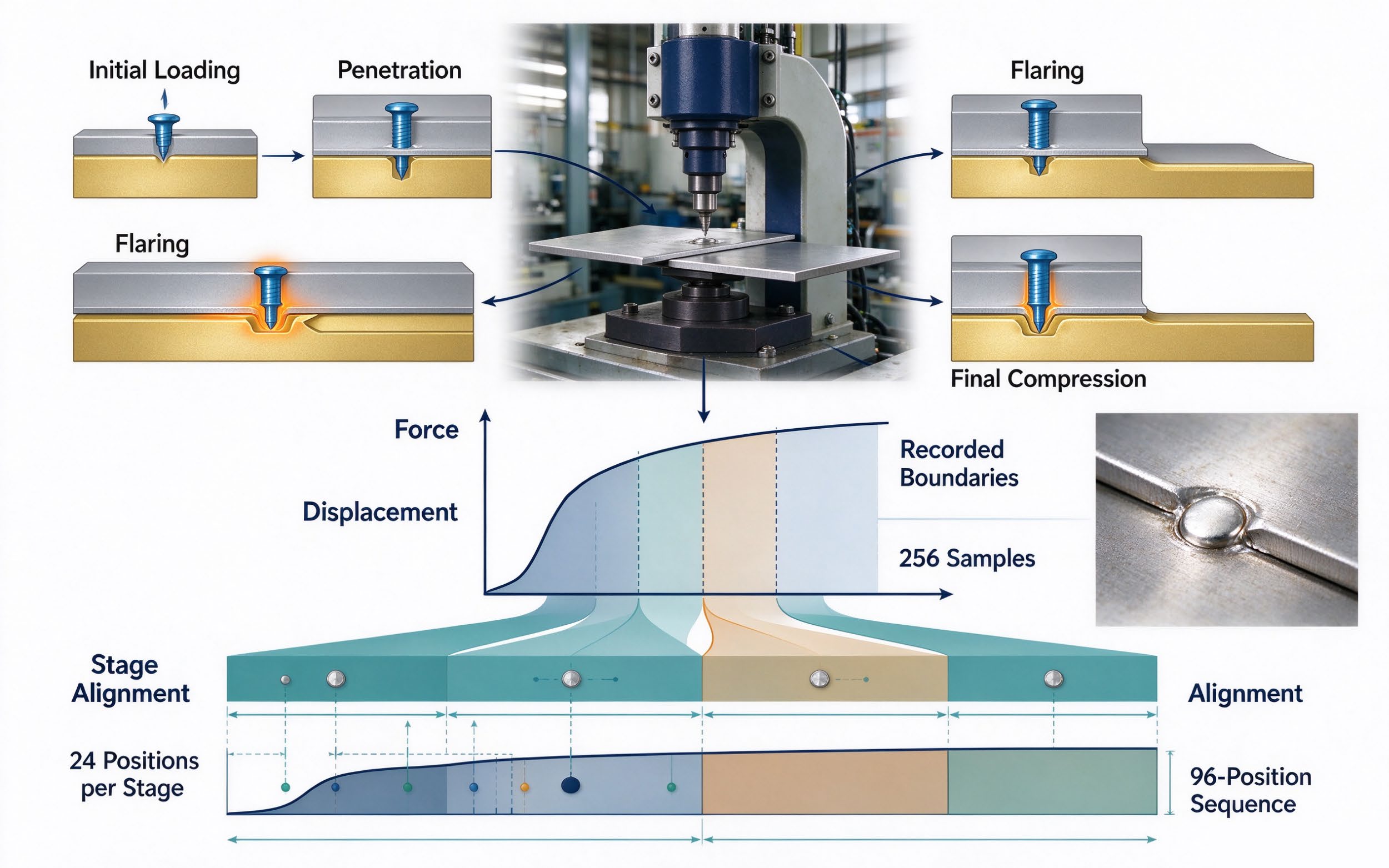
Completed self-piercing riveting strokes contain force-displacement patterns associated with final interlock, while variation in the durations of mechanical stages shifts corresponding features along the source coordinate. This study evaluates a stage-referenced long short-term memory estimator enhanced by two-level Haar decomposition. Four process intervals are mapped to equal displacement-coordinate blocks of 24 positions, yielding a 96-position aligned force sequence. A coarse approximation and two reconstructed detail channels form the recurrent input, and hidden states at the four stage endpoints feed a scalar regression head. The numerical benchmark contains 960 independently generated curves, divided into 600 training, 180 validation and 180 test records. The reference interlock is determined by expansion and lower-sheet descriptors within a declared smooth mapping. Across three training seeds, the combined model attains mean absolute error 0.0223 mm, root mean squared error 0.0288 mm and coefficient of determination 0.9514. Its mean absolute error is 65.96% lower than that of the raw-curve LSTM and 24.85% lower than that of the aligned single-channel LSTM. Aligned ridge regression reaches 0.0156 mm, showing that this constructed target also supports a simpler, more accurate estimator. A normalized-stroke boundary shift raises combined-model error to 0.0785 mm, and halving original sample density gives 0.0241 mm; added force noise yields 0.0700 mm. These findings separate stage correspondence, multiscale representation and input-quality sensitivity within a controlled curve population. Measured riveting records with independently sectioned interlock references are necessary to assess physical transfer.
References
Sun, X., Beghi, A., Susto, G. A., & Lv, Z. (2024). Deep learning-based quality prediction for multi-stage sequential hot rolling processes in heavy rail manufacturing. Computers & Industrial Engineering, 196, 110466. https://doi.org/10.1016/j.cie.2024.110466
Mohammadi Foumani, N., Miller, L., Tan, C. W., Webb, G. I., Forestier, G., & Salehi, M. (2024). Deep learning for time series classification and extrinsic regression: A current survey. ACM Computing Surveys, 56(9), Article 217, 1–45. https://doi.org/10.1145/3649448
Murad, M. M. N., Aktukmak, M., & Yilmaz, Y. (2025). WPMixer: Efficient multi-resolution mixing for long-term time series forecasting. Proceedings of the AAAI Conference on Artificial Intelligence, 39(18), 19581–19588. https://doi.org/10.1609/aaai.v39i18.34156
Wang, X., Zhang, M., & Su, J. (2025). Robust temporal alignment for multivariate time series forecasting. Expert Systems with Applications, 289, 128299. https://doi.org/10.1016/j.eswa.2025.128299
Wu, S., Song, S., Deng, S., Xie, W., & Shen, L. (2026). Variable-length time series classification: Benchmarking, analysis and effective spectral pooling strategy. Information Fusion, 126, 103584. https://doi.org/10.1016/j.inffus.2025.103584
Zhang, Z., Pham, T. D., An, Y., Doan, N. P., Alsharari, M., Tran, V.-H., Hoang, A.-T., Vandierendonck, H., & Mai, S. T. (2025). WaveletMixer: A multi-resolution wavelet based MLP-Mixer for multivariate long-term time series forecasting. Proceedings of the AAAI Conference on Artificial Intelligence, 39(21), 22741–22749. https://doi.org/10.1609/aaai.v39i21.34434
Reuel, A., Hardy, A., Smith, C., Lamparth, M., Hardy, M., & Kochenderfer, M. J. (2024). BetterBench: Assessing AI benchmarks, uncovering issues, and establishing best practices. Advances in Neural Information Processing Systems, 37, 21763–21813. https://doi.org/10.52202/079017-0685
Inácio, R., Cerqueira, V., Barandas, M., & Soares, C. (2025). Mast: Interpretable stress testing via meta-learning for forecasting model robustness evaluation. Machine Learning, 114, 251. https://doi.org/10.1007/s10994-025-06881-3
Kim, I., Na, J., Yun, J. P., & Lee, S. (2024). Deep feature selection framework for quality prediction in injection molding process. IEEE Transactions on Industrial Informatics, 20(1), 503–512. https://doi.org/10.1109/TII.2023.3268421
Ren, L., Mo, T., Cheng, X., & Li, X. (2024). Temporal–frequency attention focusing for time series extrinsic regression via auxiliary task. IEEE Transactions on Neural Networks and Learning Systems, 35(11), 15494–15506. https://doi.org/10.1109/TNNLS.2023.3287318
Wang, A., Tong, T. P., Mizera, A., & Pang, J. (2024). Benchmarking structural inference methods for interacting dynamical systems with synthetic data. Advances in Neural Information Processing Systems, 37, 135129–135185. https://doi.org/10.52202/079017-4295
Terven, J., Cordova-Esparza, D.-M., Romero-González, J.-A., Ramírez-Pedraza, A., & Chávez-Urbiola, E. A. (2025). A comprehensive survey of loss functions and metrics in deep learning. Artificial Intelligence Review, 58, 195. https://doi.org/10.1007/s10462-025-11198-7
Li, H., Yu, Y., Zhao, Z., & Tang, X. (2024). A time series short-term prediction method based on multi-granularity event matching and alignment. Computers, Materials & Continua, 78(1), 653–676. https://doi.org/10.32604/cmc.2023.046424
Beck, M., Pöppel, K., Spanring, M., Auer, A., Prudnikova, O., Kopp, M., Klambauer, G., Brandstetter, J., & Hochreiter, S. (2024). xLSTM: Extended long short-term memory. Advances in Neural Information Processing Systems, 37, 107547–107603. https://doi.org/10.52202/079017-3417
Shi, X., Hu, T., Chang, Y., Song, Y., Liang, A., & Sun, Y. (2025). Waveel: A wavelet-based ensemble learning framework for time series forecasting. EURASIP Journal on Wireless Communications and Networking, 2025, 52. https://doi.org/10.1186/s13638-025-02479-4
Tian, Y., Zhao, S., & Zhang, X. (2025). Robustness and orthogonality: Time series forecasting via wavelets. Information Sciences, 717, 122328. https://doi.org/10.1016/j.ins.2025.122328
Forootani, A., & Khosravi, M. (2026). Compact transformer variants for synthetic time series forecasting. Neurocomputing, 677, 133140. https://doi.org/10.1016/j.neucom.2026.133140
Hiniduma, K., Byna, S., & Bez, J. L. (2025). Data readiness for AI: A 360-degree survey. ACM Computing Surveys, 57(9), Article 219, 1–39. https://doi.org/10.1145/3722214
Semmelrock, H., Ross-Hellauer, T., Kopeinik, S., Theiler, D., Haberl, A., Thalmann, S., & Kowald, D. (2025). Reproducibility in machine-learning-based research: Overview, barriers, and drivers. AI Magazine, 46(2), e70002. https://doi.org/10.1002/aaai.70002
Mathieu, T., & Preux, P. (2024). Statistical comparison in empirical computer science with minimal computation usage. In Proceedings of the 2nd ACM Conference on Reproducibility and Replicability (pp. 20–24). ACM. https://doi.org/10.1145/3641525.3663618
Guijo-Rubio, D., Middlehurst, M., Arcencio, G., Silva, D. F., & Bagnall, A. (2024). Unsupervised feature based algorithms for time series extrinsic regression. Data Mining and Knowledge Discovery, 38(4), 2141–2185. https://doi.org/10.1007/s10618-024-01027-w
Koziel, S., Pietrenko-Dabrowska, A., Wojcikowski, M., & Pankiewicz, B. (2024). Efficient calibration of cost-efficient particulate matter sensors using machine learning and time-series alignment. Knowledge-Based Systems, 295, 111879. https://doi.org/10.1016/j.knosys.2024.111879
Stržinar, Ž., Pregelj, B., & Škrjanc, I. (2024). Non-elastic time series fuzzy clustering for efficient analysis of industrial data sets. Applied Soft Computing, 167, 112398. https://doi.org/10.1016/j.asoc.2024.112398
d’Hondt, J. E., Li, H., Yang, F., Papapetrou, O., & Paparrizos, J. (2025). A structured study of multivariate time-series distance measures. Proceedings of the ACM on Management of Data, 3(3), 1–29. https://doi.org/10.1145/3725258
Nasr, S., & Sikdar, S. (2024). IndMask: Inductive explanation for multivariate time series black-box models. In ECAI 2024 (pp. 1108–1115). IOS Press. https://doi.org/10.3233/FAIA240603
Šimić, I., Veas, E., & Sabol, V. (2025). A comprehensive analysis of perturbation methods in explainable AI feature attribution validation for neural time series classifiers. Scientific Reports, 15, 26607. https://doi.org/10.1038/s41598-025-09538-2
Song, Y., Li, F., Wang, Z., Zhang, B., & Zhang, B. (2024). Uncertainty quantification of data-driven quality prediction model for realizing the active sampling inspection of mechanical properties in steel production. International Journal of Computational Intelligence Systems, 17, 74. https://doi.org/10.1007/s44196-024-00451-6
Park, J., & Min, M. (2025). Robustness and performance comparison of generative AI time series anomaly detection under noise. Computer Modeling in Engineering & Sciences, 145(3), 3913–3948. https://doi.org/10.32604/cmes.2025.072261
Lin, J., Liu, D., Wu, T., Xu, Y., & Chen, Y. (2025). TSINet: A temporal-channel factorized mixing and spectral enhanced interactive network for time series forecasting. Information Sciences, 719, 122440. https://doi.org/10.1016/j.ins.2025.122440
Michałowska, K., Goswami, S., Karniadakis, G. E., & Riemer-Sørensen, S. (2025). Multi-resolution learning with DeepONets and long short-term memory neural networks. Neurocomputing, 653, 131154. https://doi.org/10.1016/j.neucom.2025.131154
Pecher, B., Srba, I., & Bielikova, M. (2024). A survey on stability of learning with limited labelled data and its sensitivity to the effects of randomness. ACM Computing Surveys, 57(1), Article 19, 1–40. https://doi.org/10.1145/3691339
Wang, X., Tang, Z., Guo, J., Meng, T., Wang, C., Wang, T., & Jia, W. (2025). Empowering edge intelligence: A comprehensive survey on on-device AI models. ACM Computing Surveys, 57(9), Article 228, 1–39. https://doi.org/10.1145/3724420