GraphSAGE Model with Tether Topology Updates for Underwater Robot Tether Entanglement Prediction
Authors
Rawda Al-Rumaithi, Hana Al-Maqbali, Shahla Al-Otaibi, Tufaha Al-SibairiFiles
Key Information
Journal

Published in Vol. 4 No. 2 (2026) of Journal of Applied Computational Intelligence.
The Journal of Applied Computational Intelligence (JACI) eISSN:3136-6937 is a peer-reviewed, international, open-access journal dedicated to the advancement of computational intelligence methodologies and their real-world applications across diverse engineering and scientific domains. The journal aims to bridge the gap between theoretical development and practical deployment of intelligent systems by providing a scholarly platform for researchers, practitioners, and industry innovators.
JACI encourages high-quality original research, review articles, and technical reports that explore the design, implementation, and optimization of intelligent algorithms for solving complex problems in fields such as manufacturing, energy, healthcare, transportation, and information systems.
Abstract
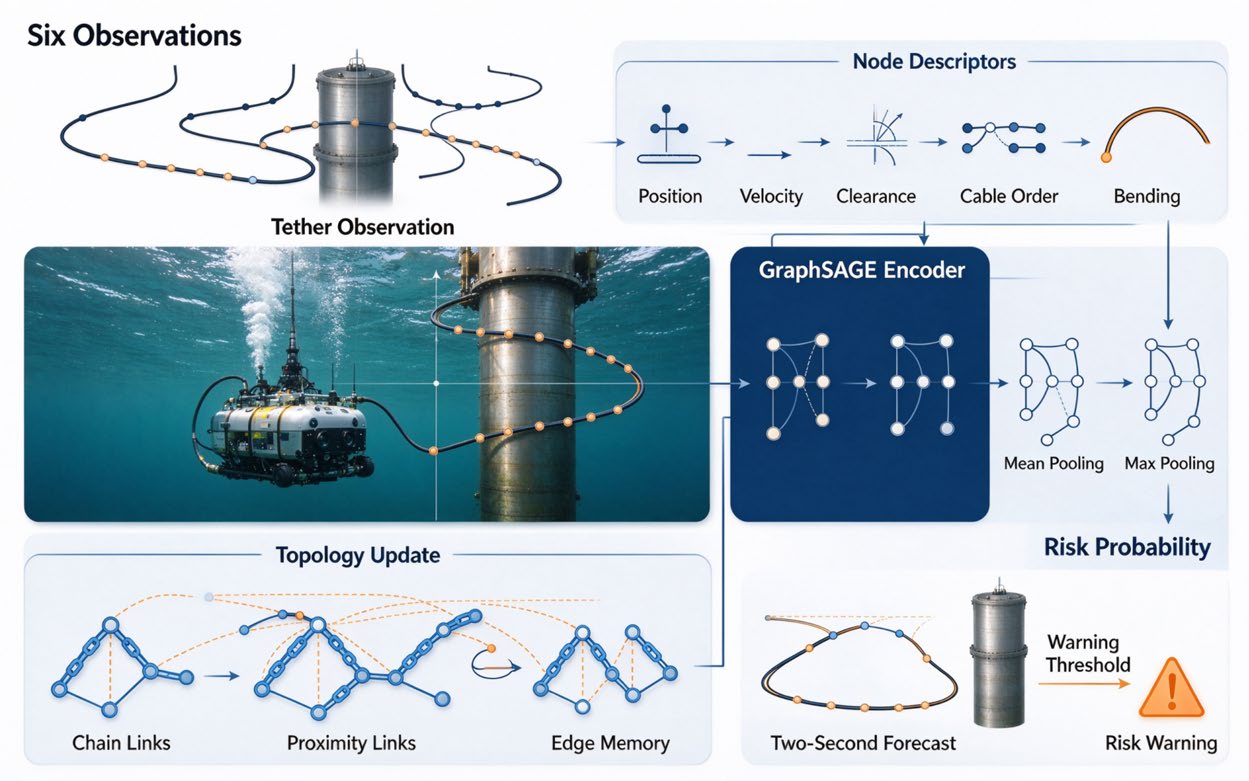
Underwater robot tether geometry changes as material segments move around obstacles, and future geometric wrapping depends on both recent motion and spatial relationships. This study evaluates a GraphSAGE predictor with permanent material-chain edges and hysteretically updated proximity edges around a vertical cylindrical obstacle. Twenty-four ordered tether nodes carry nine features comprising position, recent velocity, radial clearance, material coordinate and discrete bending. Two neighborhood-aggregation layers and graph-level mean and maximum pooling estimate the probability of a geometric risk state two seconds after a six-frame observation history. The generated benchmark contains 1,500 independent trajectories, partitioned into 900 training, 300 validation and 300 test trajectories. A positive target combines sufficient angular sweep, radial proximity and bounded axial extent at the forecast horizon. Across three training seeds, the updated-topology model attains 94.11% accuracy, 72.65% positive-state recall, F1 0.7534 and Brier score 0.0447. Chain-only and frozen-proximity alternatives attain higher F1 values of 0.7945 and 0.8013, respectively, in this trajectory family. Velocity-omitted retraining yields F1 0.5447; zeroing velocity at inference in a fitted complete model yields F1 0.4863. Proximity connectivity changes over the observation interval in 35.47% of trajectories. Independent position perturbations and graph-delay tests expose sensitivity to descriptor construction and temporal alignment. These results identify predictive value in recent motion while limiting claims of benefit from topology refresh under the declared synthetic geometry. Measured tether motion, contact and tension data are needed to link the geometric label to mechanical entanglement.
References
Khoshraftar, S., & An, A. (2024). A survey on graph representation learning methods. ACM Transactions on Intelligent Systems and Technology, 15(1), Article 19, 1–55. https://doi.org/10.1145/3633518
Han, J., Cen, J., Wu, L., Li, Z., Kong, X., Jiao, R., Yu, Z., Xu, T., Wu, F., Wang, Z., Xu, H., Wei, Z., Zhao, D., Liu, Y., Rong, Y., & Huang, W. (2025). A survey of geometric graph neural networks: Data structures, models and applications. Frontiers of Computer Science, 19(11), 1911375. https://doi.org/10.1007/s11704-025-41426-w
Zheng, Y., Yi, L., & Wei, Z. (2025). A survey of dynamic graph neural networks. Frontiers of Computer Science, 19(6), 196323. https://doi.org/10.1007/s11704-024-3853-2
Dong, J., Jiang, Z., Pan, D., Chen, Z., Guan, Q., Zhang, H., Gui, G., & Gui, W. (2025). A survey on confidence calibration of deep learning-based classification models under class imbalance data. IEEE Transactions on Neural Networks and Learning Systems, 36(9), 15664–15684. https://doi.org/10.1109/TNNLS.2025.3565159
Yang, L., Chatelain, C., & Adam, S. (2024). Dynamic graph representation learning with neural networks: A survey. IEEE Access, 12, 43460–43484. https://doi.org/10.1109/ACCESS.2024.3378111
Mamedov, S., Geist, A. R., Swevers, J., & Trimpe, S. (2024). Pseudo-rigid body networks: Learning interpretable deformable object dynamics from partial observations. In 2024 IEEE/RSJ International Conference on Intelligent Robots and Systems (IROS) (pp. 9542–9548). IEEE. https://doi.org/10.1109/IROS58592.2024.10802305
Reuel, A., Hardy, A., Smith, C., Lamparth, M., Hardy, M., & Kochenderfer, M. J. (2024). BetterBench: Assessing AI benchmarks, uncovering issues, and establishing best practices. Advances in Neural Information Processing Systems, 37, 21763–21813. https://doi.org/10.52202/079017-0685
Terven, J., Cordova-Esparza, D.-M., Romero-González, J.-A., Ramírez-Pedraza, A., & Chávez-Urbiola, E. A. (2025). A comprehensive survey of loss functions and metrics in deep learning. Artificial Intelligence Review, 58, 195. https://doi.org/10.1007/s10462-025-11198-7
Mamedov, S., Geist, A. R., Viljoen, R., Trimpe, S., & Swevers, J. (2025). Learning deformable linear object dynamics from a single trajectory. IEEE Robotics and Automation Letters, 10(7), 7635–7642. https://doi.org/10.1109/LRA.2025.3577421
Saranti, A., Pfeifer, B., Gollob, C., Stampfer, K., & Holzinger, A. (2024). From 3D point-cloud data to explainable geometric deep learning: State-of-the-art and future challenges. WIREs Data Mining and Knowledge Discovery, 14(6), e1554. https://doi.org/10.1002/widm.1554
Hiniduma, K., Byna, S., & Bez, J. L. (2025). Data readiness for AI: A 360-degree survey. ACM Computing Surveys, 57(9), Article 219, 1–39. https://doi.org/10.1145/3722214
Akasiadis, C., Kladis, E., Kamberi, P.-F., Michelioudakis, E., Alevizos, E., & Artikis, A. (2024). A framework to evaluate early time-series classification algorithms. In Proceedings of the 27th International Conference on Extending Database Technology (pp. 623–635). OpenProceedings.org. https://doi.org/10.48786/edbt.2024.54
Ju, W., Fang, Z., Gu, Y., Liu, Z., Long, Q., Qiao, Z., Qin, Y., Shen, J., Sun, F., Xiao, Z., Yang, J., Yuan, J., Zhao, Y., Wang, Y., Luo, X., & Zhang, M. (2024). A comprehensive survey on deep graph representation learning. Neural Networks, 173, 106207. https://doi.org/10.1016/j.neunet.2024.106207
Feng, Z., Wang, R., Wang, T., Song, M., Wu, S., & He, S. (2026). A comprehensive survey of dynamic graph neural networks: Models, frameworks, benchmarks, experiments and challenges. IEEE Transactions on Knowledge and Data Engineering, 38(1), 26–46. https://doi.org/10.1109/TKDE.2025.3621291
Wang, Y., Hou, W., Sheng, N., Zhao, Z., Liu, J., Huang, L., & Wang, J. (2024). Graph pooling in graph neural networks: Methods and their applications in omics studies. Artificial Intelligence Review, 57, 294. https://doi.org/10.1007/s10462-024-10918-9
Lane, R. O. (2026). A comprehensive review of classifier probability calibration metrics. Data Science, 9(1), Article 24518492261436231. https://doi.org/10.1177/24518492261436231
Wang, A., Tong, T. P., Mizera, A., & Pang, J. (2024). Benchmarking structural inference methods for interacting dynamical systems with synthetic data. Advances in Neural Information Processing Systems, 37, 135129–135185. https://doi.org/10.52202/079017-4295
Zhang, K., Liu, S., Wang, S., Shi, W., Chen, C., Li, P., Li, S., Li, J., & Ding, K. (2026). A survey of deep graph learning under distribution shifts: From graph out-of-distribution generalization to adaptation. ACM Transactions on Knowledge Discovery from Data, 20(2), Article 31, 1–38. https://doi.org/10.1145/3785475
Semmelrock, H., Ross-Hellauer, T., Kopeinik, S., Theiler, D., Haberl, A., Thalmann, S., & Kowald, D. (2025). Reproducibility in machine-learning-based research: Overview, barriers, and drivers. AI Magazine, 46(2), e70002. https://doi.org/10.1002/aaai.70002
Mathieu, T., & Preux, P. (2024). Statistical comparison in empirical computer science with minimal computation usage. In Proceedings of the 2nd ACM Conference on Reproducibility and Replicability (pp. 20–24). ACM. https://doi.org/10.1145/3641525.3663618
Pecher, B., Srba, I., & Bielikova, M. (2024). A survey on stability of learning with limited labelled data and its sensitivity to the effects of randomness. ACM Computing Surveys, 57(1), Article 19, 1–40. https://doi.org/10.1145/3691339
Chan, H. T. J., Šimić, I., & Veas, E. (2025). Explainability and importance estimate of time series classifier via embedded neural network. Scientific Reports, 15, 34515. https://doi.org/10.1038/s41598-025-17703-w
Gravina, A., & Bacciu, D. (2024). Deep learning for dynamic graphs: Models and benchmarks. IEEE Transactions on Neural Networks and Learning Systems, 35(9), 11788–11801. https://doi.org/10.1109/TNNLS.2024.3379735
Zhou, P., Yin, K., Zhu, H., Liang, Y., Li, L., & Chen, Y. (2026). A survey on graph structure learning. Neurocomputing, 696, 134114. https://doi.org/10.1016/j.neucom.2026.134114
Klankers, M. K., & Steil, J. J. (2025). Modeling of deformable linear objects under incomplete state information. In 2025 IEEE International Conference on Robotics and Automation (ICRA) (pp. 10965–10972). IEEE. https://doi.org/10.1109/ICRA55743.2025.11127734
Li, X., Wang, J., & Yan, Z. (2025). Can graph neural networks be adequately explained? A survey. ACM Computing Surveys, 57(5), Article 131, 1–36. https://doi.org/10.1145/3711122
Dai, E., Zhao, T., Zhu, H., Xu, J., Guo, Z., Liu, H., Tang, J., & Wang, S. (2024). A comprehensive survey on trustworthy graph neural networks: Privacy, robustness, fairness, and explainability. Machine Intelligence Research, 21(6), 1011–1061. https://doi.org/10.1007/s11633-024-1510-8
Zhang, W., Zhang, L., Han, J., Liu, H., Fu, Y., Zhou, J., Mei, Y., & Xiong, H. (2024). Irregular traffic time series forecasting based on asynchronous spatio-temporal graph convolutional networks. In Proceedings of the 30th ACM SIGKDD Conference on Knowledge Discovery and Data Mining (pp. 4302–4313). ACM. https://doi.org/10.1145/3637528.3671665
Salles, R., Lima, J., Reis, M., Coutinho, R., Pacitti, E., Masseglia, F., Akbarinia, R., Chen, C., Garibaldi, J., Porto, F., & Ogasawara, E. (2024). SoftED: Metrics for soft evaluation of time series event detection. Computers & Industrial Engineering, 198, 110728. https://doi.org/10.1016/j.cie.2024.110728
Ghorbani, R., Reinders, M. J. T., & Tax, D. M. J. (2024). PATE: Proximity-aware time series anomaly evaluation. In Proceedings of the 30th ACM SIGKDD Conference on Knowledge Discovery and Data Mining (pp. 872–883). ACM. https://doi.org/10.1145/3637528.3671971
Kose, H. T., Nunez-Yanez, J., Piechocki, R., & Pope, J. (2024). A survey of computationally efficient graph neural networks for reconfigurable systems. Information, 15(7), 377. https://doi.org/10.3390/info15070377
Lu, H., Wang, L., Ma, X., Cheng, J., & Zhou, M. (2025). A survey of graph neural networks and their industrial applications. Neurocomputing, 614, 128761. https://doi.org/10.1016/j.neucom.2024.128761