Articulation Constrained Neural ODE Prediction of Container Truck Trailer Rear Corner Trajectories
Authors
Fausto Rizzo, Armando Sacco, Quirino SantoroFiles
Key Information
Journal

Published in Vol. 4 No. 2 (2026) of Journal of Applied Computational Intelligence.
The Journal of Applied Computational Intelligence (JACI) eISSN:3136-6937 is a peer-reviewed, international, open-access journal dedicated to the advancement of computational intelligence methodologies and their real-world applications across diverse engineering and scientific domains. The journal aims to bridge the gap between theoretical development and practical deployment of intelligent systems by providing a scholarly platform for researchers, practitioners, and industry innovators.
JACI encourages high-quality original research, review articles, and technical reports that explore the design, implementation, and optimization of intelligent algorithms for solving complex problems in fields such as manufacturing, energy, healthcare, transportation, and information systems.
Abstract
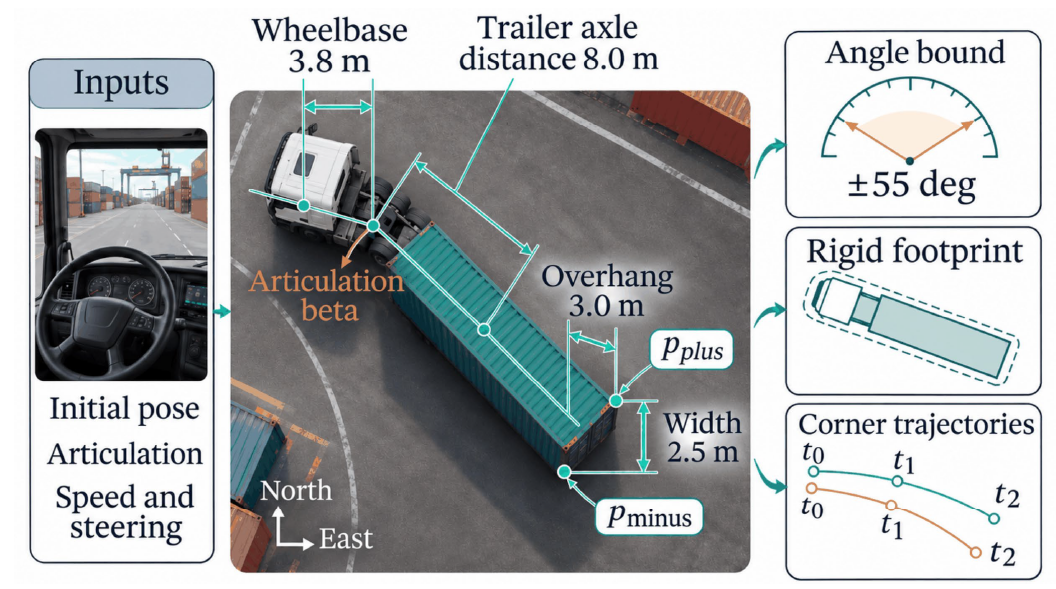
Accurate trailer boundary prediction is needed when container trucks negotiate confined terminal roads, where a plausible tractor path can still produce substantial rear corner displacement. This study develops a continuous time predictor that combines an articulated vehicle kinematic backbone, a learned articulation rate residual, and an explicit articulation angle constraint. A compact residual with fixed nonlinear features and a fitted linear readout is identified from 5,000 derivative observations, while a tangent cone projection suppresses outward angular motion at the admissible boundary. Predicted trailer poses are converted into rear corner trajectories through a rigid footprint transformation. A reproducible feasibility experiment evaluates 60 evaluation maneuvers over a five second horizon using three model variants with identical commanded motion. The constrained predictor obtains a mean rear corner displacement error of 0.0072 m, compared with 0.3678 m for the kinematic baseline and 0.1152 m for the unconstrained neural model. Its mean articulation error is 0.0371 degrees, and no sampled articulation bound violations occur under the tested numerical projection. Distributional diagnostics, six maneuver families, five initial angle perturbation amplitudes, and five integration steps distinguish model accuracy from boundary enforcement and numerical sensitivity. These results characterize the relationship between articulation feasibility and rear corner tracking accuracy under the evaluated operating conditions. The formulation provides an interpretable basis for subsequent identification with measured steering, articulation, and trailer corner observations, where uncertainty in geometry and vehicle inputs must also be addressed.
References
Ghandriz, T., Jacobson, B., Nilsson, P., & Laine, L. (2024). Trajectory-following and off-tracking minimisation of long combination vehicles: A comparison between nonlinear and linear model predictive control. Vehicle System Dynamics, 62(2), 277–310.https://doi.org/10.1080/00423114.2022.2164513
Neighborgall, C., Chen, Y., & Ahmadian, M. (2024). Tyre lateral slip effect on off-tracking of a long combination vehicle. Vehicle System Dynamics, 62(11), 2765–2784. https://doi.org/10.1080/00423114.2024.2304052
Zhou, Q., Zhang, H., He, Y., Su, Y., Jiang, Y., & Zheng, S. (2025). A directional-performance control design for articulated heavy vehicles with extendable-trailers. Vehicle System Dynamics, 63(12), 2393–2438. https://doi.org/10.1080/00423114.2024.2419460
Yan, Y., Zhang, P., Du, C., Wang, H., Wang, H., Pi, D., & Chen, Y.-H. (2026). Vehicle trajectory prediction for autonomous driving applications: State-of-the-art review, research challenges, and future directions. Automotive Innovation, 9(2), 263–295. https://doi.org/10.1007/s42154-025-00382-8
Lehtimäki, M., Paunonen, L., & Linne, M.-L. (2024). Accelerating neural ODEs using model order reduction. IEEE Transactions on Neural Networks and Learning Systems, 35(1), 519–531. https://doi.org/10.1109/TNNLS.2022.3175757
Gao, J., Michelis, M. Y., Spielberg, A., & Katzschmann, R. K. (2024). Sim-to-real of soft robots with learned residual physics. IEEE Robotics and Automation Letters, 9(10), 8523–8530. https://doi.org/10.1109/LRA.2024.3446287
Boesen, T., Haber, E., & Ascher, U. M. (2025). Neural DAEs: Constrained neural networks. SIAM Journal on Scientific Computing, 47(2), C291–C312. https://doi.org/10.1137/23M1574051
Huang, R., Xue, H., Pagnucco, M., Salim, F. D., & Song, Y. (2025). Vision-based multi-future trajectory prediction: A survey. IEEE Transactions on Neural Networks and Learning Systems, 36(8), 13691–13708. https://doi.org/10.1109/TNNLS.2025.3550350
Babaei Robat, A., Arezoo, K., Alipour, K., & Tarvirdizadeh, B. (2024). Dynamics modeling and path following controller of tractor-trailer-wheeled robots considering wheels slip. ISA Transactions, 148, 45–63. https://doi.org/10.1016/j.isatra.2024.03.004
Luu, D. L., Tran, X. D., Dinh, T. C. T., Thai, P. Q., & Truyen, P. H. (2025). Method for improving the maneuverability of the steering system for semi-trailer trucks. The University of Danang - Journal of Science and Technology, 23(9C), 69–73. https://doi.org/10.31130/ud-jst.2025.23(9C).537E
Zhang, B., Yu, W., Jia, Y., Huang, J., Yang, D., & Zhong, Z. (2024). Predicting vehicle trajectory via combination of model-based and data-driven methods using Kalman filter. Proceedings of the Institution of Mechanical Engineers, Part D: Journal of Automobile Engineering, 238(8), 2437–2450. https://doi.org/10.1177/09544070231161846
Zhu, A., Bertalan, T., Zhu, B., Tang, Y., & Kevrekidis, I. G. (2024). Implementation and (inverse modified) error analysis for implicitly templated ODE-nets. SIAM Journal on Applied Dynamical Systems, 23(4), 2643–2669. https://doi.org/10.1137/23M1564596
Kumar, T., Kumar, A., & Pal, P. (2025). A physics-constrained neural ordinary differential equations approach for robust learning of stiff chemical kinetics. Combustion Theory and Modelling, 29(3), 332–347. https://doi.org/10.1080/13647830.2025.2478266
Astuti, L., & Lin, Y.-C. (2025). ABi-LSTM: Attention-based bidirectional-LSTM for multiclass traffic agents trajectory prediction. IEEE Transactions on Vehicular Technology, 74(10), 15603–15618. https://doi.org/10.1109/TVT.2025.3572329
Wang, X., Yang, D., Li, L., Li, C., Lian, J., Zhao, J., Zhang, Z., & Bian, Y. (2026). Robust trajectory prediction based on efficient fusion of heterogeneous information. IEEE Transactions on Vehicular Technology, 75(1), 114–129. https://doi.org/10.1109/TVT.2025.3591243
Chen, J., Wu, K., & Xiu, D. (2025). DUE: A deep learning framework and library for modeling unknown equations. SIAM Review, 67(4), 873–902. https://doi.org/10.1137/24M1671827
Ye, L., Zhou, Z., Wang, J., Li, Y.-H., Jan, N.-Y., Lin, Y.-R., & Lin, Y.-C. (2024). IMGTP: A unified framework for improving and measuring the generalizability of trajectory prediction models. IEEE Transactions on Intelligent Vehicles, 9(10), 6217–6231. https://doi.org/10.1109/TIV.2024.3364714
Hasan, F., & Huang, H. (2024). Driver intention and interaction-aware trajectory forecasting via modular multi-task learning. IEEE Transactions on Consumer Electronics, 70(1), 1857–1865. https://doi.org/10.1109/TCE.2023.3321324
Amoruso, F., & Cebon, D. (2025). Brake-actuated steering control strategy for turning of articulated vehicles. Vehicle System Dynamics, 63(2), 424–454. https://doi.org/10.1080/00423114.2024.2342535
Uhlemann, N., Fent, F., & Lienkamp, M. (2024). Evaluating pedestrian trajectory prediction methods with respect to autonomous driving. IEEE Transactions on Intelligent Transportation Systems, 25(10), 13937–13946. https://doi.org/10.1109/TITS.2024.3386195
Shahirpour, A., & Reuscher, T. (2025). Design and experimental evaluation of model predictive control for autonomous articulated dump trucks. Mining, Metallurgy & Exploration, 42(4), 1975–1987. https://doi.org/10.1007/s42461-025-01265-6
Feng, Y., Ye, Q., Candela, E., Escribano-Macias, J. J., Hu, B., Demiris, Y., & Angeloudis, P. (2025). Risk-aware stochastic vehicle trajectory prediction with spatial-temporal interaction modeling. IEEE Open Journal of Intelligent Transportation Systems, 6, 37–48. https://doi.org/10.1109/OJITS.2025.3530268
Zhang, B., Xue, F., Zhou, Y., Tian, H., & Zhang, X. (2025). A study on state estimation of distributed electric drive articulated vehicle. Journal of Computational Design and Engineering, 12(8), 286–306. https://doi.org/10.1093/jcde/qwaf066
Yan, X., Feng, S., LeBlanc, D. J., Flannagan, C., & Liu, H. X. (2024). Evaluation of automated driving system safety metrics with logged vehicle trajectory data. IEEE Transactions on Intelligent Transportation Systems, 25(8), 8913–8925. https://doi.org/10.1109/TITS.2024.3397849
Xu, Y., Chen, S., & Li, Q. (2026). Correcting autodifferentiation in neural ODE training. SIAM Journal on Applied Mathematics, 86(5), 2360–2378. https://doi.org/10.1137/25M172673X
Celia, M., Monaco, S., & Apiletti, D. (2025). A comparative study of neural ordinary differential equations and neural operators for modeling temporal dynamics. Neural Computing and Applications, 37(30), 25319–25338. https://doi.org/10.1007/s00521-025-11580-0