Noise Covariance Adaptive OAMP-Net for MIMO-OFDM Detection under Colored Interference
Authors
Hsin-hao Kuai, Mei-yu Teng, Mei-hao OuFiles
Key Information
Journal

Published in Vol. 4 No. 2 (2026) of Journal of Applied Computational Intelligence.
The Journal of Applied Computational Intelligence (JACI) eISSN:3136-6937 is a peer-reviewed, international, open-access journal dedicated to the advancement of computational intelligence methodologies and their real-world applications across diverse engineering and scientific domains. The journal aims to bridge the gap between theoretical development and practical deployment of intelligent systems by providing a scholarly platform for researchers, practitioners, and industry innovators.
JACI encourages high-quality original research, review articles, and technical reports that explore the design, implementation, and optimization of intelligent algorithms for solving complex problems in fields such as manufacturing, energy, healthcare, transportation, and information systems.
Abstract
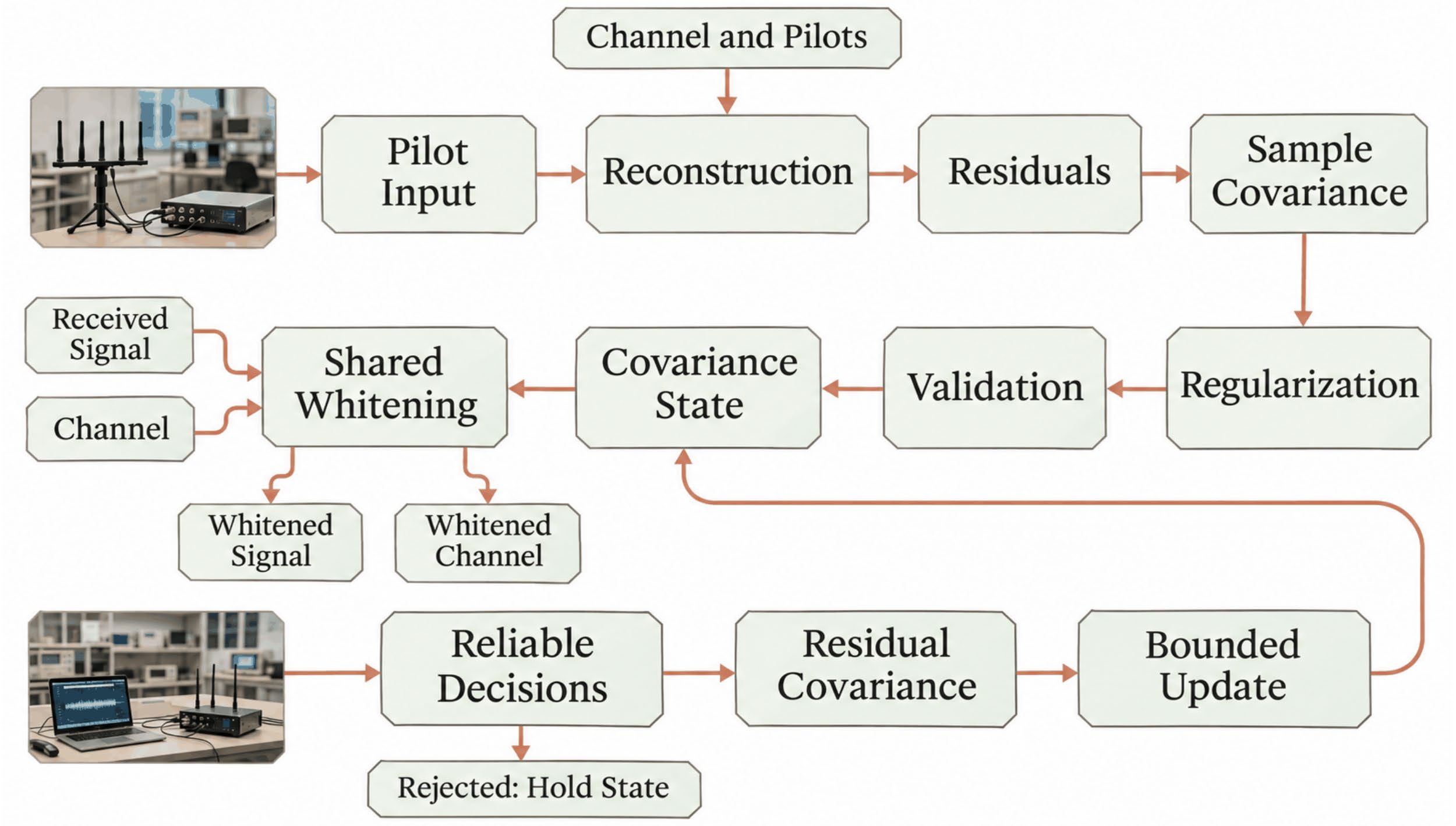
Spatially colored interference alters the geometry of the residual signal in a MIMO-OFDM receiver. A detector calibrated only with the average noise power may assign excessive confidence to interference-dominated directions. A noise- covariance adaptive orthogonal approximate message-passing network with pilot-residual estimation, shrinkage regularization, shared whitening and confidence-gated feedback is presented in this paper. Trace-normalized linear estimators and finite-alphabet posterior denoisers are used to keep an explicit dependence on the channel, and bounded- layer parameters regulate the step-size, damping and variance correction. The numerical dataset is a constructed demonstration of the reporting protocol across interference correlation, pilot availability, covariance drift and channel mismatch; independent detector measurements and completed training outcomes remain to be established. The reported bit error rates at a signal-to-noise ratio of 18 dB for covariance adaptation, frozen whitening and a white noise network are 0.0062, 0.0128 and 0.0230, respectively. Increasing pilot support from 16 to 128 snapshots reduces normalized covariance error from 0.32 to 0.09. Confidence-threshold analysis identifies a trade-off between residual contamination and accepted sample support, and the lowest reported error rate is at an intermediate threshold. The architecture provides a structured interface between covariance estimation and unfolded inference. The evaluation framework links detection error to conditioning, confidence calibration, transient recovery and computational cost, enabling analysis of receiver behavior under changes in the spatial disturbance metric.
References
Shao, M., Ma, W.-K., Liu, J., & Huang, Z. (2024). Accelerated and deep expectation maximization for one-bit MIMO-OFDM detection. IEEE Transactions on Signal Processing, 72, 1094–1113. https://doi.org/10.1109/tsp.2024.3359083
Tomasin, S., Hasler, R., Tulino, A. M., & Sánchez-Fernández, M. (2024). Estimation of interference correlation in mmWave cellular systems. IEEE Transactions on Wireless Communications, 23(3), 1771–1782. https://doi.org/10.1109/twc.2023.3291917
Chowdhury, A., Verma, G., Swami, A., & Segarra, S. (2024). Deep graph unfolding for beamforming in MU-MIMO interference networks. IEEE Transactions on Wireless Communications, 23(5), 4889–4903. https://doi.org/10.1109/twc.2023.3323207
Kuang, Y., Xu, J., & Liu, L. (2025). Joint maximum likelihood channel and covariance estimation for co-channel interference rejection in OFDM systems. IEEE Transactions on Vehicular Technology, 74(10), 15718–15727. https://doi.org/10.1109/tvt.2025.3567300
Takeuchi, K. (2024). Orthogonal approximate message-passing for spatially coupled linear models. IEEE Transactions on Information Theory, 70(1), 594–631. https://doi.org/10.1109/tit.2023.3311408
He, L., Wang, Z., Yang, S., Liu, T., & Huang, Y. (2024). Generalizing projected gradient descent for deep-learning-aided massive MIMO detection. IEEE Transactions on Wireless Communications, 23(3), 1827–1839. https://doi.org/10.1109/twc.2023.3292124
Kwon, J., Jeon, S., Jeon, Y.-S., & Poor, H. V. (2024). MIMO detection under hardware impairments: Learning with noisy labels. IEEE Transactions on Wireless Communications, 23(6), 6015–6029. https://doi.org/10.1109/twc.2023.3329521
Yang, C.-H., Doss, H., & Vemuri, B. C. (2024). An empirical Bayes approach to shrinkage estimation on the manifold of symmetric positive-definite matrices. Journal of the American Statistical Association, 119(545), 259–272. https://doi.org/10.1080/01621459.2022.2110877
Tan, K., Romon, G., & Bellec, P. C. (2024). Noise covariance estimation in multi-task high-dimensional linear models. Bernoulli, 30(3), 1695–1722. https://doi.org/10.3150/23-bej1644
Babulghum, A., Xu, C., Ng, S. X., & El-Hajjar, M. (2024). Partial learning-based iterative detection of MIMO systems. IEEE Open Journal of Vehicular Technology, 5, 1600–1610. https://doi.org/10.1109/ojvt.2024.3482008
Daha, M. Y., Khurshid, K., Ashraf, M. I., & Hadi, M. U. (2024). Optimizing signal detection in MIMO systems: AI vs approximate and linear detectors. IEEE Communications Letters, 28(10), 2387–2391. https://doi.org/10.1109/lcomm.2024.3451655
Liu, L., Liang, S., & Ping, L. (2024). On capacity optimality of OAMP: Beyond IID sensing matrices and Gaussian signaling. IEEE Transactions on Communications, 72(5), 2519–2535. https://doi.org/10.1109/tcomm.2024.3354201
Zhou, Y., Li, X., Zhang, X., Hui, X., & Chen, Y. (2024). Model-driven channel estimation for MIMO monostatic backscatter system with deep unfolding. IEEE Open Journal of the Communications Society, 5, 6697–6712. https://doi.org/10.1109/ojcoms.2024.3479234
Dong, J., Cui, W., & Liu, Y. (2025). Covariance matrix estimation from correlated sub-Gaussian samples via the shrinkage estimator. IEEE Signal Processing Letters, 32, 841–845. https://doi.org/10.1109/lsp.2025.3541427
Wang, P., Fang, J., Ma, B., Wang, B., & Leus, G. (2025). Low-rank covariance matrix recovery from rank-one measurements: An analytical solution. IEEE Signal Processing Letters, 32, 2674–2678. https://doi.org/10.1109/lsp.2025.3584252
Cheng, L., Liu, X., Kong, L., Xiong, J., Zhao, H., & Wei, J. (2026). Label-free environment adaptation for wireless receivers via physics-informed constraints. IEEE Transactions on Wireless Communications, 25, 23250–23264. https://doi.org/10.1109/twc.2026.3730873
Uzlaner, N., Raviv, T., Shlezinger, N., & Todros, K. (2025). Asynchronous online adaptation via modular drift detection for deep receivers. IEEE Transactions on Wireless Communications, 24(5), 4454–4468. https://doi.org/10.1109/twc.2025.3533959
Shallal Abbas Anooz, R., Pourrostam, J., & Al-Ibadi, M. (2024). Adaptive filters versus machine learning based beam tracking techniques for millimeter-wave wireless communications systems. IEEE Access, 12, 165878–165888. https://doi.org/10.1109/access.2024.3491870
Chen, S., Qi, X., Peng, M., & Yan, S. (2025). Anti-main-lobe jamming beamforming with covariance matrix reconstruction for wireless communication systems under jamming attacks. IEEE Transactions on Vehicular Technology, 74(4), 6168–6179. https://doi.org/10.1109/tvt.2024.3515972
Lin, Y., Song, M., & van der Sluis, B. (2025). Bootstrap inference for linear time-varying coefficient models in locally stationary time series. Journal of Computational and Graphical Statistics, 34(2), 654–667. https://doi.org/10.1080/10618600.2024.2403705
Raina, R., Simmons, N., Simmons, D. E., Yacoub, M. D., & Duong, T. Q. (2026). To trust or not to trust: On calibration in ML-based resource allocation for wireless networks. IEEE Transactions on Network Science and Engineering, 13, 5961–5977. https://doi.org/10.1109/tnse.2025.3636073
Zhou, J., Xie, J., & Chen, J. (2026). Direct estimation of eigenvalues of large dimensional precision matrix. IEEE Transactions on Signal Processing, 74, 183–199. https://doi.org/10.1109/tsp.2025.3647215
Pan, Z., Zhang, B., Wang, H., Ma, W., & Guo, D. (2024). Beamforming design for anti-jamming IoT communication based on covariance matrix reconstruction with little prior knowledge. IEEE Transactions on Consumer Electronics, 70(4), 7494–7504. https://doi.org/10.1109/tce.2024.3420450
Zhu, F., Zhang, X.-Y., Cheng, Z., & Liu, C.-L. (2024). Revisiting confidence estimation: Towards reliable failure prediction. IEEE Transactions on Pattern Analysis and Machine Intelligence, 46(5), 3370–3387. https://doi.org/10.1109/tpami.2023.3342285
Khalili, A., Rastegarnia, A., Farzamnia, A., Sanei, S., & Alghamdi, T. A. H. (2024). Tracking analysis of maximum Versoria criterion based adaptive filter. IEEE Access, 12, 30747–30753. https://doi.org/10.1109/access.2024.3370471
Wang, M., Yang, H., Huang, J., & Cheng, Q. (2024). Moderate message passing improves calibration: A universal way to mitigate confidence bias in graph neural networks. Proceedings of the AAAI Conference on Artificial Intelligence, 38(19), 21681–21689. https://doi.org/10.1609/aaai.v38i19.30167
Qureshi, S. F., Damjancevic, S., Matus, E., van der Wolf, P., Utyansky, D., & Fettweis, G. (2025). Low-complexity MIMO detection in 5G IoT: The box decoding approach. Journal of Signal Processing Systems, 97(2-4), 173–184. https://doi.org/10.1007/s11265-025-01963-w
Hu, J., Song, S., & Wang, Z. (2024). A low-complexity soft-output massive MIMO detector with near-optimum performance. IEEE Transactions on Circuits and Systems I: Regular Papers, 71(12), 5445–5456. https://doi.org/10.1109/tcsi.2024.3435361