Dielectric Prior Guided U-Net for Two-Dimensional Reconstruction of Railway Ballast Fouling from Ground Penetrating Radar
Authors
Marek Ciesielski, Robert StępieńFiles
Key Information
Journal

Published in Vol. 4 No. 2 (2026) of Journal of Applied Computational Intelligence.
The Journal of Applied Computational Intelligence (JACI) eISSN:3136-6937 is a peer-reviewed, international, open-access journal dedicated to the advancement of computational intelligence methodologies and their real-world applications across diverse engineering and scientific domains. The journal aims to bridge the gap between theoretical development and practical deployment of intelligent systems by providing a scholarly platform for researchers, practitioners, and industry innovators.
JACI encourages high-quality original research, review articles, and technical reports that explore the design, implementation, and optimization of intelligent algorithms for solving complex problems in fields such as manufacturing, energy, healthcare, transportation, and information systems.
Abstract
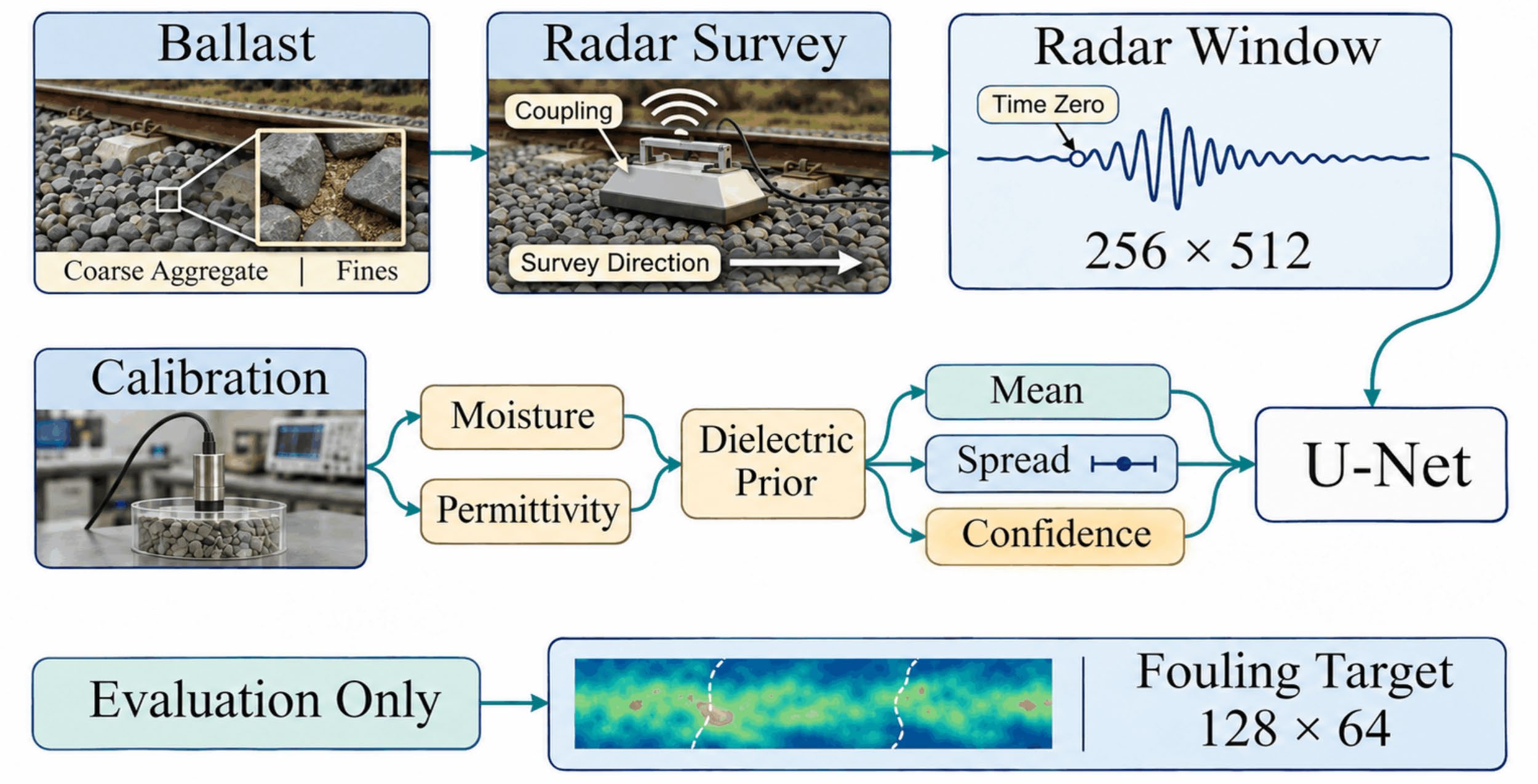
Spatially varying ballast fouling affects railway drainage and complicates ground-penetrating radar interpretation because moisture and fines produce overlapping electromagnetic responses. This study develops a dielectric prior-guided U-Net for reconstructing a two-dimensional section of continuous volumetric fouling fractions. Separate radar and dielectric encoders exchange information through confidence-gated feature fusion, while training combines supervised reconstruction, interface preservation and moisture-conditioned dielectric consistency. The reported evaluation comprises 1,200 partitioned ballast scenarios and 24,000 radar windows, with partitioning performed before window extraction. Mean absolute error decreases from 0.086 for a conventional U-Net to 0.048 for the proposed configuration, corresponding to a relative reduction of 44.2%. Structural similarity increases from 0.781 to 0.893, and intersection-over-union increases from 0.614 to 0.782 at a diagnostic fouling threshold of 0.25. Ablation comparisons associate the complete configuration with lower error than configurations omitting gating or dielectric consistency. Under a relative prior bias of 20%, error rises from 0.048 to 0.072, showing that reliability-weighted conditioning remains sensitive to calibration. These comparisons describe performance within the stated evaluation conditions; their interpretation depends on scenario provenance, reference support and independent calibration records. The method offers a framework for incorporating uncertain dielectric information into spatial ballast assessment. Transfer to operational inspection requires field validation across moisture states, antenna configurations and material domains.
References
Charoenwong, C., Connolly, D. P., Alves Costa, P., Galvín, P., & Romero, A. (2024). The effect of ballast moisture content and fouling index on railway track settlement. Transportation Geotechnics, 45, Article 101193. https://doi.org/10.1016/j.trgeo.2024.101193 DOI: https://doi.org/10.1016/j.trgeo.2024.101193
Rahman, M. H., Bhuyan, M. H., & Hayano, K. (2025). Fouling conditions and associated deformation characteristics of railway ballast. International Journal of Rail Transportation, 13(3), 425–443. https://doi.org/10.1080/23248378.2024.2363919 DOI: https://doi.org/10.1080/23248378.2024.2363919
Koohmishi, M., Kaewunruen, S., Chang, L., & Guo, Y. (2024). Advancing railway track health monitoring: Integrating GPR, InSAR and machine learning for enhanced asset management. Automation in Construction, 162, Article 105378. https://doi.org/10.1016/j.autcon.2024.105378 DOI: https://doi.org/10.1016/j.autcon.2024.105378
Bu, J., Jing, G., Long, X., Wang, L., Peng, Z., & Guo, Y. (2025). Intelligent classification of ballast bed defects using a bimodal deep learning model. Transportation Geotechnics, 50, Article 101464. https://doi.org/10.1016/j.trgeo.2024.101464 DOI: https://doi.org/10.1016/j.trgeo.2024.101464
Junkai, G., Huaifeng, S., Wei, S., Dong, L., Yuhong, Y., Yi, Z.,... & Shangbin, L. (2024). GPR-TransUNet: An improved TransUNet based on self-attention mechanism for ground penetrating radar inversion. Journal of applied geophysics, 222, 105333. https://doi.org/10.1016/j.jappgeo.2024.105333 DOI: https://doi.org/10.1016/j.jappgeo.2024.105333
Fang, Y., Tong, Z., Hei, T., Wang, S., & Ma, T. (2026). Deep learning applications in ground-penetrating radar inversion: A review. Measurement, 258, Article 119399. https://doi.org/10.1016/j.measurement.2025.119399 DOI: https://doi.org/10.1016/j.measurement.2025.119399
Sun, J., Liu, Y., Lin, Y., Xing, L., & Liu, H. (2025). Implicit multiparameter full waveform inversion of multioffset ground penetrating radar data. Geophysical Journal International, 240(2), 904–919. https://doi.org/10.1093/gji/ggae420 DOI: https://doi.org/10.1093/gji/ggae420
Aziz, I., Soltanaghai, E., Watts, A., & Alipour, M. (2024). Bayesian inversion of GPR waveforms for sub-surface material characterization: An uncertainty-aware retrieval of soil moisture and overlaying biomass properties. Remote Sensing of Environment, 313, Article 114351. https://doi.org/10.1016/j.rse.2024.114351 DOI: https://doi.org/10.1016/j.rse.2024.114351
Shapovalov, V., Arkhipov, V., Okost, M., & Morozov, A. (2026). Comparison of approaches to assessing ballast layer contamination using ground penetrating radar. International Journal of Transportation Science and Technology, 21, 286–305. https://doi.org/10.1016/j.ijtst.2025.02.001 DOI: https://doi.org/10.1016/j.ijtst.2025.02.001
Mbubia Tchoua, E., Tissier, J., Martin, A., Fargier, Y., & Ihamouten, A. (2026). The use of ground penetrating radar and artificial intelligence for automated railway trackbed stratigraphy and ballast fouling assessment. Transportation Engineering, 23, Article 100415. https://doi.org/10.1016/j.treng.2025.100415 DOI: https://doi.org/10.1016/j.treng.2025.100415
Wu, M., Liu, Q., & Ouyang, S. (2025). Two-stage GPR image inversion method based on multi-scale dilated convolution and hybrid attention gate. Remote Sensing, 17(2), Article 322. https://doi.org/10.3390/rs17020322 DOI: https://doi.org/10.3390/rs17020322
Zhang, H., Hu, Y., Wang, Q., Qian, Z., & Liu, P. (2025). End-to-end frequency enhancement framework for GPR images using domain-adaptive generative adversarial networks. Computer-Aided Civil and Infrastructure Engineering, 40(22), 3466–3482. https://doi.org/10.1111/mice.13525 DOI: https://doi.org/10.1111/mice.13525
Wang, Z., Jiang, H., Wang, W., Xu, J., Sui, Q., Gao, S., & Wang, J. (2025). A semisupervised deep learning method for ground-penetrating radar data inversion and concrete subsurface defect imaging. IEEE Transactions on Geoscience and Remote Sensing, 63, Article 4503511. https://doi.org/10.1109/tgrs.2025.3546212 DOI: https://doi.org/10.1109/TGRS.2025.3546212
Awais, M., Li, L., Zaigham Abbas Naqvi, S. M., Zhang, W., Wu, J., Tlili, I., & Hu, J. (2026). Coupling dielectric physics with calibration models for soil moisture sensing: Progress and perspectives. Ain Shams Engineering Journal, 17(2), Article 103968. https://doi.org/10.1016/j.asej.2025.103968 DOI: https://doi.org/10.1016/j.asej.2025.103968
Jiao, T., Guo, C., Feng, X., Chen, Y., & Song, J. (2024). A comprehensive survey on deep learning multi-modal fusion: Methods, technologies and applications. Computers, Materials & Continua, 80(1), 1–35. https://doi.org/10.32604/cmc.2024.053204 DOI: https://doi.org/10.32604/cmc.2024.053204
Rojas Vivanco, J., Breul, P., Talon, A., Benz-Navarrete, M. A., Barbier, S., & Ranvier, F. (2024). On site fouling index assessment of ballasted layers using cone dynamic penetrometer and miniature borescope image analysis. Transportation Geotechnics, 45, Article 101213. https://doi.org/10.1016/j.trgeo.2024.101213 DOI: https://doi.org/10.1016/j.trgeo.2024.101213
John, K., Saurette, D. D., & Heung, B. (2025). The problematic case of data leakage: A case for leave-profile-out cross-validation in 3-dimensional digital soil mapping. Geoderma, 455, Article 117223. https://doi.org/10.1016/j.geoderma.2025.117223 DOI: https://doi.org/10.1016/j.geoderma.2025.117223
Pathirana, S., Lambot, S., Krishnapillai, M., Smeaton, C., Cheema, M., & Galagedara, L. (2024). Potential of ground-penetrating radar to calibrate electromagnetic induction for shallow soil water content estimation. Journal of Hydrology, 633, Article 130957. https://doi.org/10.1016/j.jhydrol.2024.130957 DOI: https://doi.org/10.1016/j.jhydrol.2024.130957
Agaian, S. S., Grigoryan, A. M., & Ayunts, H. (2026). A survey and tutorial on image quality assessment with a contrast-weighted structural similarity framework. Information, 17(7), Article 632. https://doi.org/10.3390/info17070632 DOI: https://doi.org/10.3390/info17070632
Arthur, R. (2025). A general method for resampling autocorrelated spatial data. Geographical Analysis, 57(2), 302–319. https://doi.org/10.1111/gean.12417 DOI: https://doi.org/10.1111/gean.12417
Rojas-Vivanco, J., Benz-Navarrete, M., García, J., Breul, P., Talon, A., & Villavicencio, G. (2025). Assessment of railway ballast fouling using GPR and AI-based learning from LDCP and geoendoscopy data. Transportation Geotechnics, 55, Article 101701. https://doi.org/10.1016/j.trgeo.2025.101701 DOI: https://doi.org/10.1016/j.trgeo.2025.101701
Xu, T., Feng, D., Qin, H., Wang, X., Zhang, B., Chen, C., Li, D., Tao, X., Cai, L., Xiao, Y., & Cao, W. (2025). TGPInvNet: Deep learning-based ground-penetrating radar data inversion for tunnel geological prediction. IEEE Transactions on Geoscience and Remote Sensing, 63, Article 4511225. https://doi.org/10.1109/tgrs.2025.3641163 DOI: https://doi.org/10.1109/TGRS.2025.3641163
Lones, M. A. (2024). Avoiding common machine learning pitfalls. Patterns, 5(10), Article 101046. https://doi.org/10.1016/j.patter.2024.101046 DOI: https://doi.org/10.1016/j.patter.2024.101046
Liu, D., Zhou, M., Wang, X., Shi, Z., Sacchi, M. D., Chen, W., Liu, Z., & Wang, X. (2024). Enhancing ground-penetrating radar (GPR) data resolution through weakly supervised learning. IEEE Transactions on Geoscience and Remote Sensing, 62, Article 5107513. https://doi.org/10.1109/tgrs.2024.3410184 DOI: https://doi.org/10.1109/TGRS.2024.3410184
Hou, F., Qian, X., Meng, Q., Dong, J., & Lyu, F. (2025). Multi-scale GAN-driven GPR data inversion for monitoring urban road substructure. Automation in Construction, 174, Article 106140. https://doi.org/10.1016/j.autcon.2025.106140 DOI: https://doi.org/10.1016/j.autcon.2025.106140
Fu, L., Lan, J., & Xu, Z. (2026). Ground-penetrating radar contamination analysis method based on time–frequency features and ballast condition. Applied Sciences, 16(6), Article 2728. https://doi.org/10.3390/app16062728 DOI: https://doi.org/10.3390/app16062728
Zhan, Y., Yang, R., You, J., Huang, M., Liu, W., & Liu, X. (2025). A systematic literature review on incomplete multimodal learning: Techniques and challenges. Systems Science & Control Engineering, 13(1), Article 2467083. https://doi.org/10.1080/21642583.2025.2467083 DOI: https://doi.org/10.1080/21642583.2025.2467083
Wiecha, N., Hoppin, J. A., & Reich, B. J. (2025). Two-stage estimators for spatial confounding with point-referenced data. Biometrics, 81(3), Article ujaf093. https://doi.org/10.1093/biomtc/ujaf093 DOI: https://doi.org/10.1093/biomtc/ujaf093