
Bridge Weigh-in-Motion Axle Load Identification Using a Graph Attention Network with Moving-Load Influence-Line Encoding
Authors
Klemen Majcen, Alenka Kobal, Simona PečnikFiles
Key Information
Journal

Published in Vol. 4 No. 2 (2026) of Journal of Applied Computational Intelligence.
The Journal of Applied Computational Intelligence (JACI) eISSN:3136-6937 is a peer-reviewed, international, open-access journal dedicated to the advancement of computational intelligence methodologies and their real-world applications across diverse engineering and scientific domains. The journal aims to bridge the gap between theoretical development and practical deployment of intelligent systems by providing a scholarly platform for researchers, practitioners, and industry innovators.
JACI encourages high-quality original research, review articles, and technical reports that explore the design, implementation, and optimization of intelligent algorithms for solving complex problems in fields such as manufacturing, energy, healthcare, transportation, and information systems.
Abstract
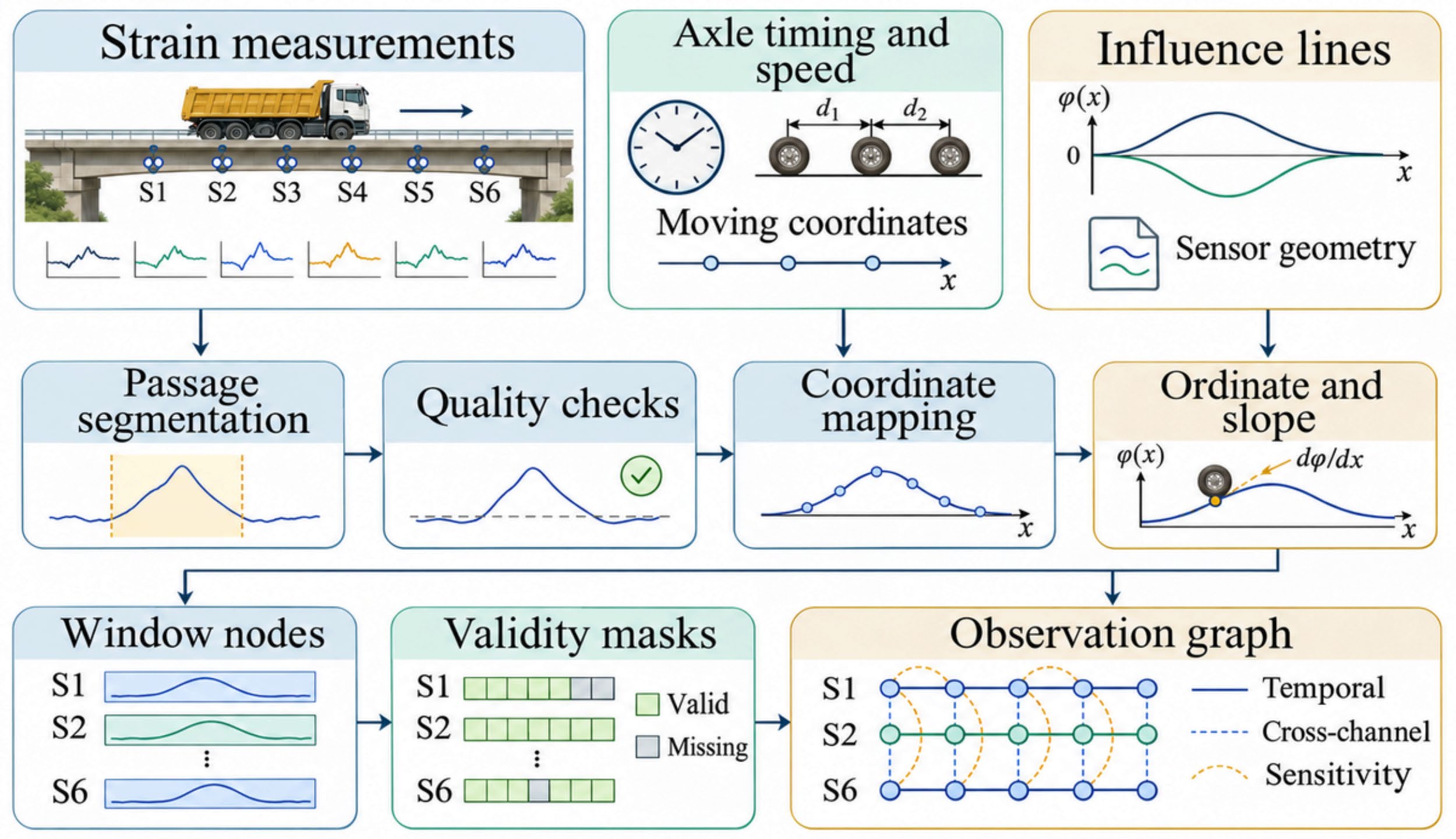
Bridge weigh in motion requires individual axle loads to be separated from structural responses that overlap in time and vary with vehicle position. This paper develops an influence line encoded graph attention framework that represents sensor windows as graph nodes and conditions message exchange on moving axle coordinates. A position dependent encoder supplies influence ordinates, local slopes, and axle separation features, while a positive regression head estimates static axle loads. A response consistency term links the predicted axle loads to reconstruction of the measured strain envelope. The evaluation benchmark comprises 12000 vehicle passages, six bridge strain channels, five speed levels, and three noise conditions. The comparison gives the proposed framework a mean axle absolute percentage error of 3.20%, compared with 6.10% for a graph attention model without influence encoding and 8.70% for regularized inversion. The 95th percentile axle error is 8.10%, and the corresponding vehicle gross weight error is 1.80%. Controlled sensitivity scenarios raise mean axle error to 5.80% under a 15% influence line perturbation and to 4.60% when two channels are unavailable. The evaluation examines overall accuracy together with condition dependent degradation and the distribution of axle errors. The framework provides a physically interpretable route for combining bridge response geometry with adaptive relational learning, and defines the calibration, uncertainty, and validation checks required before field deployment. The reported errors describe the specified benchmark and do not establish a certified weighing class or an operational acceptance threshold.
References
Rocheti, E. O., & Bacurau, R. M. (2024). Weigh-in-motion systems review: Methods for axle and gross vehicle weight estimation. IEEE Access, 12, 134822–134836. https://doi.org/10.1109/access.2024.3461653
Irawan, J., Kim, C.-W., Cantero, D., & Yokoyama, T. (2025). Revised virtual axle method for damage detection using bridge weigh-in-motion systems. Journal of Civil Structural Health Monitoring, 15(8), 3731–3742. https://doi.org/10.1007/s13349-025-01013-w
Ren, J., Li, M., Chen, Y., Zhang, Y., & Sun, Z. (2024). Semi-analytical model of vehicle-pavement-continuous beam bridge coupled system. Applied Mathematical Modelling, 131, 159–189. https://doi.org/10.1016/j.apm.2024.03.031
Yan, W., Ren, H., Luo, X., & Li, S. (2025). Hybrid-data-driven bridge weigh-in-motion technology using a two-level sequential artificial neural network. Computer-Aided Civil and Infrastructure Engineering, 40(20), 2992–3012. https://doi.org/10.1111/mice.13415
Li, C., Wu, C., & Zhang, C. (2025). Wavelet denoising based on comprehensive index optimization and improved L2 regularization for load identification. Journal of Vibration and Control, 31(7–8), 1093–1107. https://doi.org/10.1177/10775463241239790
Hussain, S., Hussain, S. M., Xin, Y., & Wang, Z.-C. (2025). Vehicle load identification based on bridge response using deep convolutional neural network. Journal of Asian Architecture and Building Engineering, 24(3), 1235–1252. https://doi.org/10.1080/13467581.2024.2328634
Ren, Z., & Zhou, Y. (2026). On cross-attention-based graph neural networks for fault diagnosis using multi-sensor measurement. Structural Health Monitoring, 25(4), 2716–2738. https://doi.org/10.1177/14759217251327760
Michaloglou, A., Papadimitriou, I., Gialampoukidis, I., Vrochidis, S., & Kompatsiaris, I. (2026). Physics-informed neural networks in materials modeling and design: A review. Archives of Computational Methods in Engineering, 33(4), 5223–5260. https://doi.org/10.1007/s11831-025-10448-9
Li, X., & Zhu, J. (2025). Identification of bridge influence line and multiple-vehicle loads based on physics-informed neural networks. Structural Health Monitoring, 24(2), 1167-1186. https://doi.org/10.1177/14759217241248570
Hongqiu, L. I., Jiang, J., & Mohamed, M. S. (2026). Research on Dynamic Load Identification Based on the Newmark-β Method and Novel Iterative Regularization Strategy. Mechanics, 32(2), 107-115. https://doi.org/10.5755/j02.mech.42732
Liangou, T., Zilakos, I., & Anyfantis, K. N. (2025). D-optimal sensor placement for load identification in wind turbine rotor blades. Journal of Intelligent Material Systems and Structures, 36(6), 411–427. https://doi.org/10.1177/1045389x251320802
Dibiantara, D. P., Adha, A., Darmawan, M. S., Imjai, T., Russell, J., & Laory, I. (2025). Spatio–temporal enhanced anomaly detection in FRP bridge monitoring using MPCA, biGRU, and attention mechanisms. Journal of Civil Structural Health Monitoring, 15(6), 1837–1855. https://doi.org/10.1007/s13349-025-00913-1
Masciotta, M. G., Barontini, A., Pellegrini, D., Brando, G., & Lourenço, P. B. (2024). Optimal sensor placement for bridge structural health monitoring: Integration of physics-based models with data-driven approaches. Procedia Structural Integrity, 62, 932–939. https://doi.org/10.1016/j.prostr.2024.09.125
Mardani, K., Vretos, N., & Daras, P. (2024). Mahalanobis distance-based graph attention networks. IEEE Access, 12, 166923–166935. https://doi.org/10.1109/access.2024.3495531
Shen, S., & Málaga‐Chuquitaype, C. (2026). Learning rocking dynamics from sparse shake-table data with interpretable physics-informed neural networks. Earthquake Engineering & Structural Dynamics, 55(12), 3115–3136. https://doi.org/10.1002/eqe.70239
Shi, S., Yarnold, M., Hurlebaus, S., & Mander, J. (2025). Evaluation of a load cell-based bridge weigh-in-motion system. Transportation Research Record: Journal of the Transportation Research Board, 2679(2), 535–549. https://doi.org/10.1177/03611981241263336
Schlieper, P., Dombrowski, M., Nguyen, A., Zanca, D., & Eskofier, B. (2024). Data-centric benchmarking of neural network architectures for the univariate time series forecasting task. Forecasting, 6(3), 718–747. https://doi.org/10.3390/forecast6030037
Wang, Y., Li, S., & Wei, N. (2024). Dynamic response impact of vehicle braking on simply supported beam bridges with corrugated steel webs based on vehicle-bridge coupled vibration analysis. Computer Modeling in Engineering & Sciences, 139(3), 3467–3493. https://doi.org/10.32604/cmes.2024.046454
Mo, S., Chen, K., Huang, Z., & Zhang, W. (2024). Dynamic analysis and optimization of vehicle-bridge interaction system under road roughness and time variability of element interpolation function. Transportation Research Record: Journal of the Transportation Research Board, 2678(8), 294–309. https://doi.org/10.1177/03611981231215336
Pan, Q., & Bao, Y. (2026). A hybrid attention hierarchical network-based extreme event detection method for structural health monitoring. Structural Health Monitoring, 25(6), 3882–3901. https://doi.org/10.1177/14759217251322943
Wang, Y., Yang, D., Yuan, Y., Zhang, J., & Au, F. T. K. (2025). Hybrid physics-informed neural network with parametric identification for modeling bridge temperature distribution. Computer-Aided Civil and Infrastructure Engineering, 40(22), 3503–3524. https://doi.org/10.1111/mice.13436
Barontini, A., Masciotta, M. G., Lourenço, P. B., & Brando, G. (2026). Compare stochastic optimal sensor placement strategies for bridge monitoring. Procedia Structural Integrity, 84, 352–359. https://doi.org/10.1016/j.prostr.2026.06.046
Naseri, R., Mohammadzadeh, S., & Rizos, D. C. (2025). Rail surface spot irregularity effects in vehicle-track interaction simulations of train-track-bridge interaction. Journal of Vibration and Control, 31(5–6), 738–752. https://doi.org/10.1177/10775463241232024
Barr, B. L., McIntosh, V. V. W., Britt, E. F., Jordan, J., & Carter, J. D. (2024). Visualizing agreement: Bland–Altman plots as a supplement to inter-rater reliability indices. Measurement: Interdisciplinary Research and Perspectives, 22(2), 175–187. https://doi.org/10.1080/15366367.2023.2246114
Hansen, B. E. (2025). Standard errors for difference-in-difference regression. Journal of Applied Econometrics, 40(3), 291–309. https://doi.org/10.1002/jae.3110
Gibbs, I., Cherian, J. J., & Candès, E. J. (2025). Conformal prediction with conditional guarantees. Journal of the Royal Statistical Society Series B: Statistical Methodology, 87(4), 1100–1126. https://doi.org/10.1093/jrsssb/qkaf008
Alibekov, M. R., Berezina, N. E., Vasiliev, E. P., Vikhrev, I. B., Kamelina, Y. D., Kustikova, V. D., Maslova, Z. A., Mukhin, I. S., Sidorova, A. K., & Suchkov, V. N. (2024). Performance analysis methodology of deep neural networks inference on the example of an image classification problem. Numerical Methods and Programming (Vychislitel'nye Metody i Programmirovanie), 25(2), 127–141. https://doi.org/10.26089/nummet.v25r211
Šoberl, D., Kalin, J., Anžlin, A., Kreslin, M., Čopič Pucihar, K., Kljun, M., Hekič, D., & Žnidarič, A. (2025). Enhanced precision in axle configuration inference for bridge weigh-in-motion systems using computer vision and deep learning. Computer-Aided Civil and Infrastructure Engineering, 40(30), 6201–6216. https://doi.org/10.1111/mice.70144
