Transformer Model for Rail Squat Classification with Lift off Invariant Eddy Current Embeddings
Authors
Oktay Savaş, Mesut RaufFiles
Key Information
Journal

Published in Vol. 4 No. 2 (2026) of Journal of Applied Computational Intelligence.
The Journal of Applied Computational Intelligence (JACI) eISSN:3136-6937 is a peer-reviewed, international, open-access journal dedicated to the advancement of computational intelligence methodologies and their real-world applications across diverse engineering and scientific domains. The journal aims to bridge the gap between theoretical development and practical deployment of intelligent systems by providing a scholarly platform for researchers, practitioners, and industry innovators.
JACI encourages high-quality original research, review articles, and technical reports that explore the design, implementation, and optimization of intelligent algorithms for solving complex problems in fields such as manufacturing, energy, healthcare, transportation, and information systems.
Abstract
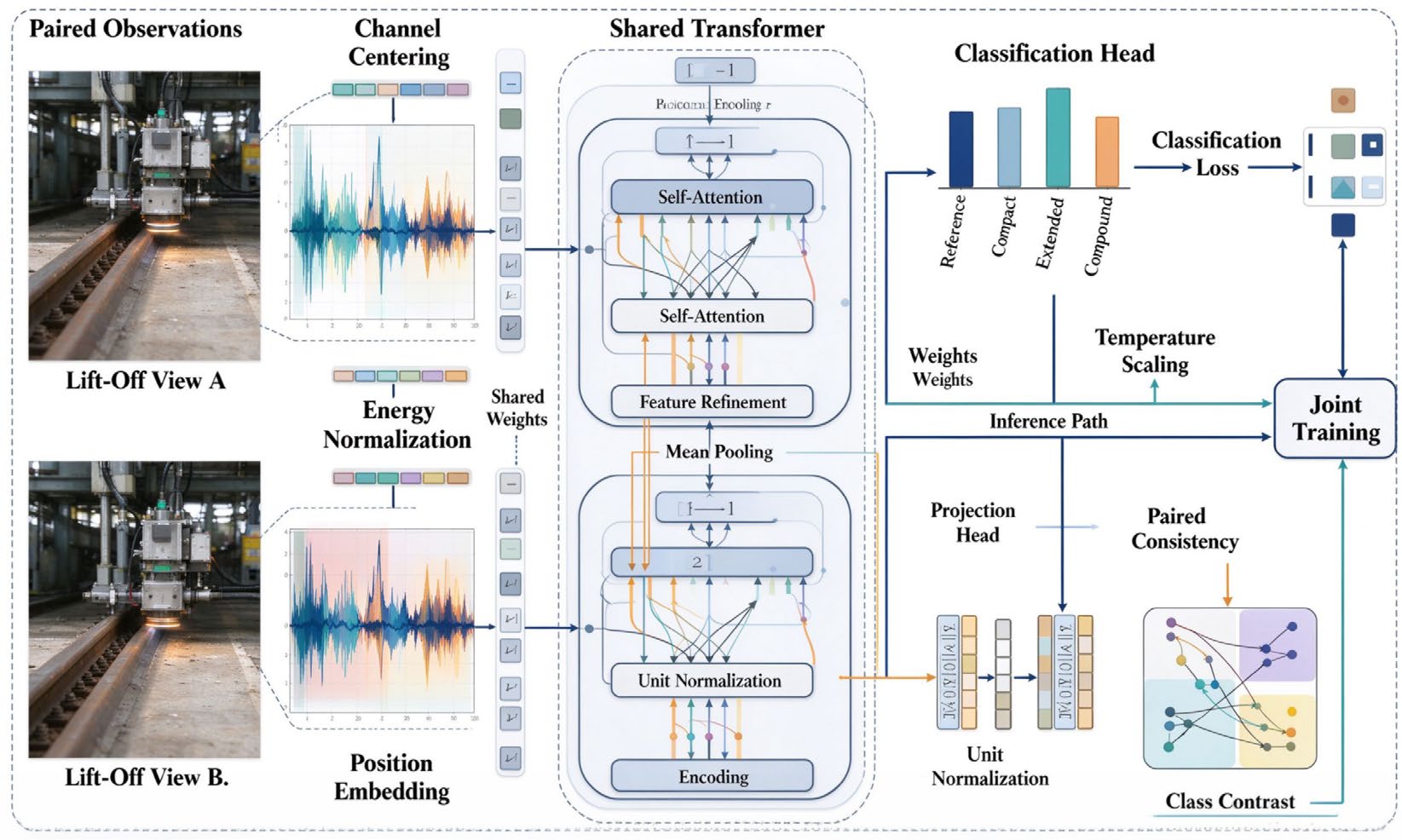
Probe lift-off changes the amplitude, phase and spatial extent of eddy-current responses, complicating classification of rail- squat indication morphology. This study evaluates a two-layer Transformer with lift-off-invariant projected embeddings on a declared numerical response family. Three complex observation channels at nominal excitation settings 25, 50 and 100 kHz are sampled at 96 positions across an 80 mm window. Training-derived channel standardization, window centering and common energy normalization precede 24 ordered spatial tokens. Paired observations of one geometry receive a consistency objective, while supervised contrastive learning organizes projected vectors by four reference families: reference, compact, extended and compound. Independent geometry partitions contain 1,200 training, 320 validation and 640 held-out sources. Each held-out geometry is observed in a seen lift-off interval of 0.5-2.5 mm and an unseen interval of 2.8-4.0 mm. Under the unseen condition, the full model reaches 97.19% accuracy and macro-F1 0.9720, versus 95.00% and 0.9500 for a raw-input Transformer. Its paired-embedding cosine similarity is 0.9655, compared with 0.9226 for the raw model, and seen-range ridge-probe lift-off R squared is 0.0684 versus 0.3491. A class-only objective reaches higher unseen accuracy of 98.28% in the primary run. Validation-selected temperature 0.5 increases unseen expected calibration error from 0.0155 to 0.0241, indicating weaker probability transfer than class decision transfer. At 4.1-5.0 mm lift-off, full-model accuracy is 73.28%; added noise and central evidence gaps yield 76.56% and 74.53%. These outcomes distinguish classification, representation consistency and confidence within the synthetic condition-shift setting.
References
Quercio, M., Santoro, L., Sesana, R., & Riganti Fulginei, F. (2025). Advanced feature analysis of eddy current testing signals for rail surface defect characterization. IEEE Access, 13, 141156–141169. https://doi.org/10.1109/ACCESS.2025.3597079
Shao, Y., Xia, Z., Ding, Y., Crocker, B., Saunders, S., Bai, X., Peyton, A., Conniffe, D., & Yin, W. (2024). Eddy current sensor array for electromagnetic sensing and crack reconstruction with high lift-off in railway tracks. Sensors, 24(13), 4216. https://doi.org/10.3390/s24134216
Ma, Q., Tian, G., Gao, B., Robinson, M., Yang, C., & Ibrahim, E. T. (2024). Novel common-differential inductance coils with dual signal conditionings for separation of lift-off and defects. IEEE Sensors Journal, 24(2), 2055–2065. https://doi.org/10.1109/JSEN.2023.3336066
Rath, M., & Condurache, A. P. (2024). Boosting deep neural networks with geometrical prior knowledge: A survey. Artificial Intelligence Review, 57, 95. https://doi.org/10.1007/s10462-024-10722-5
Khoee, A. G., Yu, Y., & Feldt, R. (2024). Domain generalization through meta-learning: A survey. Artificial Intelligence Review, 57, 285. https://doi.org/10.1007/s10462-024-10922-z
Sasse, L., Nicolaisen-Sobesky, E., Dukart, J., Eickhoff, S. B., Götz, M., Hamdan, S., Komeyer, V., Kulkarni, A., Lahnakoski, J. M., Love, B. C., Raimondo, F., & Patil, K. R. (2025). Overview of leakage scenarios in supervised machine learning. Journal of Big Data, 12, 135. https://doi.org/10.1186/s40537-025-01193-8
Hu, H., Wang, X., Zhang, Y., Chen, Q., & Guan, Q. (2024). A comprehensive survey on contrastive learning. Neurocomputing, 610, 128645. https://doi.org/10.1016/j.neucom.2024.128645
Zhang, K., Wen, Q., Zhang, C., Cai, R., Jin, M., Liu, Y., Zhang, J. Y., Liang, Y., Pang, G., Song, D., & Pan, S. (2024). Self-supervised learning for time series analysis: Taxonomy, progress, and prospects. IEEE Transactions on Pattern Analysis and Machine Intelligence, 46(10), 6775–6794. https://doi.org/10.1109/TPAMI.2024.3387317
Balanya, S. A., Maroñas, J., & Ramos, D. (2024). Adaptive temperature scaling for robust calibration of deep neural networks. Neural Computing and Applications, 36(14), 8073–8095. https://doi.org/10.1007/s00521-024-09505-4
Li, Y., Xia, Z., She, S., Shao, Y., Yang, Y., & Yin, W. (2025). A Mobius transformation-based liftoff effect reduction method for crack classification and prediction in eddy current testing. NDT & E International, 149, 103261. https://doi.org/10.1016/j.ndteint.2024.103261
Cho, Y. S., & Kim, S. B. (2024). Supervised contrastive learning for multisensor signals classification in automobile engine manufacturing. IEEE Transactions on Industrial Informatics, 20(5), 7764–7776. https://doi.org/10.1109/TII.2024.3363189
Abdullahi, M., Alhussian, H., Aziz, N., Abdulkadir, S. J., Khairy, S. O. F., Bala, A., Adamu, S., & Yunus, R. B. (2026). A systematic literature review and taxonomy of normalization techniques in training DNNs for time-series data. Neurocomputing, 696, 134095. https://doi.org/10.1016/j.neucom.2026.134095
Meng, B., Zhuang, Z., Ma, J., & Zhao, S. (2025). A pulsed eddy current data-driven interpretable neural network for metallic foreign objects’ characteristics identification. IEEE Sensors Journal, 25(19), 35835–35843. https://doi.org/10.1109/JSEN.2025.3598371
Uelwer, T., Robine, J., Wagner, S. S., Höftmann, M., Upschulte, E., Konietzny, S., Behrendt, M., & Harmeling, S. (2025). A survey on self-supervised methods for visual representation learning. Machine Learning, 114, 111. https://doi.org/10.1007/s10994-024-06708-7
Cui, J., Zhong, Z., Tian, Z., Liu, S., Yu, B., & Jia, J. (2024). Generalized parametric contrastive learning. IEEE Transactions on Pattern Analysis and Machine Intelligence, 46(12), 7463–7474. https://doi.org/10.1109/TPAMI.2023.3278694
Zhong, Y., Zhou, W., & Wang, Z. (2025). A survey of data augmentation in domain generalization. Neural Processing Letters, 57, 34. https://doi.org/10.1007/s11063-025-11747-9
Abbasi, M., & Saeedi, P. (2024). Enhancing multivariate time series classifiers through self-attention and relative positioning infusion. IEEE Access, 12, 67273–67290. https://doi.org/10.1109/ACCESS.2024.3397783
Lones, M. A. (2024). Avoiding common machine learning pitfalls. Patterns, 5(10), 101046. https://doi.org/10.1016/j.patter.2024.101046
Wu, Y., Shi, B., Dong, B., & Zheng, Q. (2026). TransTS: An adaptive post-hoc method for probability calibration under label noise. Science China Information Sciences, 69, 122105. https://doi.org/10.1007/s11432-025-4576-9
Apicella, A., Isgrò, F., & Prevete, R. (2025). Don’t push the button! Exploring data leakage risks in machine learning and transfer learning. Artificial Intelligence Review, 58, 339. https://doi.org/10.1007/s10462-025-11326-3
Migus, P. (2026). Newton–Puiseux analysis for interpretability and calibration of complex-valued neural networks. Neural Networks, 195, 108172. https://doi.org/10.1016/j.neunet.2025.108172
Ilbert, R., Hoang, T. V., & Zhang, Z. (2024). Data augmentation for multivariate time series classification: An experimental study. In 2024 IEEE 40th International Conference on Data Engineering Workshops (ICDEW) (pp. 128–139). IEEE. https://doi.org/10.1109/ICDEW61823.2024.00023
Babu, M. A. A., Pandey, S. K., Durisic, D., Koppisetty, A. C., & Staron, M. (2025). D-LeDe: A data leakage detection method for automotive perception systems. In Proceedings of the 11th International Conference on Vehicle Technology and Intelligent Transport Systems (pp. 210–221). SciTePress. https://doi.org/10.5220/0013476700003941
Mohammadi Foumani, N., Miller, L., Tan, C. W., Webb, G. I., Forestier, G., & Salehi, M. (2024). Deep learning for time series classification and extrinsic regression: A current survey. ACM Computing Surveys, 56(9), Article 217, 1–45. https://doi.org/10.1145/3649448
Opitz, J. (2024). A closer look at classification evaluation metrics and a critical reflection of common evaluation practice. Transactions of the Association for Computational Linguistics, 12, 820–836. https://doi.org/10.1162/tacl_a_00675
Middlehurst, M., Schäfer, P., & Bagnall, A. (2024). Bake off redux: A review and experimental evaluation of recent time series classification algorithms. Data Mining and Knowledge Discovery, 38(4), 1958–2031. https://doi.org/10.1007/s10618-024-01022-
Klabunde, M., Schumacher, T., Strohmaier, M., & Lemmerich, F. (2025). Similarity of neural network models: A survey of functional and representational measures. ACM Computing Surveys, 57(9), Article 242, 1–52. https://doi.org/10.1145/3728458
Waldis, A., Perlitz, Y., Choshen, L., Hou, Y., & Gurevych, I. (2024). Holmes ⌕ A benchmark to assess the linguistic competence of language models. Transactions of the Association for Computational Linguistics, 12, 1616–1647. https://doi.org/10.1162/tacl_a_00718
Li, T., Guo, X., & Ji, C. (2025). A literature survey of shapelet quality measures for time series classification. PeerJ Computer Science, 11, e3115. https://doi.org/10.7717/peerj-cs.3115
Liu, M., Sheng, H., Zhang, N., Zhao, P., Yi, Y., Jiang, Y., & Dai, J. (2024). DSDCLNet: Dual-stream encoder and dual-level contrastive learning network for supervised multivariate time series classification. Knowledge-Based Systems, 292, 111638. https://doi.org/10.1016/j.knosys.2024.111638
Dong, C. G., Li, Z. D., Zheng, L. N., Chen, W., & Zhang, W. E. (2024). Boosting certificate robustness for time series classification with efficient self-ensemble. In Proceedings of the 33rd ACM International Conference on Information and Knowledge Management (pp. 477–486). ACM. https://doi.org/10.1145/3627673.3679748
Dong, J., Jiang, Z., Pan, D., Chen, Z., Guan, Q., Zhang, H., Gui, G., & Gui, W. (2025). A survey on confidence calibration of deep learning-based classification models under class imbalance data. IEEE Transactions on Neural Networks and Learning Systems, 36(9), 15664–15684. https://doi.org/10.1109/TNNLS.2025.3565159
Vos, G., van Eijk, L., Sarnyai, Z., & Rahimi Azghadi, M. (2025). Stabilizing machine learning for reproducible and explainable results: A novel validation approach to subject-specific insights. Computer Methods and Programs in Biomedicine, 269, 108899. https://doi.org/10.1016/j.cmpb.2025.108899
He, Z., Li, Z., Dong, J., Liu, X., Jiang, M., & Hu, L. (2025). Conjunction subspaces test for conformal and selective classification. Information Sciences, 707, 122037. https://doi.org/10.1016/j.ins.2025.122037
Semmelrock, H., Ross-Hellauer, T., Kopeinik, S., Theiler, D., Haberl, A., Thalmann, S., & Kowald, D. (2025). Reproducibility in machine-learning-based research: Overview, barriers, and drivers. AI Magazine, 46(2), e70002. https://doi.org/10.1002/aaai.70002