Predicting Lattice Crushing Response with Contact State Gated MeshGraphNets
Authors
Vasilica Gheorghiu, Rareșa Ciobanu, Horia Georgescu, Livia KovașiFiles
Key Information
Journal

Published in Vol. 4 No. 1 (2026) of Journal of Applied Computational Intelligence.
The Journal of Applied Computational Intelligence (JACI) eISSN:3136-6937 is a peer-reviewed, international, open-access journal dedicated to the advancement of computational intelligence methodologies and their real-world applications across diverse engineering and scientific domains. The journal aims to bridge the gap between theoretical development and practical deployment of intelligent systems by providing a scholarly platform for researchers, practitioners, and industry innovators.
JACI encourages high-quality original research, review articles, and technical reports that explore the design, implementation, and optimization of intelligent algorithms for solving complex problems in fields such as manufacturing, energy, healthcare, transportation, and information systems.
Abstract
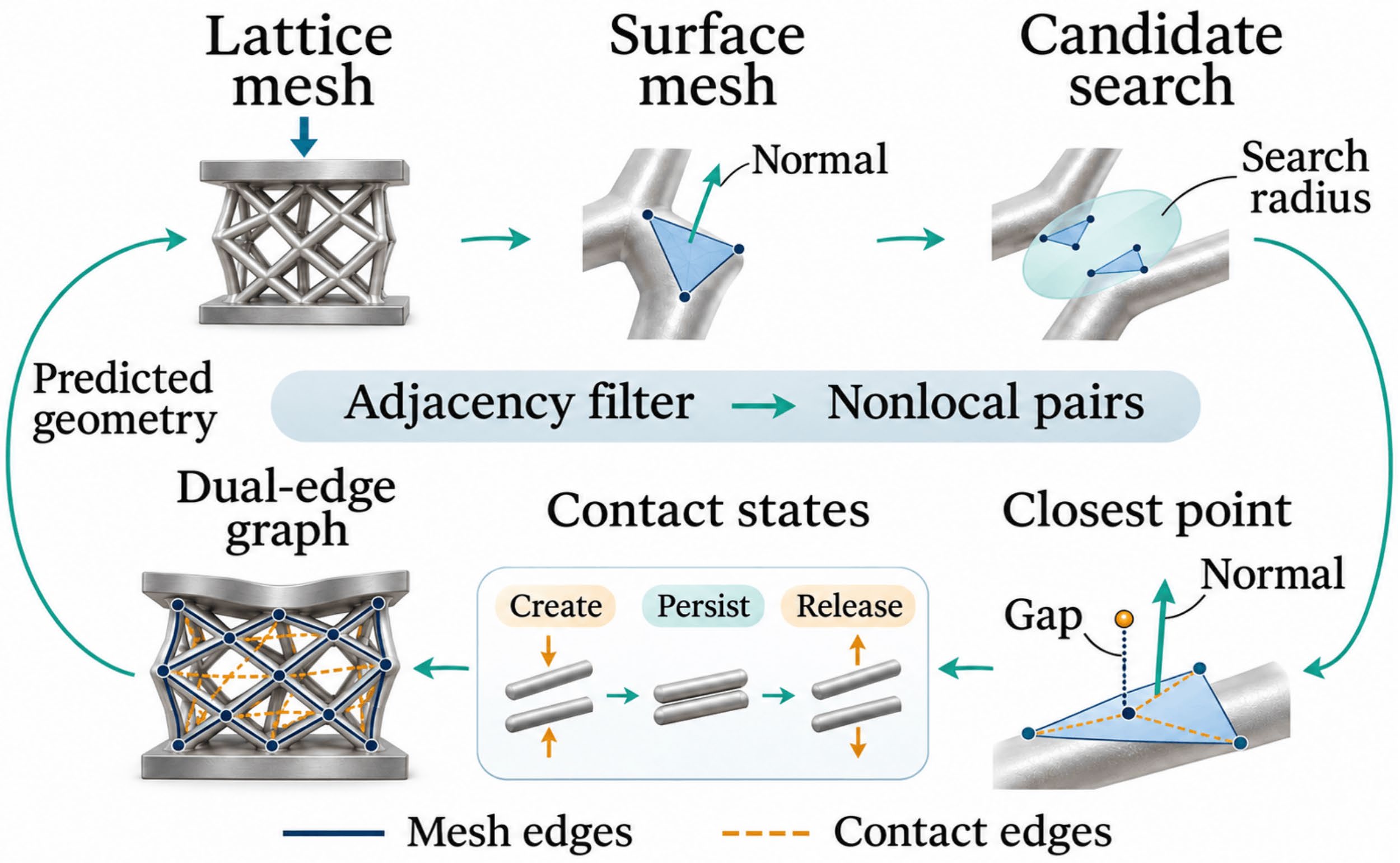
Lattice crushing involves evolving load paths, irreversible deformation, and intermittent contact between members that are distant in the undeformed mesh. A surrogate restricted to structural connectivity may therefore miss the interactions that govern compaction. This paper proposes a contact state gated MeshGraphNets model for predicting nodal motion and platen reaction during displacement-controlled compression. The formulation combines permanent mesh edges with dynamically updated surface contact edges, using geometric gaps, relative velocities, and edge persistence to distinguish approaching, sustained, and separating interactions. A short rollout objective couples state prediction with reaction consistency and penetration control. The evaluation design considers 480 trajectories spanning three lattice families, with geometry separated training, validation, and test partitions. Across the comparison, median normalized displacement error decreases from 8.4% for a mesh only baseline to 3.2% for the proposed model, while reaction curve error decreases from 12.6% to 4.8%. Maximum penetration decreases from 0.31 to 0.06 mm, and the proposed rollout requires 18 s against a 720 s reference solve. The evaluation tracks both local geometric admissibility and the global force response throughout compaction. The proposed protocol distinguishes contact representation from processor capacity through controlled ablations and evaluates compaction, generalization, and computational cost separately. The formulation establishes a testable route toward contact sensitive surrogates, with separate criteria for prediction accuracy, contact admissibility, and computational efficiency. The present scope is monotonic compression of intact elastoplastic lattices; fracture, unloading, and impact conditions require separate validation.
References
Bieler, S., & Weinberg, K. (2025). Energy absorption of sustainable lattice structures under static compression. Meccanica, 60(8), 2533–2547. https://doi.org/10.1007/s11012-025-02003-4
Yu, Z., Savinov, R., Matura, M., Zhang, P., & Shi, J. (2025). Current research status on advanced lattice structures for impact and energy absorption applications: A systematic review. Thin-Walled Structures, 215, Article 113490. https://doi.org/10.1016/j.tws.2025.113490
Ding, J., Ma, Q., Li, X., Zhang, L., Yang, H., Qu, S., Wang, M. Y., Zhai, W., Gao, H., & Song, X. (2024). Imperfection-enabled strengthening of ultra-lightweight lattice materials. Advanced Science, 11(41), Article 2402727. https://doi.org/10.1002/advs.202402727
Daynes, S., & Feih, S. (2025). Functionally graded lattice structures with tailored stiffness and energy absorption. International Journal of Mechanical Sciences, 285, Article 109861. https://doi.org/10.1016/j.ijmecsci.2024.109861
Maddio, P. D., Sinatra, R., & Cammarata, A. (2026). A novel 2D penalty formulation for frictionless contact. Multibody System Dynamics, 67(1), 221–245. https://doi.org/10.1007/s11044-025-10119-4
Guo, Z., Yang, F., Li, L., & Wu, J. (2024). Bio-inspired curved-elliptical lattice structures for enhanced mechanical performance and deformation stability. Materials, 17(17), Article 4191. https://doi.org/10.3390/ma17174191
Scheunemann, L., & Faust, E. (2026). A manifold learning approach to nonlinear model order reduction of quasi-static problems in solid mechanics: Proof of concept and parameter study. Computational Mechanics, 77(4), 983–1023. https://doi.org/10.1007/s00466-025-02696-0
Storm, J., Rocha, I. B. C. M., & van der Meer, F. P. (2024). A microstructure-based graph neural network for accelerating multiscale simulations. Computer Methods in Applied Mechanics and Engineering, 427, Article 117001. https://doi.org/10.1016/j.cma.2024.117001
Dubey, V. K., Haese, C. E., Gültekin, O., Dalton, D., Rausch, M. K., & Fuhg, J. (2026). Graph neural network surrogates for contacting deformable bodies with necessary and sufficient contact detection. Computer Methods in Applied Mechanics and Engineering, 448, Article 118413. https://doi.org/10.1016/j.cma.2025.118413
Prakash, S. K. A., & Tucker, C. (2024). Probabilistic graph networks for learning physics simulations. Journal of Computational Physics, 513, Article 113137. https://doi.org/10.1016/j.jcp.2024.113137
Gongora, A. E., Friedman, C., Newton, D. K., Yee, T. D., Doorenbos, Z., Giera, B., Duoss, E. B., Han, T. Y.-J., Sullivan, K., & Rodriguez, J. N. (2024). Accelerating the design of lattice structures using machine learning. Scientific Reports, 14(1), Article 13703. https://doi.org/10.1038/s41598-024-63204-7
Vlachas, K., Garland, A., Quinn, D. D., & Chatzi, E. (2024). Parametric reduced-order modeling for component-oriented treatment and localized nonlinear feature inclusion. Nonlinear Dynamics, 112(5), 3399–3420. https://doi.org/10.1007/s11071-023-09213-z
Kneifl, J., Fehr, J., Brunton, S. L., & Kutz, J. N. (2025). Multi-hierarchical surrogate learning for explicit structural dynamical systems using graph convolutional neural networks. Computational Mechanics, 75(3), 1115–1135. https://doi.org/10.1007/s00466-024-02553-6
Würth, T., Freymuth, N., Zimmerling, C., Neumann, G., & Kärger, L. (2024). Physics-informed MeshGraphNets (PI-MGNs): Neural finite element solvers for non-stationary and nonlinear simulations on arbitrary meshes. Computer Methods in Applied Mechanics and Engineering, 429, Article 117102. https://doi.org/10.1016/j.cma.2024.117102
Gladstone, R. J., Rahmani, H., Suryakumar, V., Meidani, H., D’Elia, M., & Zareei, A. (2024). Mesh-based GNN surrogates for time-independent PDEs. Scientific Reports, 14(1), Article 3394. https://doi.org/10.1038/s41598-024-53185-y
Perera, R., & Agrawal, V. (2024). Multiscale graph neural networks with adaptive mesh refinement for accelerating mesh-based simulations. Computer Methods in Applied Mechanics and Engineering, 429, Article 117152. https://doi.org/10.1016/j.cma.2024.117152
Pegolotti, L., Pfaller, M. R., Rubio, N. L., Ding, K., Brugarolas Brufau, R., Darve, E., & Marsden, A. L. (2024). Learning reduced-order models for cardiovascular simulations with graph neural networks. Computers in Biology and Medicine, 168, Article 107676. https://doi.org/10.1016/j.compbiomed.2023.107676
Dornheim, J., Morand, L., Nallani, H. J., & Helm, D. (2024). Neural networks for constitutive modeling: From universal function approximators to advanced models and the integration of physics. Archives of Computational Methods in Engineering, 31(2), 1097–1127. https://doi.org/10.1007/s11831-023-10009-y
Bernard, A. R., & ElSayed, M. S. A. (2024). Design, manufacturing, and analysis of periodic three-dimensional cellular materials for energy absorption applications: A critical review. Materials, 17(10), Article 2181. https://doi.org/10.3390/ma17102181
Li, L., Yang, F., Guo, Z., Wu, J., Lu, G., & Fan, H. (2024). Truss-plate hybrid lattice metamaterials with broadband vibration attenuation and enhanced energy absorption. Virtual and Physical Prototyping, 19(1), Article e2345386. https://doi.org/10.1080/17452759.2024.2345386
Dai, X., Kövecses, J., & Teichmann, M. (2024). Dynamic simulation and collision detection for flexible mechanical systems with contact using the floating frame of reference formulation. Journal of Computational and Nonlinear Dynamics, 19(11), Article 111005. https://doi.org/10.1115/1.4066329
Fatoretto, M. B., Demétrio, C. G. B., Brophy, C., & de Andrade Moral, R. (2026). Bootstrap confidence intervals for generalized linear mixed models in dose-response analysis. Journal of Statistical Computation and Simulation, 96(14), 3630–3653. https://doi.org/10.1080/00949655.2026.2677023
Bozkurt, I. (2024). Determination of deformation behaviors and energy absorption of lightweight composite lattice cylinders with different structures. International Journal of Polymer Science, 2024(1), Article 2280726. https://doi.org/10.1155/2024/2280726
Du, Y., Li, Y., Coros, S., & Thomaszewski, B. (2024). Robust and artefact-free deformable contact with smooth surface representations. Computer Graphics Forum, 43(8), Article e15187. https://doi.org/10.1111/cgf.15187
Raymundo, C., Pérez-Zuñiga, G., & Yupanqui, I. (2026). Phase-dependent nonlinear MPC for stair climbing: Edge-pivot control with a double-pendulum model. Results in Control and Optimization, 22, Article 100675. https://doi.org/10.1016/j.rico.2026.100675
Kängsepp, M., Valk, K., & Kull, M. (2025). On the usefulness of the fit-on-test view on evaluating calibration of classifiers. Machine Learning, 114(4), Article 105. https://doi.org/10.1007/s10994-024-06652-6
Gao, J., & McShane, G. J. (2026). Using heterogeneous fold patterns to manipulate the compressive collapse mechanisms of ductile origami-inspired metamaterials. International Journal of Mechanical Sciences, 314, Article 111377. https://doi.org/10.1016/j.ijmecsci.2026.111377
Ma, J. (2024). A survey of out-of-distribution generalization for graph machine learning from a causal view. AI Magazine, 45(4), 537–548. https://doi.org/10.1002/aaai.12202
Phan, Q. M., & Luong, N. H. (2024). Parameter-less Pareto local search for multi-objective neural architecture search with the Interleaved Multi-start Scheme. Swarm and Evolutionary Computation, 87, Article 101573. https://doi.org/10.1016/j.swevo.2024.101573
Geiß, A., Hovi, T., Calotoiu, A., & Wolf, F. (2026). Validating the performance of GPU ports using differential performance models. Future Generation Computer Systems, 174, Article 108018. https://doi.org/10.1016/j.future.2025.108018