
Evaluating Pairwise Resource Contention Features in a CatBoost Model for GPU Colocation Slowdown Prediction
Authors
Barbara Danijela Galić, Bojana Tomašević, Adrijana Budimir, Karla KlarićFiles
Key Information
Journal
Published in Vol. 4 No. 1 (2026) of Journal of Applied Computational Intelligence.
The Journal of Applied Computational Intelligence (JACI) eISSN:3136-6937 is a peer-reviewed, international, open-access journal dedicated to the advancement of computational intelligence methodologies and their real-world applications across diverse engineering and scientific domains. The journal aims to bridge the gap between theoretical development and practical deployment of intelligent systems by providing a scholarly platform for researchers, practitioners, and industry innovators.
JACI encourages high-quality original research, review articles, and technical reports that explore the design, implementation, and optimization of intelligent algorithms for solving complex problems in fields such as manufacturing, energy, healthcare, transportation, and information systems.
Abstract
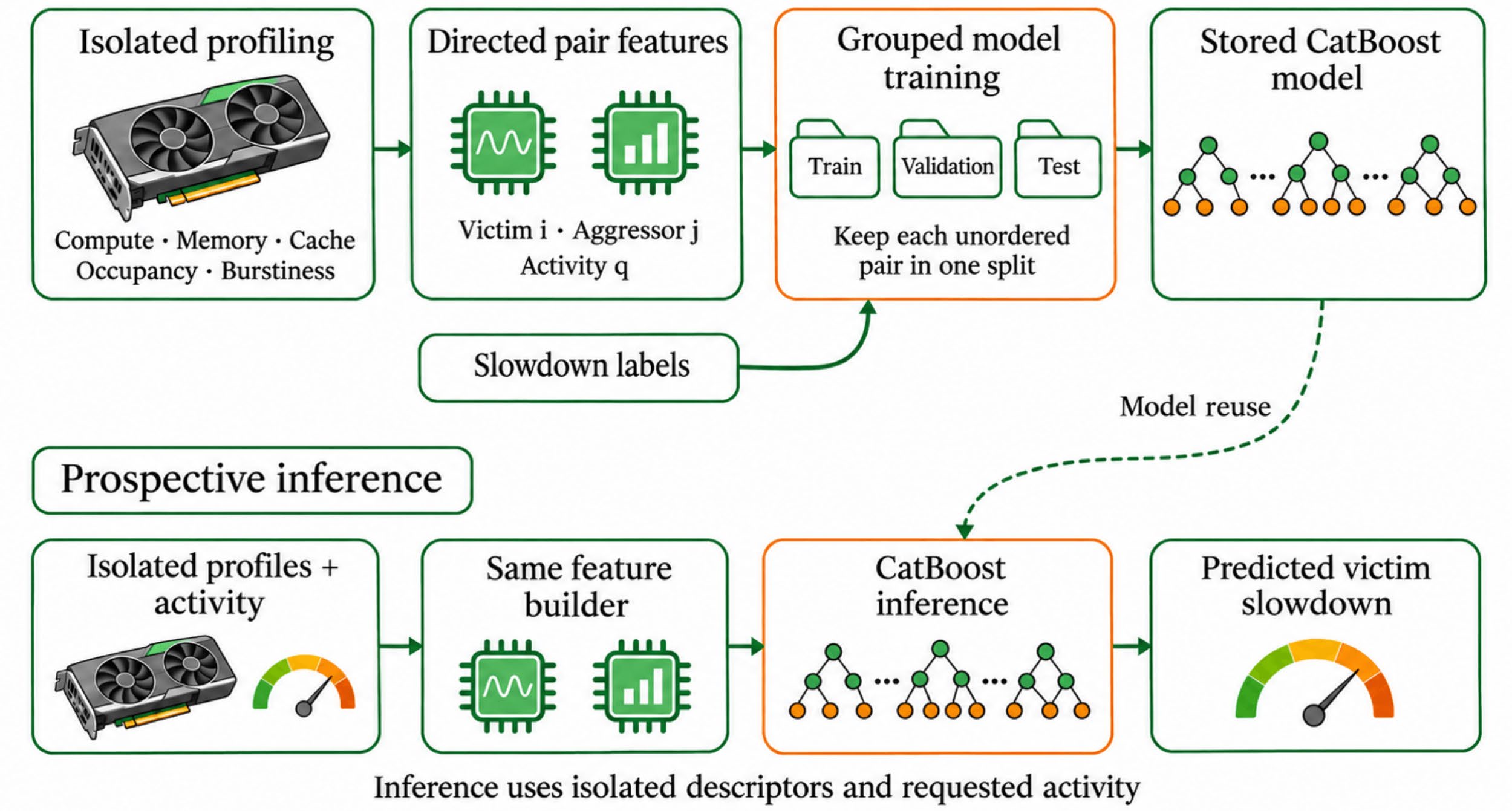
Predicting interference before colocating graphics processing unit workloads requires a representation of how their resource demands interact. Isolated utilization measurements describe individual workloads, while shared bottlenecks and directional interference require interaction descriptors. This study develops a CatBoost regression framework that augments isolated profiles with resource products, capacity exceedance terms, and directional differences. The target is the ratio between colocated and isolated completion times for a designated victim workload. A reproducible benchmark contains 36 workload profiles, 1,260 directed workload pairs, and three aggressor activity levels, producing 3,780 observations. Unordered pair grouping prevents reversed pairs and repeated activity levels from crossing the training and test boundary. Five regressors are compared using identical partitions, while a separate workload holdout examines transfer beyond familiar profiles. The pairwise CatBoost model obtains a test mean absolute error of 0.02834 and a mean absolute percentage error of 1.631%, compared with 0.02615 mean absolute error for CatBoost using isolated descriptors alone. Its coefficient of determination is 0.97571, and its error on the workload holdout is 0.03381. Six data figures examine prediction dispersion, residual structure, feature dependence, sample efficiency, and decision sensitivity alongside aggregate accuracy. The findings characterize the proposed representation under a fixed evaluation protocol and identify the resource and response regions that merit closer assessment before deployment. The ablation does not establish an accuracy advantage for the pairwise feature expansion under the reported settings.
References
Huang, J., Lin, W., Wu, W., Wang, Y., Zhong, H., Wang, X., & Li, K. (2025). On efficiency, fairness and security in AI accelerator resource sharing: A survey. ACM Computing Surveys, 57(9), 1–35. https://doi.org/10.1145/3721427
Bechtel, M. G., & Yun, H. (2024). Analysis and mitigation of shared resource contention on heterogeneous multicore: An industrial case study. IEEE Transactions on Computers, 73(7), 1753–1766. https://doi.org/10.1109/tc.2024.3386059
Han, Z., Zhou, R., Xu, C., Zeng, Y., & Zhang, R. (2024). InSS: An intelligent scheduling orchestrator for multi-GPU inference with spatio-temporal sharing. IEEE Transactions on Parallel and Distributed Systems, 35(10), 1735–1748. https://doi.org/10.1109/tpds.2024.3430063
Ali, S. W., Tong, Z., Goh, J., & Anderson, J. H. (2024). Predictable GPU sharing in component-based real-time systems. In R. Pellizzoni (Ed.), 36th Euromicro Conference on Real-Time Systems (ECRTS 2024) (Leibniz International Proceedings in Informatics, Vol. 298, pp. 15:1–15:22). Schloss Dagstuhl–Leibniz-Zentrum für Informatik. https://doi.org/10.4230/LIPIcs.ECRTS.2024.15
Chen, S., Wang, D., Zhang, W., Hao, M., Tian, Y.-C., & He, H. (2026). Performance prediction of concurrent DNN training tasks in GPU spatial sharing environments. ACM Transactions on Architecture and Code Optimization, 23(2), 1–25. https://doi.org/10.1145/3807454
Jiang, Z., Cai, Z., Zhao, H., Zhang, B., Wu, T., Qiang, Y., Ma, R., Guan, H., & Buyya, R. (2026). HeShare: Energy-aware and efficient multi-task GPU sharing in heterogeneous GPU-based computing systems. IEEE Transactions on Computers, 75(3), 776–787. https://doi.org/10.1109/tc.2025.3628924
Riahi, A., Savadi, A., & Naghibzadeh, M. (2024). Many-BSP: An analytical performance model for CUDA kernels. Computing, 106(5), 1519–1555. https://doi.org/10.1007/s00607-023-01255-w
Gu, B., Zhao, L., Li, C., & Chi, X. (2026). Review and analysis of performance prediction methods and tools for heterogeneous parallel programs. CCF Transactions on High Performance Computing, 8(3), 331–351. https://doi.org/10.1007/s42514-025-00236-z
Sadana, U., Chenreddy, A., Delage, E., Forel, A., Frejinger, E., & Vidal, T. (2025). A survey of contextual optimization methods for decision-making under uncertainty. European Journal of Operational Research, 320(2), 271–289. https://doi.org/10.1016/j.ejor.2024.03.020
Bernett, J., Blumenthal, D. B., Grimm, D. G., Haselbeck, F., Joeres, R., Kalinina, O. V., & List, M. (2024). Guiding questions to avoid data leakage in biological machine learning applications. Nature Methods, 21(8), 1444–1453. https://doi.org/10.1038/s41592-024-02362-y
Yang, J., Zhou, K., Li, Y., & Liu, Z. (2024). Generalized out-of-distribution detection: A survey. International Journal of Computer Vision, 132(12), 5635–5662. https://doi.org/10.1007/s11263-024-02117-4
Jain, R., Jiang, Y., Sinclair, M. D., & Venkataraman, S. (2026). Minos: Systematically classifying performance and power characteristics of GPU workloads on HPC clusters. Proceedings of the ACM on Measurement and Analysis of Computing Systems, 10(2), 1–27. https://doi.org/10.1145/3805644
Liu, J., Cai, Z., Liu, Y., Li, H., Zhang, Z., Ma, R., & Buyya, R. (2025). SMore: Enhancing GPU utilization in deep learning clusters by serverless-based co-location scheduling. IEEE Transactions on Parallel and Distributed Systems, 36(5), 903–917. https://doi.org/10.1109/tpds.2025.3548320
Liu, Z., Cheng, Y., Chen, C., Hu, J., Fu, R., & Zhang, D. (2025). ISACPP: Interference-aware scheduling approach for deep learning training workloads based on co-location performance prediction. IEEE Transactions on Parallel and Distributed Systems, 36(8), 1591–1607. https://doi.org/10.1109/tpds.2025.3577796
Hao, M., Wu, Z., Tian, X., Yang, S., Guo, G., Yang, H., He, H., Wang, Y., Wang, F., Wang, D., & Zhang, W. (2026). PctoDL: Adaptive GPU throughput optimization for deep learning inference with power constraints. ACM Transactions on Architecture and Code Optimization, 23(2), 1–25. https://doi.org/10.1145/3805802
Emami, S., & Martínez-Muñoz, G. (2025). Condensed-gradient boosting. International Journal of Machine Learning and Cybernetics, 16(1), 687–701. https://doi.org/10.1007/s13042-024-02279-0
Lin, S., Liang, Z., Dong, M., Guo, H., & Zheng, H. (2024). Imbalanced rock burst assessment using variational autoencoder-enhanced gradient boosting algorithms and explainability. Underground Space, 17, 226–245. https://doi.org/10.1016/j.undsp.2023.11.008
Liu, Z., Huang, Y., & Liu, L. (2024). ShaderPerFormer: Platform-independent context-aware shader performance predictor. Proceedings of the ACM on Computer Graphics and Interactive Techniques, 7(1), 1–17. https://doi.org/10.1145/3651295
Han, M., Chen, R., Shen, W., Zhang, H., Yang, J., & Chen, H. (2026). Real-time, work-conserving GPU scheduling for concurrent DNN inference. ACM Transactions on Computer Systems, 44(1), 1–42. https://doi.org/10.1145/3768622
Maleki, F., Moy, L., Forghani, R., Ghosh, T., Ovens, K., Langer, S., Rouzrokh, P., Khosravi, B., Ganjizadeh, A., Warren, D., Daneshjou, R., Moassefi, M., Haddadi Avval, A., Sotardi, S., Tenenholtz, N., Kitamura, F., & Kline, T. (2025). RIDGE: Reproducibility, integrity, dependability, generalizability, and efficiency assessment of medical image segmentation models. Journal of Imaging Informatics in Medicine, 38(4), 2524–2536. https://doi.org/10.1007/s10278-024-01282-9
Topcu, B., Karabacak, D., & Öz, I. (2025). Demystifying power and performance variations in GPU systems through microarchitectural analysis. Computer Science and Information Systems, 22(2), 533–561. https://doi.org/10.2298/csis240722021t
Allgaier, J., & Pryss, R. (2024). Cross-validation visualized: A narrative guide to advanced methods. Machine Learning and Knowledge Extraction, 6(2), 1378–1388. https://doi.org/10.3390/make6020065
Willemsen, F.-J., Schoonhoven, R., Filipovič, J., Tørring, J. O., van Nieuwpoort, R., & van Werkhoven, B. (2024). A methodology for comparing optimization algorithms for auto-tuning. Future Generation Computer Systems, 159, 489–504. https://doi.org/10.1016/j.future.2024.05.021
Li, W., Cook, D., Tanaka, E., & VanderPlas, S. (2024). A plot is worth a thousand tests: Assessing residual diagnostics with the lineup protocol. Journal of Computational and Graphical Statistics, 33(4), 1497–1511. https://doi.org/10.1080/10618600.2024.2344612
Delong, Ł., & Wüthrich, M. V. (2025). Isotonic regression for variance estimation and its role in mean estimation and model validation. North American Actuarial Journal, 29(3), 563–591. https://doi.org/10.1080/10920277.2024.2421221
Verdinelli, I., & Wasserman, L. (2024). Feature importance: A closer look at Shapley values and LOCO. Statistical Science, 39(4), 623–636. https://doi.org/10.1214/24-sts937
Muschalik, M., Fumagalli, F., Hammer, B., & Hüllermeier, E. (2024). Beyond TreeSHAP: Efficient computation of any-order Shapley interactions for tree ensembles. Proceedings of the AAAI Conference on Artificial Intelligence, 38(13), 14388–14396. https://doi.org/10.1609/aaai.v38i13.29352
Mohr, F., & van Rijn, J. N. (2024). Learning curves for decision making in supervised machine learning: A survey. Machine Learning, 113(11–12), 8371–8425. https://doi.org/10.1007/s10994-024-06619-7
Rawal, A., Raglin, A., Rawat, D. B., Sadler, B. M., & McCoy, J. (2025). Causality for trustworthy artificial intelligence: Status, challenges and perspectives. ACM Computing Surveys, 57(6), 1–30. https://doi.org/10.1145/3665494
Mandi, J., Kotary, J., Berden, S., Mulamba, M., Bucarey, V., Guns, T., & Fioretto, F. (2024). Decision-focused learning: Foundations, state of the art, benchmark and future opportunities. Journal of Artificial Intelligence Research, 80, 1623–1701. https://doi.org/10.1613/jair.1.15320
