Geometrically Constrained DeepLabv3 Plus for Pantograph Carbon Strip Thickness Estimation
Authors
Biljana Todorović, Mihaila Pavlović, Dejana SimićFiles
Key Information
Journal

Published in Vol. 4 No. 1 (2026) of Journal of Applied Computational Intelligence.
The Journal of Applied Computational Intelligence (JACI) eISSN:3136-6937 is a peer-reviewed, international, open-access journal dedicated to the advancement of computational intelligence methodologies and their real-world applications across diverse engineering and scientific domains. The journal aims to bridge the gap between theoretical development and practical deployment of intelligent systems by providing a scholarly platform for researchers, practitioners, and industry innovators.
JACI encourages high-quality original research, review articles, and technical reports that explore the design, implementation, and optimization of intelligent algorithms for solving complex problems in fields such as manufacturing, energy, healthcare, transportation, and information systems.
Abstract
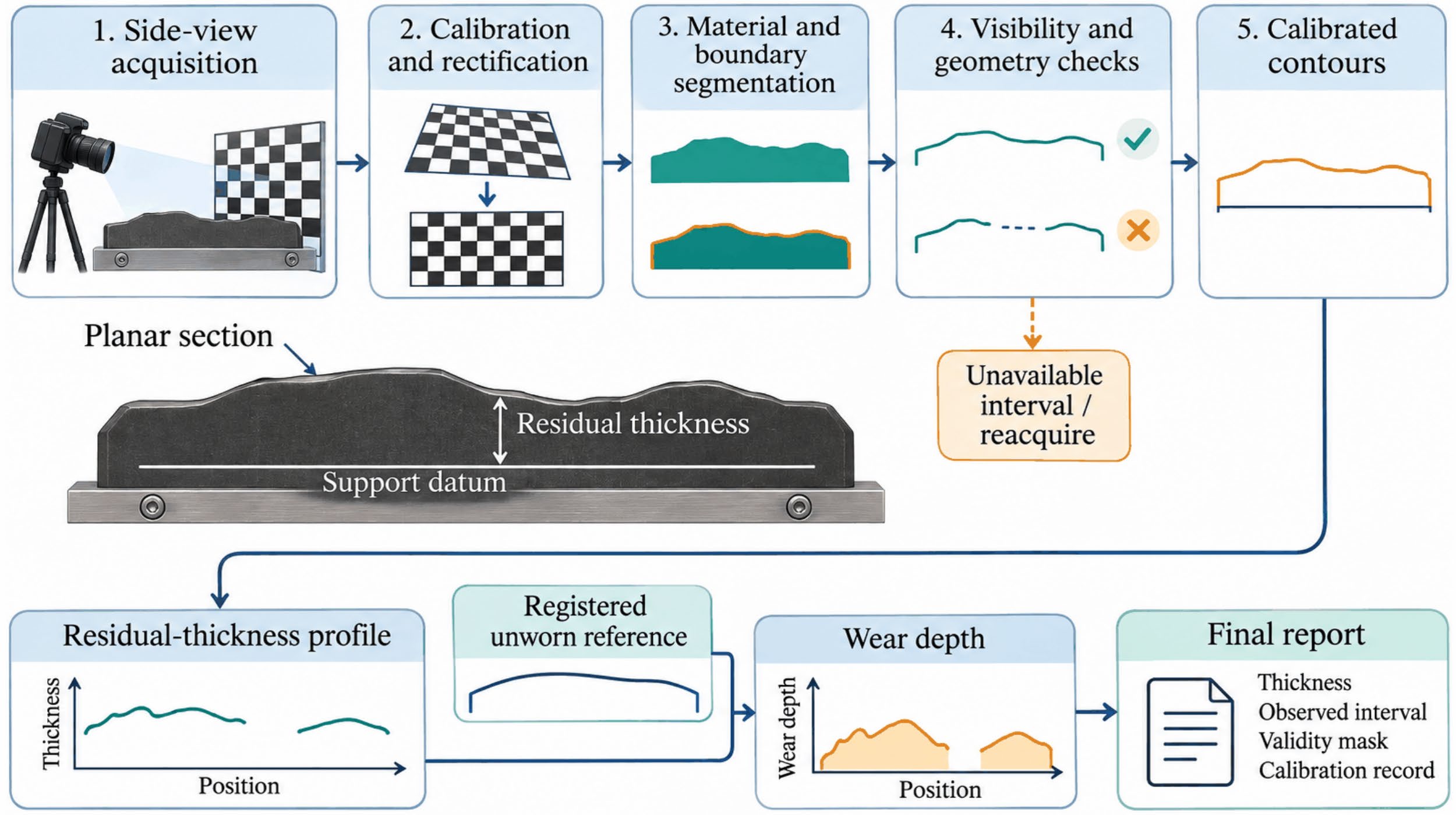
Reliable pantograph carbon strip inspection requires accurate contour localization and a defensible conversion from image coordinates to physical dimensions. This paper proposes a geometrically constrained DeepLabv3+ framework for estimating visible residual thickness in a calibrated observation plane. Boundary and visibility branches distinguish measurable contours from unavailable intervals, while weak ordering and continuity penalties regulate contour relationships without imposing a uniform wear profile. Wear depth is obtained only when a registered unworn reference is available. A numerical benchmark design groups 2400 image-condition records under 120 specimen identifiers, with development and evaluation partitions separated by identifier. The illustrative comparison assigns mean absolute errors of 0.286 mm to the unconstrained baseline and 0.118 mm to the complete configuration, with boundary F1 values of 90.2% and 95.8%, respectively. The corresponding error without the geometric term is 0.173 mm, and the highest-stress example reaches 0.241 mm. These descriptive values demonstrate the proposed evaluation and reporting logic; they do not establish independently measured performance on physical strips or causal improvements from trained model components. Calibration sensitivity, interval undercoverage, and accepted coverage are examined separately because segmentation agreement alone cannot verify dimensional accuracy. The contribution is the integration of contour geometry, visibility- aware reporting, and calibrated dimensional interpretation. Empirical applicability remains to be established through traceable reference measurements, fully specified training and decoding settings, repeated-seed comparisons, and specimen-level validation under contamination, perspective variation, and service damage.
References
Zhou, N., Zhi, X., Cheng, Y., Sun, Y., Wang, J., Gu, Z., Li, Z., & Zhang, W. (2024). Contact strip of pantograph heuristic wear model and its application. Tribology International, 194, Article 109546. https://doi.org/10.1016/j.triboint.2024.109546
Judek, S. (2025). Defect detection of railway pantograph contact strips based on laser scanning measurements. Measurement Science and Technology, 36(11), Article 116110. https://doi.org/10.1088/1361-6501/ae15af
Song, Y., Mei, G., Liu, Z., & Gao, S. (2024). Assessment of railway pantograph-catenary interaction performance with realistic pantograph strip imperfection. Vehicle System Dynamics, 62(9), 2355–2374. https://doi.org/10.1080/00423114.2023.2289662
Yang, K., Liu, Y., Li, X., Bai, Z., Wan, Y., Xiao, Y., & Li, J. (2024). A high-accuracy single-frame 3D reconstruction method with color speckle projection for pantograph sliders. Measurement, 237, Article 115192. https://doi.org/10.1016/j.measurement.2024.115192
Wang, J., Xie, C., Zhang, X., Zhang, Z., & Wang, X. (2026). Online pantograph wear detection under busbar occlusion using line laser scanning with region-based registration. Measurement, 288, Article 122553. https://doi.org/10.1016/j.measurement.2026.122553
Hou, X., Chen, P., & Gu, H. (2024). LM-DeeplabV3+: A lightweight image segmentation algorithm based on multi-scale feature interaction. Applied Sciences, 14(4), Article 1558. https://doi.org/10.3390/app14041558
Sun, J., & Zhang, P. (2026). MSCA-Deeplabv3+: A fine-grained optical image segmentation model based on multi-scale channel attention. Alexandria Engineering Journal, 145, 430–445. https://doi.org/10.1016/j.aej.2026.04.026
Qiu, S., Chen, J., Zhang, H., Wan, R., Xue, X., & Pu, J. (2024). Guided contrastive boundary learning for semantic segmentation. Pattern Recognition, 155, Article 110723. https://doi.org/10.1016/j.patcog.2024.110723
Zhang, P., Cheng, Y., & Tamura, S. (2024). Shape prior-constrained deep learning network for medical image segmentation. Computers in Biology and Medicine, 180, Article 108932. https://doi.org/10.1016/j.compbiomed.2024.108932
Zhang, S., Ni, P., Han, Q., Wen, J., Du, X., & Li, J. (2025). Measurement uncertainty quantification for computer vision-based structural dynamic displacement monitoring. Measurement, 253, Article 117835. https://doi.org/10.1016/j.measurement.2025.117835
Hendrickx, K., Perini, L., Van der Plas, D., Meert, W., & Davis, J. (2024). Machine learning with a reject option: A survey. Machine Learning, 113(5), 3073–3110. https://doi.org/10.1007/s10994-024-06534-x
Rosenblatt, M., Tejavibulya, L., Jiang, R., Noble, S., & Scheinost, D. (2024). Data leakage inflates prediction performance in connectome-based machine learning models. Nature Communications, 15(1), Article 1829. https://doi.org/10.1038/s41467-024-46150-w
Zschiesche, K., & Reiterer, A. (2024). Optical measurement system for monitoring railway infrastructure—A review. Applied Sciences, 14(19), Article 8801. https://doi.org/10.3390/app14198801
Duan, Q., Wang, Z., Huang, J., Xing, C., Li, Z., Qi, M., Gao, J., & Ai, S. (2024). A deep-learning based high-accuracy camera calibration method for large-scale scene. Precision Engineering, 88, 464–474. https://doi.org/10.1016/j.precisioneng.2024.02.019
Yang, H., Zhu, K., Zhao, J., Lan, T., & Pan, B. (2025). Metrological performance quantification of a 3D-DIC system. Measurement, 249, Article 117008. https://doi.org/10.1016/j.measurement.2025.117008
Liu, H., Chen, Y., Wang, R., Li, M., & Li, Z. (2025). MFA-Deeplabv3+: An improved lightweight semantic segmentation algorithm based on Deeplabv3+. Complex & Intelligent Systems, 11(10), Article 424. https://doi.org/10.1007/s40747-025-02028-y
Lin, Q., Chen, X., Chen, C., & Garibaldi, J. M. (2024). Boundary-wise loss for medical image segmentation based on fuzzy rough sets. Information Sciences, 661, Article 120183. https://doi.org/10.1016/j.ins.2024.120183
Vareto, R. H., Szczerbacki, R., Lima, L. A., Vaz-de-Melo, P. O. S., & Schwartz, W. R. (2026). Distance Transform Loss: Boundary-aware segmentation of seismic data. Computers & Geosciences, 207, Article 106061. https://doi.org/10.1016/j.cageo.2025.106061
Maier-Hein, L., Reinke, A., Godau, P., Tizabi, M. D., Buettner, F., Christodoulou, E., Glocker, B., Isensee, F., Kleesiek, J., Kozubek, M., Reyes, M., Riegler, M. A., Wiesenfarth, M., Kavur, A. E., Sudre, C. H., Baumgartner, M., Eisenmann, M., Heckmann-Nötzel, D., Rädsch, T., … Jäger, P. F. (2024). Metrics Reloaded: Recommendations for image analysis validation. Nature Methods, 21(2), 195–212. https://doi.org/10.1038/s41592-023-02151-z
Zeng, L., Li, X., Yang, X., Chen, W., Liu, J., Shen, L., & Wu, S. (2024). SCPMan: Shape context and prior constrained multi-scale attention network for pancreatic segmentation. Expert Systems with Applications, 252, Article 124070. https://doi.org/10.1016/j.eswa.2024.124070
Hasan, M. M., Abdar, M., Khosravi, A., Aickelin, U., Lio, P., Hossain, I., Rahman, A., & Nahavandi, S. (2025). Survey on leveraging uncertainty estimation towards trustworthy deep neural networks: The case of reject option and post-training processing. ACM Computing Surveys, 57(9), Article 236. https://doi.org/10.1145/3727633
Gao, S., Felgner, A., & Brand, U. (2025). Metrological-characteristics-based calibration of optical areal surface measuring instruments and evaluation of measurement uncertainty for surface texture measurements. Instruments, 9(2), Article 11. https://doi.org/10.3390/instruments9020011
Brookshire, G., Kasper, J., Blauch, N. M., Wu, Y. C., Glatt, R., Merrill, D. A., Gerrol, S., Yoder, K. J., Quirk, C., & Lucero, C. (2024). Data leakage in deep learning studies of translational EEG. Frontiers in Neuroscience, 18, Article 1373515. https://doi.org/10.3389/fnins.2024.1373515
Trombini, M., Maculotti, G., Maisano, D. A., Pagani, A., & Franceschini, F. (2025). Scaling photogrammetry: A comparative evaluation and metrological assessment across small- and meso-scale domains. Precision Engineering, 92, 124–140. https://doi.org/10.1016/j.precisioneng.2024.12.002
Dias, L. C., Faria, A. D., Costa, P. B., & Amorim, I. L. R. (2025). Traceability of line scales using image processing. Acta IMEKO, 14(2), 1–5. https://doi.org/10.21014/actaimeko.v14i2.1972
Sasse, L., Nicolaisen-Sobesky, E., Dukart, J., Eickhoff, S. B., Götz, M., Hamdan, S., Komeyer, V., Kulkarni, A., Lahnakoski, J. M., Love, B. C., Raimondo, F., & Patil, K. R. (2025). Overview of leakage scenarios in supervised machine learning. Journal of Big Data, 12(1), Article 135. https://doi.org/10.1186/s40537-025-01193-8
Hallberg Szabadváry, J., Löfström, T., Johansson, U., Sönströd, C., Ahlberg, E., & Carlsson, L. (2025). Classification with reject option: Distribution-free error guarantees via conformal prediction. Machine Learning with Applications, 20, Article 100664. https://doi.org/10.1016/j.mlwa.2025.100664
Reinke, A., Tizabi, M. D., Baumgartner, M., Eisenmann, M., Heckmann-Nötzel, D., Kavur, A. E., Rädsch, T., Sudre, C. H., Acion, L., Antonelli, M., Arbel, T., Bakas, S., Benis, A., Buettner, F., Cardoso, M. J., Cheplygina, V., Chen, J., Christodoulou, E., Cimini, B. A., … Maier-Hein, L. (2024). Understanding metric-related pitfalls in image analysis validation. Nature Methods, 21(2), 182–194. https://doi.org/10.1038/s41592-023-02150-0
Silveira, P. S. P., Vieira, J. E., & Siqueira, J. d. O. (2024). Is the Bland-Altman plot method useful without inferences for accuracy, precision, and agreement? Revista de Saúde Pública, 58, Article 01. https://doi.org/10.11606/s1518-8787.2024058005430
Zhao, Y., Chen, W., Xu, Z., Patwardhan, M., Wang, C., Liu, Y., Vig, L., & Cohan, A. (2025). AbGen: Evaluating large language models in ablation study design and evaluation for scientific research. In W. Che, J. Nabende, E. Shutova, & M. T. Pilehvar (Eds.), Proceedings of the 63rd Annual Meeting of the Association for Computational Linguistics (Volume 1: Long Papers) (pp. 12479–12491). Association for Computational Linguistics. https://doi.org/10.18653/v1/2025.acl-long.611
Ni, J., Zhao, H., Yang, Y., & Guo, D. (2026). Deep neural network calibration by reducing classifier shift with stochastic masking. Pattern Recognition, 177, Article 113217. https://doi.org/10.1016/j.patcog.2026.113217
Cabezas, L. M. C., Otto, M. P., Izbicki, R., & Stern, R. B. (2025). Regression trees for fast and adaptive prediction intervals. Information Sciences, 686, Article 121369. https://doi.org/10.1016/j.ins.2024.121369
Li, Z., Paolieri, M., & Golubchik, L. (2024). Inference latency prediction for CNNs on heterogeneous mobile devices and ML frameworks. Performance Evaluation, 165, Article 102429. https://doi.org/10.1016/j.peva.2024.102429