
A Gaussian Process Model for Ocean Sound Speed Profile Inversion Incorporating Ray Travel Time Kernels
Authors
Tahani Al-Ghafli, Hessa Al-Mansoori, Karima Al-RiyamiFiles
Key Information
Journal

Published in Vol. 4 No. 1 (2026) of Journal of Applied Computational Intelligence.
The Journal of Applied Computational Intelligence (JACI) eISSN:3136-6937 is a peer-reviewed, international, open-access journal dedicated to the advancement of computational intelligence methodologies and their real-world applications across diverse engineering and scientific domains. The journal aims to bridge the gap between theoretical development and practical deployment of intelligent systems by providing a scholarly platform for researchers, practitioners, and industry innovators.
JACI encourages high-quality original research, review articles, and technical reports that explore the design, implementation, and optimization of intelligent algorithms for solving complex problems in fields such as manufacturing, energy, healthcare, transportation, and information systems.
Abstract
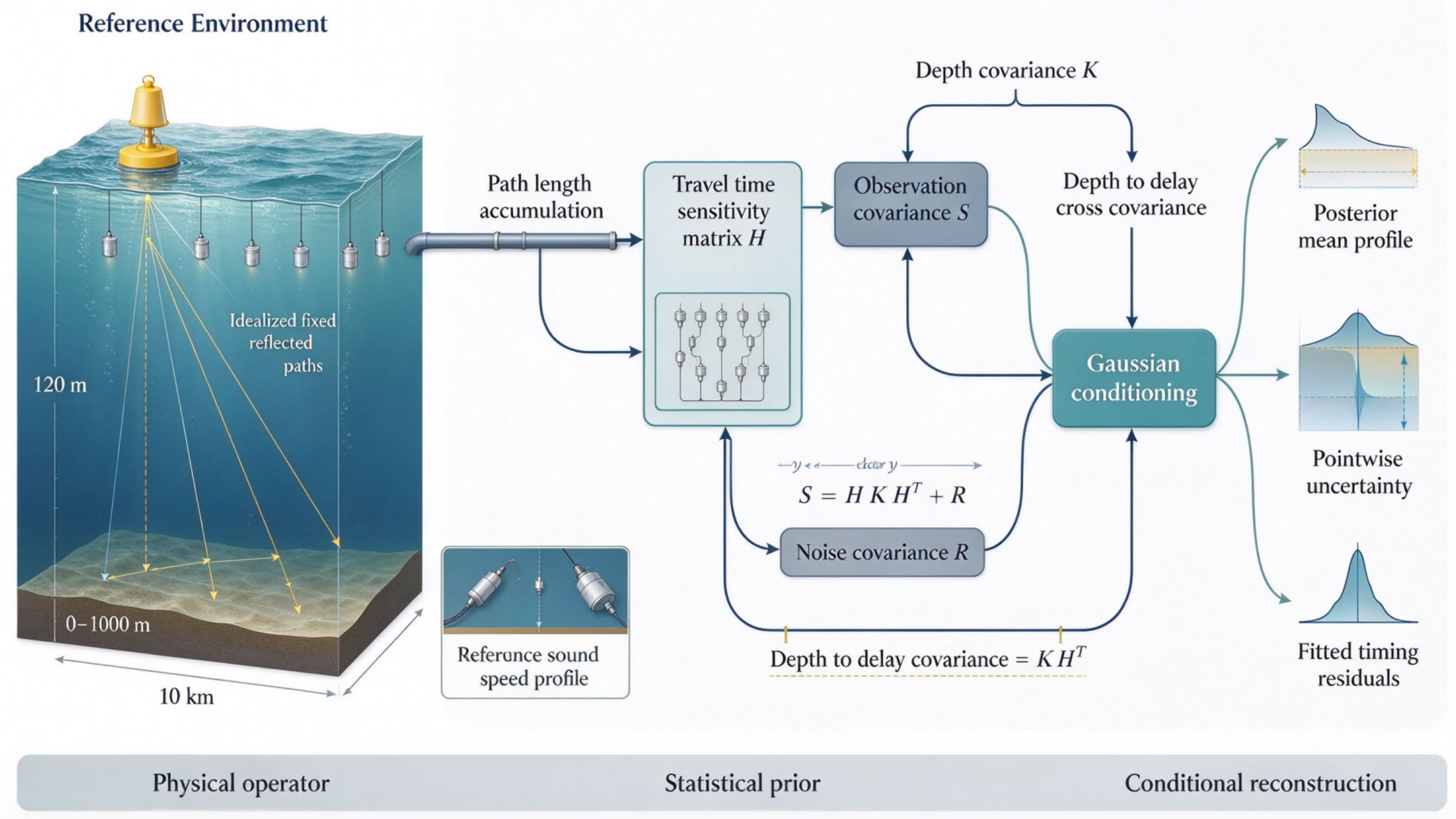
Ocean sound speed profile inversion from acoustic travel times is limited by uneven depth sensitivity and the small number of distinguishable propagation paths. This study develops a Gaussian process formulation in which ray travel time kernels act directly on a depth covariance model, allowing profile estimates and conditional uncertainty to be computed within the same linear inverse problem. The evaluation uses a one-kilometre water column, a ten-kilometre transmission range, twenty-four idealized reflected paths, and eighty sound speed anomaly profiles. The observation noise standard deviation is 0.3 milliseconds. The proposed model is compared with independent depth regularization, an excessively smooth Gaussian process, a short correlation model, and an oracle covariance reference. Reconstruction error, interval coverage, timing residuals, and depth dependent uncertainty are evaluated using identical observations for every method. The kernel- based model attains a root mean square error of 1.227 metres per second and pointwise interval coverage of 86.68 percent; the independent depth reference produces an error of 1.450 metres per second. Sensitivity experiments examine six noise levels, six prior correlation lengths, and six retained path counts. The resulting analysis separates prior assumptions from acoustic information and identifies conditions under which small timing residuals coexist with substantial profile error. The model provides an interpretable probabilistic baseline for profile reconstruction, while its present validation remains restricted to fixed straight reflected paths and Gaussian perturbations. The controlled benchmark uses a deliberately mismatched prior; empirical coverage below the nominal 95 percent level identifies a calibration limitation alongside the reconstruction improvement.
References
Xu, W., Chen, Y., Jiang, Y., Li, Z., Wang, X., Li, B., Li, N., & Zhang, W. (2026). A framework for inversion and assimilation of deep-sea mirror ocean acoustic tomography observations. International Journal of Applied Earth Observation and Geoinformation, 154, Article 105626. https://doi.org/10.1016/j.jag.2026.105626
Ollivier, E., Touret, R. X., McKinley, M., Jin, J., Bracco, A., & Sabra, K. G. (2024). Performance study of ray-based ocean acoustic tomography methods for estimating submesoscale variability in the upper ocean. The Journal of the Acoustical Society of America, 155(2), 1315–1335. https://doi.org/10.1121/10.0024819
Peng, S., Callies, J., Wu, W., & Zhan, Z. (2024). Seismic ocean thermometry of the Kuroshio Extension region. Journal of Geophysical Research: Oceans, 129(2), Article e2023JC020636. https://doi.org/10.1029/2023JC020636
Fan, H., Xie, S., & Xue, S. (2026). Inversion of sound speed profile controlled by sparse observations: Research background, current status and technical analysis. Oceans, 7(3), Article 45. https://doi.org/10.3390/oceans7030045
Bortolotti, V., Landi, G., & Zama, F. (2025). Uniform multipenalty regularization for linear ill-posed inverse problems. SIAM Journal on Scientific Computing, 47(2), A790–A810. https://doi.org/10.1137/23M1600943
Horst, A., Maboudi Afkham, B., Dong, Y., & Lemvig, J. (2025). Uncertainty quantification for linear inverse problems with Besov prior: A randomize-then-optimize method. Statistics and Computing, 35(4), Article 101. https://doi.org/10.1007/s11222-025-10638-2
Paine, T., & Bhatt, E. (2024). Geometric stochastic ray propagation using the special Euclidean group. JASA Express Letters, 4(4), Article 046002. https://doi.org/10.1121/10.0025522
Azizzadenesheli, K., Kovachki, N., Li, Z., Liu-Schiaffini, M., Kossaifi, J., & Anandkumar, A. (2024). Neural operators for accelerating scientific simulations and design. Nature Reviews Physics, 6(5), 320–328. https://doi.org/10.1038/s42254-024-00712-5
Bai, T., Teckentrup, A. L., & Zygalakis, K. C. (2024). Gaussian processes for Bayesian inverse problems associated with linear partial differential equations. Statistics and Computing, 34(4), Article 139. https://doi.org/10.1007/s11222-024-10452-2
Matsumoto, T., & Sullivan, T. J. (2024). Images of Gaussian and other stochastic processes under closed, densely-defined, unbounded linear operators. Analysis and Applications, 22(03), 619–633. https://doi.org/10.1142/S0219530524400025
Lahtinen, J. (2024). On bias and its reduction via standardization in discretized electromagnetic source localization problems. Inverse Problems, 40(9), 095002. https://doi.org/10.1088/1361-6420/ad5f53
Liu, Y., Hu, R., Dou, D., Niu, H., Chen, D., & Xu, L. (2024). Gaussian processes with normal-mode-based kernels for matched field processing. Applied Acoustics, 220, Article 109954. https://doi.org/10.1016/j.apacoust.2024.109954
Peng, S., Callies, J., Nagura, M., & McPhaden, M. J. (2025). Yanai waves in the deep East Indian Ocean observed with seismic ocean tomography. Journal of Physical Oceanography, 55(4), 471–488. https://doi.org/10.1175/JPO-D-24-0107.1
Roux, P., Iturbe, I., Nicolas, B., Virieux, J., & Mars, J. I. (2011). Travel-time tomography in shallow water: Experimental demonstration at an ultrasonic scale. The Journal of the Acoustical Society of America, 130(3), 1232–1241. https://doi.org/10.1121/1.3621271
Zheng, Y., Yu, S., Qin, Z., Liu, X., Xie, C., Liu, M., & Zhao, J. (2024). Bottom multi-parameter Bayesian inversion based on an acoustic backscattering model. Journal of Marine Science and Engineering, 12(4), Article 629. https://doi.org/10.3390/jmse12040629
Travelletti, C., & Ginsbourger, D. (2024). Disintegration of Gaussian measures for sequential assimilation of linear operator data. Electronic Journal of Statistics, 18(2), 3825–3857. https://doi.org/10.1214/24-EJS2262
Chlingaryan, A., Leung, R., & Melkumyan, A. (2024). Augmenting stationary covariance functions with a smoothness hyperparameter and improving Gaussian process regression using a structural similarity index. Mathematical Geosciences, 56(3), 605–637. https://doi.org/10.1007/s11004-023-10095-5
Saha, P., Touret, R. X., Ollivier, E., Jin, J., McKinley, M., Romberg, J., & Sabra, K. G. (2025). Leveraging sound speed dynamics and generative deep learning for ray-based ocean acoustic tomography. JASA Express Letters, 5(4), Article 040801. https://doi.org/10.1121/10.0036312
Narnhofer, D., Habring, A., Holler, M., & Pock, T. (2024). Posterior-variance–based error quantification for inverse problems in imaging. SIAM Journal on Imaging Sciences, 17(1), 301–333. https://doi.org/10.1137/23M1546129
Yang, W., Xue, S., Ma, Y., Xiao, Z., Li, B., & Wang, K. (2026). An ultra-efficient ray-tracing method based on a precomputed full-element ray grid for underwater acoustic positioning. Measurement, 258, Article 119546. https://doi.org/10.1016/j.measurement.2025.119546
Smaragdakis, C., Taroudaki, V., & Taroudakis, M. I. (2024). Using machine learning techniques in inverse problems of acoustical oceanography. Studies in Applied Mathematics, 153(2), Article e12704. https://doi.org/10.1111/sapm.12704
Hauptmann, A., Mukherjee, S., Schönlieb, C.-B., & Sherry, F. (2025). Convergent regularization in inverse problems and linear plug-and-play denoisers. Foundations of Computational Mathematics, 25(4), 1087–1120. https://doi.org/10.1007/s10208-024-09654-x
Han, X., Liu, C., Li, S., Gao, D., Li, G., Zhu, M., & Xu, P. (2026). A segmented Bayesian method for parameter calibration in shallow-water acoustic tomography. Journal of Marine Science and Engineering, 14(19), Article 1850. https://doi.org/10.3390/jmse14191850
Bonnel, J., Dosso, S. E., Hodgkiss, W. S., Ballard, M. S., Garcia, D. D., Lee, K. M., McNeese, A. R., & Wilson, P. S. (2024). Trans-dimensional inversion for seafloor properties for three mud depocenters on the New England shelf under dynamical oceanographic conditions. The Journal of the Acoustical Society of America, 155(3), 1825–1839. https://doi.org/10.1121/10.0025176
Modrák, M., Moon, A. H., Kim, S., Bürkner, P., Huurre, N., Faltejsková, K., Gelman, A., & Vehtari, A. (2025). Simulation-based calibration checking for Bayesian computation: The choice of test quantities shapes sensitivity. Bayesian Analysis, 20(2), 461–488. https://doi.org/10.1214/23-BA1404
Jones, K. D., & Dowling, A. W. (2026). BITS for GAPS: Bayesian information-theoretic sampling for hierarchical Gaussian process surrogates. Computers & Chemical Engineering, 211, Article 109650. https://doi.org/10.1016/j.compchemeng.2026.109650
Marrel, A., & Iooss, B. (2024). Probabilistic surrogate modeling by Gaussian process: A review on recent insights in estimation and validation. Reliability Engineering & System Safety, 247, Article 110094. https://doi.org/10.1016/j.ress.2024.110094
Eberle-Blick, S., & Hyvönen, N. (2024). Bayesian experimental design for linear elasticity. Inverse Problems and Imaging, 18(6), 1294–1319. https://doi.org/10.3934/ipi.2024015
Paganin, S., & de Valpine, P. (2025). Computational methods for fast Bayesian model assessment via calibrated posterior p-values. Journal of Computational and Graphical Statistics, 34(2), 462–473. https://doi.org/10.1080/10618600.2024.2374585
Mills, C. L., Rudolph, M. L., & Lekić, V. (2025). Exploring and summarizing ensemble solutions to geophysical inverse problems. Journal of Geophysical Research: Machine Learning and Computation, 2(4), Article e2024JH000472. https://doi.org/10.1029/2024JH000472
