Delay-Doppler Sparsity-Constrained U-Net for OTFS Channel Estimation under Fractional Doppler
Authors
Riccardo Amato, Stefano Di Marco, Antonio Ferrara, Emiliano GentileFiles
Key Information
Journal

Published in Vol. 4 No. 1 (2026) of Journal of Applied Computational Intelligence.
The Journal of Applied Computational Intelligence (JACI) eISSN:3136-6937 is a peer-reviewed, international, open-access journal dedicated to the advancement of computational intelligence methodologies and their real-world applications across diverse engineering and scientific domains. The journal aims to bridge the gap between theoretical development and practical deployment of intelligent systems by providing a scholarly platform for researchers, practitioners, and industry innovators.
JACI encourages high-quality original research, review articles, and technical reports that explore the design, implementation, and optimization of intelligent algorithms for solving complex problems in fields such as manufacturing, energy, healthcare, transportation, and information systems.
Abstract
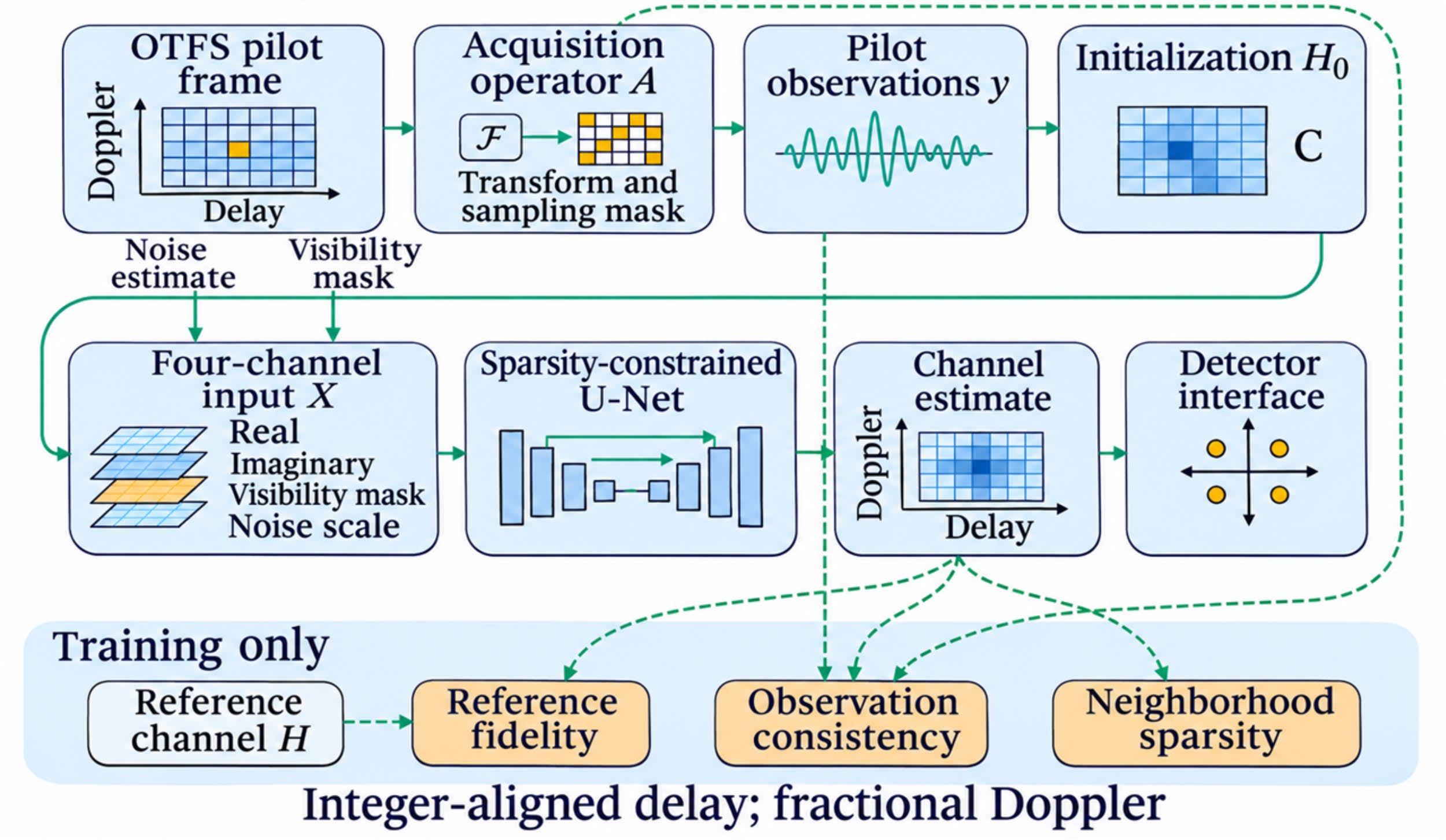
Fractional Doppler distributes the response of a propagation path across neighboring delay-Doppler cells, complicating sparse channel estimation in orthogonal time-frequency space systems. This study presents a residual U-Net that combines local Doppler neighborhoods with observation consistency to reconstruct an effective sampled channel. Its four input channels contain the real and imaginary components of a pilot-based initialization, a visibility mask, and a noise scale map. A piecewise differentiable shrinkage stage uses shared neighborhood energy to regulate the reconstructed support while preserving the phase of retained coefficients. Five estimator configurations are compared within a common evaluation specification. At a nominal signal-to-noise ratio of 20 dB, the reported normalized mean square error is −22.4 dB for the constrained configuration and −18.8 dB for the unconstrained U-Net, a separation of 3.6 dB. The corresponding support precision and recall are 0.91 and 0.89, compared with 0.82 and 0.86 for the unconstrained configuration. Ablation, offset, and path-density comparisons examine the relationship between neighborhood sharing and leakage reconstruction. The contribution concerns the integration of residual reconstruction, noise-conditioned neighborhood shrinkage, and an explicit observation penalty under integer-aligned delays. The reported coordinates describe the numerical comparison; the specified training allocation and device-level receiver validation remain separate implementation requirements. Practical assessment should examine pulse conventions, synchronization mismatch, fractional delay, and fixed-detector performance. These conditions define the scope of the present channel-domain interpretation.
References
Aldababsa, M., Özyurt, S., Kurt, G. K., & Kucur, O. (2024). A survey on orthogonal time frequency space modulation. IEEE Open Journal of the Communications Society, 5, 4483–4518. https://doi.org/10.1109/ojcoms.2024.3422801
Sheng, H.-T., & Wu, W.-R. (2024). Time-frequency domain channel estimation for OTFS systems. IEEE Transactions on Wireless Communications, 23(2), 937–948. https://doi.org/10.1109/twc.2023.3283578
Jesbin, F., & Chockalingam, A. (2026). Delay-Doppler pulse shaping in Zak-OTFS using Hermite basis functions. IEEE Transactions on Vehicular Technology, 75(10), 23804–23817. https://doi.org/10.1109/tvt.2026.3703829
Liu, C., Xiang, W., Long, H., & Jia, Y. (2024). Spectral-efficient reference signal design and iterative channel estimation for OTFS modulation. IEEE Transactions on Vehicular Technology, 73(10), 15286–15301. https://doi.org/10.1109/tvt.2024.3414468
Wang, X., Zheng, C., Hu, P., Yang, J., & Kang, C. G. (2025). A sparsity-agnostic SL0 channel estimation approach for OTFS systems. IEEE Communications Letters, 29(5), 1097–1101. https://doi.org/10.1109/lcomm.2025.3554379
Zegrar, S. E., Sümer, A. S., & Arslan, H. (2025). Fractional delay and fractional Doppler estimation and mitigation framework in OTFS systems. IEEE Transactions on Vehicular Technology, 74(2), 2884–2896. https://doi.org/10.1109/tvt.2024.3470839
Lee, H.-G., Kim, J., Zhao, J., & Joung, J. (2025). Single-tone-based channel estimation method for OTFS systems. IEEE Transactions on Communications, 73(3), 1638–1651. https://doi.org/10.1109/tcomm.2024.3455240
Li, W., Zhou, D., & Ye, Q. (2025). Channel computation based on multi-scale attention residual network. Journal of Information and Intelligence, 3(3), 275–287. https://doi.org/10.1016/j.jiixd.2025.03.001
Al-Imran, Nazim, M. S., Nguyen, H., & Jang, Y. M. (2025). Channel estimation of massive MIMO FSO communication system using deep attention residual U-Net. ICT Express, 11(2), 287–292. https://doi.org/10.1016/j.icte.2024.09.012
Wang, Q., Chen, X., Tao, Q., Qian, L. P., Kam, P.-Y., & Wu, Y. (2025). Model-driven channel estimation network for orthogonal time-frequency space systems. IEEE Transactions on Vehicular Technology, 74(7), 11552–11556. https://doi.org/10.1109/tvt.2025.3548639
He, Y., & Joseph, G. (2025). Bayesian algorithms for Kronecker-structured sparse vector recovery with application to IRS-MIMO channel estimation. IEEE Transactions on Signal Processing, 73, 142–157. https://doi.org/10.1109/tsp.2024.3416543
Luan, D., & Thompson, J. S. (2026). Achieving robust channel estimation neural networks by designed training data. IEEE Transactions on Cognitive Communications and Networking, 12, 2311–2324. https://doi.org/10.1109/tccn.2025.3592299
Zhang, H., Huang, X., & Zhang, J. A. (2024). Low-overhead OTFS transmission with frequency or time domain channel estimation. IEEE Transactions on Vehicular Technology, 73(1), 799–811. https://doi.org/10.1109/tvt.2023.3305921
Wang, R., Ren, H., Pan, C., Weng, R., & Wang, J. (2026). A cyclic shift embedded pilot-based channel estimation for multiuser MIMO-OTFS systems with fractional delay and Doppler. IEEE Transactions on Signal Processing, 74, 4466–4482. https://doi.org/10.1109/tsp.2026.3721735
He, X., Yuan, W., & Fan, P. (2024). On the pilot-aided channel estimation for windowed OTFS with data interference in rapidly time-varying channels. IEEE Transactions on Wireless Communications, 23(11), 16359–16374. https://doi.org/10.1109/twc.2024.3440586
Tang, M., Wang, H., Yuan, Z., & Yuan, J. (2024). A novel off-grid channel estimation with fast BCS using LSM prior for OTFS modulation. IEEE Transactions on Wireless Communications, 23(9), 12157–12171. https://doi.org/10.1109/twc.2024.3388449
Guo, Q., Jiang, H., Xiang, J., & Zhong, Y. (2024). A CS-BEM OTFS channel estimation approach for sparse continuous Doppler-spread channels. IEEE Wireless Communications Letters, 13(11), 2985–2989. https://doi.org/10.1109/lwc.2024.3432090
Lan, X., Zhang, X., Zhang, L., Ma, Z., Wang, Q., & Akan, O. B. (2026). A sparse Bayesian learning-based OTFS channel estimation for 6G wireless system. IEEE Wireless Communications Letters, 15, 805–809. https://doi.org/10.1109/lwc.2025.3642986
Meng, K., Yang, S., Wang, X.-Y., Bu, Y., Tang, Y., Zhang, J., & Hanzo, L. (2024). Joint sparsity pattern learning based channel estimation for massive MIMO-OTFS systems. IEEE Transactions on Vehicular Technology, 73(8), 12189–12194. https://doi.org/10.1109/tvt.2024.3375027
Mattu, S. R., & Chockalingam, A. (2024). Learning in time-frequency domain for fractional delay-Doppler channel estimation in OTFS. IEEE Wireless Communications Letters, 13(5), 1245–1249. https://doi.org/10.1109/lwc.2024.3367112
Gupta, C., & Yadav, S. S. (2025). Deep learning based channel estimation for UAVs: A modified U-Net approach. Advances in Electrical and Computer Engineering, 25(1), 61–70. https://doi.org/10.4316/aece.2025.01007
Wang, X., Zhang, H., Yang, Q., Wang, B., Gui, G., Yuen, C., & Sari, H. (2026). Model-based deep unfolding for efficient zero-padded OTFS channel estimation. IEEE Transactions on Vehicular Technology, 75(1), 756–768. https://doi.org/10.1109/tvt.2025.3592422
Lee, J. W., & Choi, K. W. (2026). Two-tier PEFT adapter switching for environment- and SNR-adaptive channel estimation. IEEE Open Journal of the Communications Society, 7, 6024–6046. https://doi.org/10.1109/ojcoms.2026.3697928
Das, A., Jesbin, F., & Chockalingam, A. (2026). A Gaussian-sinc pulse shaping filter for Zak-OTFS. IEEE Transactions on Vehicular Technology, 75(3), 4307–4322. https://doi.org/10.1109/tvt.2025.3609781
Zhou, M., Chen, F., Xia, M., Zhang, X., & Yu, H. (2025). Iterative channel estimation for multi-user OTFS uplink systems with superimposed full pilots. IEEE Transactions on Vehicular Technology, 74(3), 4485–4497. https://doi.org/10.1109/tvt.2024.3497176
Ying, D., & Ye, F. (2025). Deep learning supported path prediction and channel estimation for MIMO-OTFS system with high delay resolution. IEEE Transactions on Vehicular Technology, 74(3), 3584–3597. https://doi.org/10.1109/tvt.2024.3493921
Mehrotra, A., Srivastava, S., Shanmughanadha Reddy, N., Jagannatham, A., & Hanzo, L. (2025). Sparse channel estimation for MIMO OTFS/OTSM systems using finite-resolution ADCs. IEEE Transactions on Communications, 73(6), 3971–3987. https://doi.org/10.1109/tcomm.2024.3502682
Zhang, X., Liu, C., Yuan, W., Zhang, J. A., & Ng, D. W. K. (2024). Sparse prior-guided deep learning for OTFS channel estimation. IEEE Transactions on Vehicular Technology, 73(12), 19913–19918. https://doi.org/10.1109/tvt.2024.3450012
Li, X., Fan, P., Wang, Q., & Liu, Z. (2025). Grid evolution for doubly fractional channel estimation in OTFS systems. IEEE Transactions on Vehicular Technology, 74(2), 3486–3490. https://doi.org/10.1109/tvt.2024.3472695
Kong, L., Liu, X., Zhang, X., Xiong, J., Zhao, H., & Wei, J. (2025). Representation-based continual learning for channel estimation in dynamic wireless environments. IEEE Transactions on Wireless Communications, 24(8), 6382–6396. https://doi.org/10.1109/twc.2025.3552836
Ma, M., Dai, J., & Jiang, X.-Q. (2025). Fast burst-sparsity learning approach for massive MIMO-OTFS channel estimation. IEEE Wireless Communications Letters, 14(5), 1546–1550. https://doi.org/10.1109/lwc.2025.3548685
Ito, K., Takahashi, T., Furuta, K., Ibi, S., & Thadeu Freitas de Abreu, G. (2024). Joint channel and data estimation via parametric bilinear inference for OTFS demodulation. IEEE Open Journal of the Communications Society, 5, 6090–6105. https://doi.org/10.1109/ojcoms.2024.3463202
Yue, Y., Shi, J., Li, Z., Hu, J., & Tie, Z. (2024). Model-driven deep learning assisted detector for OTFS with channel estimation error. IEEE Communications Letters, 28(4), 842–846. https://doi.org/10.1109/lcomm.2024.3362970