Humidity Threshold Constrained Temporal Fusion Transformer for Airport Fog Visibility Prediction
Authors
Hugo Polák, Kamil Hora, Miloš PříhodaFiles
Key Information
Journal

Published in Vol. 4 No. 1 (2026) of Journal of Applied Computational Intelligence.
The Journal of Applied Computational Intelligence (JACI) eISSN:3136-6937 is a peer-reviewed, international, open-access journal dedicated to the advancement of computational intelligence methodologies and their real-world applications across diverse engineering and scientific domains. The journal aims to bridge the gap between theoretical development and practical deployment of intelligent systems by providing a scholarly platform for researchers, practitioners, and industry innovators.
JACI encourages high-quality original research, review articles, and technical reports that explore the design, implementation, and optimization of intelligent algorithms for solving complex problems in fields such as manufacturing, energy, healthcare, transportation, and information systems.
Abstract
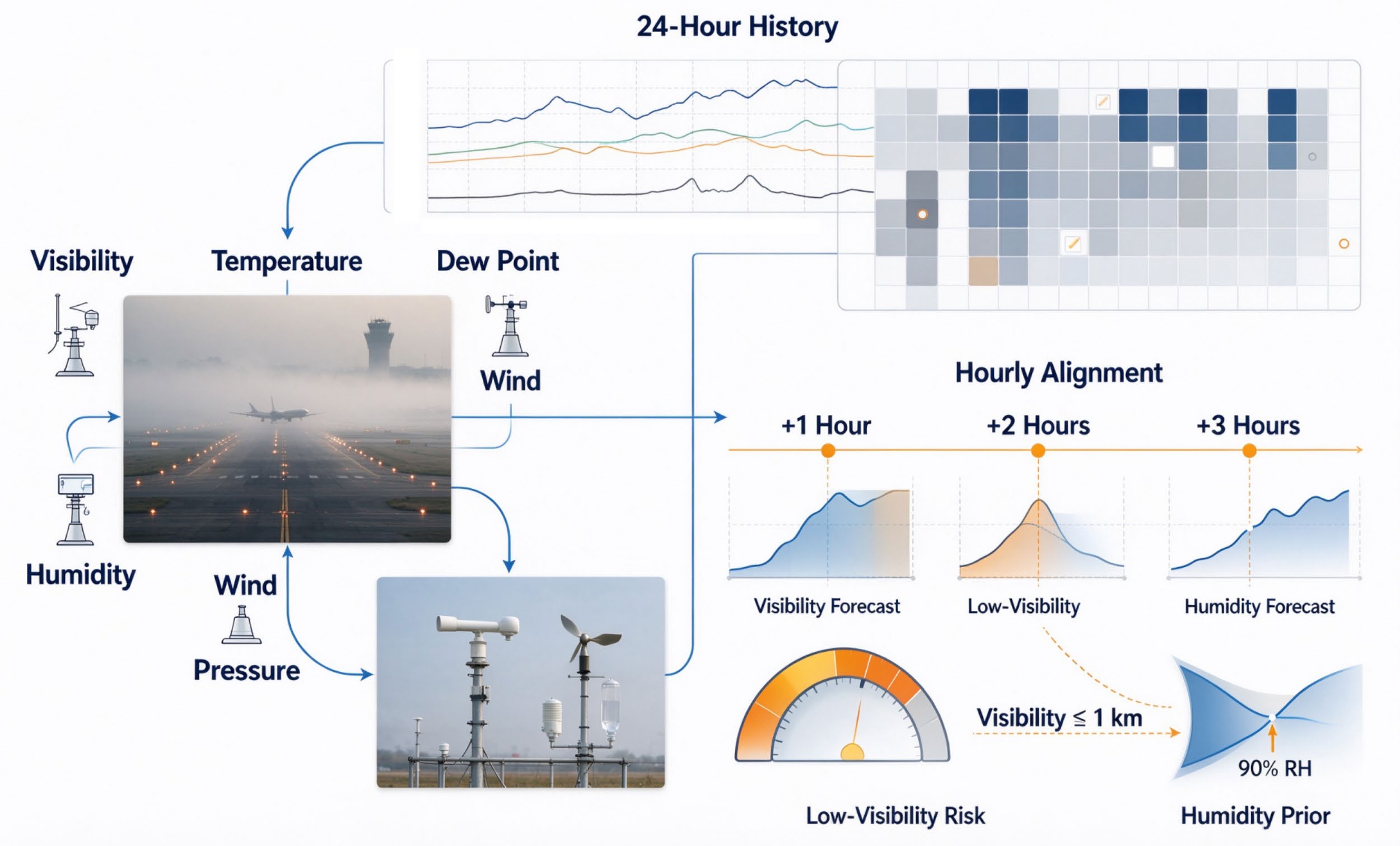
Airport fog forecasting requires both continuous visibility estimates and reliable warnings for rare low-visibility hours. This study evaluates a humidity-threshold-constrained Temporal Fusion Transformer using 24 hours of observations to predict visibility one, two and three hours ahead. Variable-specific embeddings, state-dependent selection, recurrent encoding and masked temporal attention combine observed meteorology with known UTC calendar variables. An auxiliary future-humidity estimate supplies a smooth increasing gate at relative humidity 0.90; a conditional penalty relates this gate to the predicted probability of reported visibility at or below 1 km. The model jointly learns ordered 0.1, 0.5 and 0.9 visibility quantiles. Public hourly reports from Fresno Airport between 2021 and 2025 yield 24,430 training windows, 4,220 checkpoint-selection windows, 4,259 calibration windows and 8,572 final test windows. Test mean absolute errors at one, two and three hours are 0.462, 0.590 and 0.681 km. One-hour warning recall is 0.7576 and F1 is 0.617, with false- positive rate 0.00814 and 69 false alarms. Post-fit probability calibration reduces one-hour Brier score from 0.01045 to 0.00596. The nominal 80% interval covers 94.67% of all one-hour targets but 75.85% of targets below the 16.09344 km reporting ceiling, which contains 79.13% of the one-hour test targets. Persistence has lower one-hour absolute error and higher one-hour F1, whereas the constrained model has lower absolute error at two and three hours. Matched ablations separate humidity regularization, variable selection and attention; standardized noise and held recent observations expose distinct sensitivities. These results qualify continuous forecast accuracy, event detection and interval reliability within a chronological single-airport evaluation.
References
Yi, K., Zhang, Q., He, H., Shi, K., Hu, L., An, N., & Niu, Z. (2024). Deep coupling network for multivariate time series forecasting. ACM Transactions on Information Systems, 42(5), Article 127, 1–28. https://doi.org/10.1145/3653447
Ying, C., & Lu, J. (2024). TFEformer: Temporal feature enhanced transformer for multivariate time series forecasting. IEEE Access, 12, 153694–153708. https://doi.org/10.1109/ACCESS.2024.3480953
Goyal, K., Dumancic, S., & Blockeel, H. (2024). DeepSaDe: Learning neural networks that guarantee domain constraint satisfaction. Proceedings of the AAAI Conference on Artificial Intelligence, 38(11), 12199–12207. https://doi.org/10.1609/aaai.v38i11.29109
Feng, S., Miao, C., Xu, K., Wu, J., Wu, P., Zhang, Y., & Zhao, P. (2024). Multi-scale attention flow for probabilistic time series forecasting. IEEE Transactions on Knowledge and Data Engineering, 36(5), 2056–2068. https://doi.org/10.1109/TKDE.2023.3319672
Chen, W., Yang, K., Yu, Z., Shi, Y., & Chen, C. L. P. (2024). A survey on imbalanced learning: Latest research, applications and future directions. Artificial Intelligence Review, 57, 137. https://doi.org/10.1007/s10462-024-10759-6
Dong, J., Jiang, Z., Pan, D., Chen, Z., Guan, Q., Zhang, H., Gui, G., & Gui, W. (2025). A survey on confidence calibration of deep learning-based classification models under class imbalance data. IEEE Transactions on Neural Networks and Learning Systems, 36(9), 15664–15684. https://doi.org/10.1109/TNNLS.2025.3565159
Jensen, V., Bianchi, F. M., & Anfinsen, S. N. (2024). Ensemble conformalized quantile regression for probabilistic time series forecasting. IEEE Transactions on Neural Networks and Learning Systems, 35(7), 9014–9025. https://doi.org/10.1109/TNNLS.2022.3217694
Apicella, A., Isgrò, F., & Prevete, R. (2025). Don’t push the button! Exploring data leakage risks in machine learning and transfer learning. Artificial Intelligence Review, 58, 339. https://doi.org/10.1007/s10462-025-11326-3
Raj, S., Deo, R. C., Sharma, E., Prasad, R., Dinh, T., & Salcedo-Sanz, S. (2024). Atmospheric visibility and cloud ceiling predictions with hybrid IIS-LSTM integrated model: Case studies for Fiji’s aviation industry. IEEE Access, 12, 72530–72543. https://doi.org/10.1109/ACCESS.2024.3401091
Liu, K., Ding, K., Cheng, X., Xu, G., Hu, X., Liu, T., Feng, S., Cai, B., Chen, J., Lin, H., Song, J., & Zhu, C. (2025). Airport delay prediction with temporal fusion transformers. In Proceedings of the 17th ACM SIGSPATIAL International Workshop on Computational Transportation Science (pp. 5–11). Association for Computing Machinery. https://doi.org/10.1145/3681772.3698212
Cao, C., Huang, J., Wu, M., Lin, Z., & Sun, Y. (2024). A multivariate time series prediction method based on convolution-residual gated recurrent neural network and double-layer attention. Electronics, 13(14), 2834. https://doi.org/10.3390/electronics13142834
Rudolph, M., Kurz, S., & Rakitsch, B. (2024). Hybrid modeling design patterns. Journal of Mathematics in Industry, 14, 3. https://doi.org/10.1186/s13362-024-00141-0
Abdelsamie, M. M., Azab, S. S., & Hefny, H. A. (2026). Deep multi-task learning: A review of concepts, methods, and cross-domain applications. International Journal of Data Science and Analytics, 21, 77. https://doi.org/10.1007/s41060-025-00892-y
Song, M., Yang, D., Lerch, S., Xia, X., Yagli, G. M., Bright, J. M., Shen, Y., Liu, B., Liu, X., & Mayer, M. J. (2024). Non-crossing quantile regression neural network as a calibration tool for ensemble weather forecasts. Advances in Atmospheric Sciences, 41(7), 1417–1437. https://doi.org/10.1007/s00376-023-3184-5
Balanya, S. A., Maroñas, J., & Ramos, D. (2024). Adaptive temperature scaling for robust calibration of deep neural networks. Neural Computing and Applications, 36(14), 8073–8095. https://doi.org/10.1007/s00521-024-09505-4
Schlembach, F., Smirnov, E., Koprinska, I., & Winands, M. H. M. (2025). Conformal multistep-ahead multivariate time-series forecasting. Machine Learning, 114, 165. https://doi.org/10.1007/s10994-024-06722-9
von Stackelberg, P., Goedhart, R., Birbil, Ş. İ., & Does, R. J. M. M. (2024). Comparison of threshold tuning methods for predictive monitoring. Quality and Reliability Engineering International, 40(1), 499–512. https://doi.org/10.1002/qre.3436
Li, N., Qi, Y., Li, C., & Zhao, Z. (2024). Active learning for data quality control: A survey. Journal of Data and Information Quality, 16(2), Article 11, 1–45. https://doi.org/10.1145/3663369
Chen, M., Shen, L., Fu, H., Li, Z., Sun, J., & Liu, C. (2024). Calibration of time-series forecasting: Detecting and adapting context-driven distribution shift. In Proceedings of the 30th ACM SIGKDD Conference on Knowledge Discovery and Data Mining (pp. 341–352). Association for Computing Machinery. https://doi.org/10.1145/3637528.3671926
Liu, W., He, Y., Guan, J., & Zhou, S. (2024). Multivariate time series forecasting with causal-temporal attention network. In ICASSP 2024—2024 IEEE International Conference on Acoustics, Speech and Signal Processing (pp. 5735–5739). IEEE. https://doi.org/10.1109/ICASSP48485.2024.10448031
Adin, A., Krainski, E. T., Lenzi, A., Liu, Z., Martínez-Minaya, J., & Rue, H. (2024). Automatic cross-validation in structured models: Is it time to leave out leave-one-out? Spatial Statistics, 62, 100843. https://doi.org/10.1016/j.spasta.2024.100843
Beck, N., Dovern, J., & Vogl, S. (2025). Mind the naive forecast! A rigorous evaluation of forecasting models for time series with low predictability. Applied Intelligence, 55, 395. https://doi.org/10.1007/s10489-025-06268-w
Cerqueira, V., Roque, L., & Soares, C. (2025). Modelradar: Aspect-based forecast evaluation. Machine Learning, 114, 229. https://doi.org/10.1007/s10994-025-06877-z
Terven, J., Cordova-Esparza, D.-M., Romero-González, J.-A., Ramírez-Pedraza, A., & Chávez-Urbiola, E. A. (2025). A comprehensive survey of loss functions and metrics in deep learning. Artificial Intelligence Review, 58, 195. https://doi.org/10.1007/s10462-025-11198-7
Sousa, M., Tomé, A. M., & Moreira, J. (2024). A general framework for multi-step ahead adaptive conformal heteroscedastic time series forecasting. Neurocomputing, 608, 128434. https://doi.org/10.1016/j.neucom.2024.128434
Lane, R. O. (2026). A comprehensive review of classifier probability calibration metrics. Data Science, 9(1), 24518492261436231. https://doi.org/10.1177/24518492261436231
Yang, M., & Bi, X. (2025). Cost-aware calibration of classifiers. INFORMS Journal on Data Science, 4(2), 101–113. https://doi.org/10.1287/ijds.2024.0038
Opitz, J. (2024). A closer look at classification evaluation metrics and a critical reflection of common evaluation practice. Transactions of the Association for Computational Linguistics, 12, 820–836. https://doi.org/10.1162/tacl_a_00675
Inácio, R., Cerqueira, V., Barandas, M., & Soares, C. (2025). Mast: Interpretable stress testing via meta-learning for forecasting model robustness evaluation. Machine Learning, 114, 251. https://doi.org/10.1007/s10994-025-06881-3
Su, Q., Kloukinas, C., & d’Avila Garcez, A. (2024). FocusLearn: Fully-interpretable, high-performance modular neural networks for time series. In 2024 International Joint Conference on Neural Networks (pp. 1–8). IEEE. https://doi.org/10.1109/IJCNN60899.2024.10651481
Shao, Z., Wang, F., Xu, Y., Wei, W., Yu, C., Zhang, Z., Yao, D., Sun, T., Jin, G., Cao, X., Cong, G., Jensen, C. S., & Cheng, X. (2025). Exploring progress in multivariate time series forecasting: Comprehensive benchmarking and heterogeneity analysis. IEEE Transactions on Knowledge and Data Engineering, 37(1), 291–305. https://doi.org/10.1109/TKDE.2024.3484454
Semmelrock, H., Ross-Hellauer, T., Kopeinik, S., Theiler, D., Haberl, A., Thalmann, S., & Kowald, D. (2025). Reproducibility in machine-learning-based research: Overview, barriers, and drivers. AI Magazine, 46(2), e70002. https://doi.org/10.1002/aaai.70002