
Edge-Aware CausalTFT Model for PCB Solder Bridging Segmentation
Authors
Ferhat İnan, Davut GürFiles
Key Information
Journal

Published in Vol. 5 No. 1 (2026) of Applied Manufacturing Intelligence Journal .
The Applied Manufacturing Intelligence Journal (AMIJ) eISSN:3136-7658 is a peer-reviewed, international, open-access journal that serves as a dedicated platform for researchers, engineers, and practitioners working at the intersection of advanced manufacturing and artificial intelligence. The journal aims to accelerate the integration of intelligent algorithms, autonomous decision-making, and data-driven optimization in modern manufacturing environments.
AMIJ emphasizes practical relevance, empirical validation, and industrial impact. It welcomes contributions that demonstrate how AI, machine learning, cyber-physical systems (CPS), and smart control technologies are transforming manufacturing systems and processes.
About the JournalAbstract
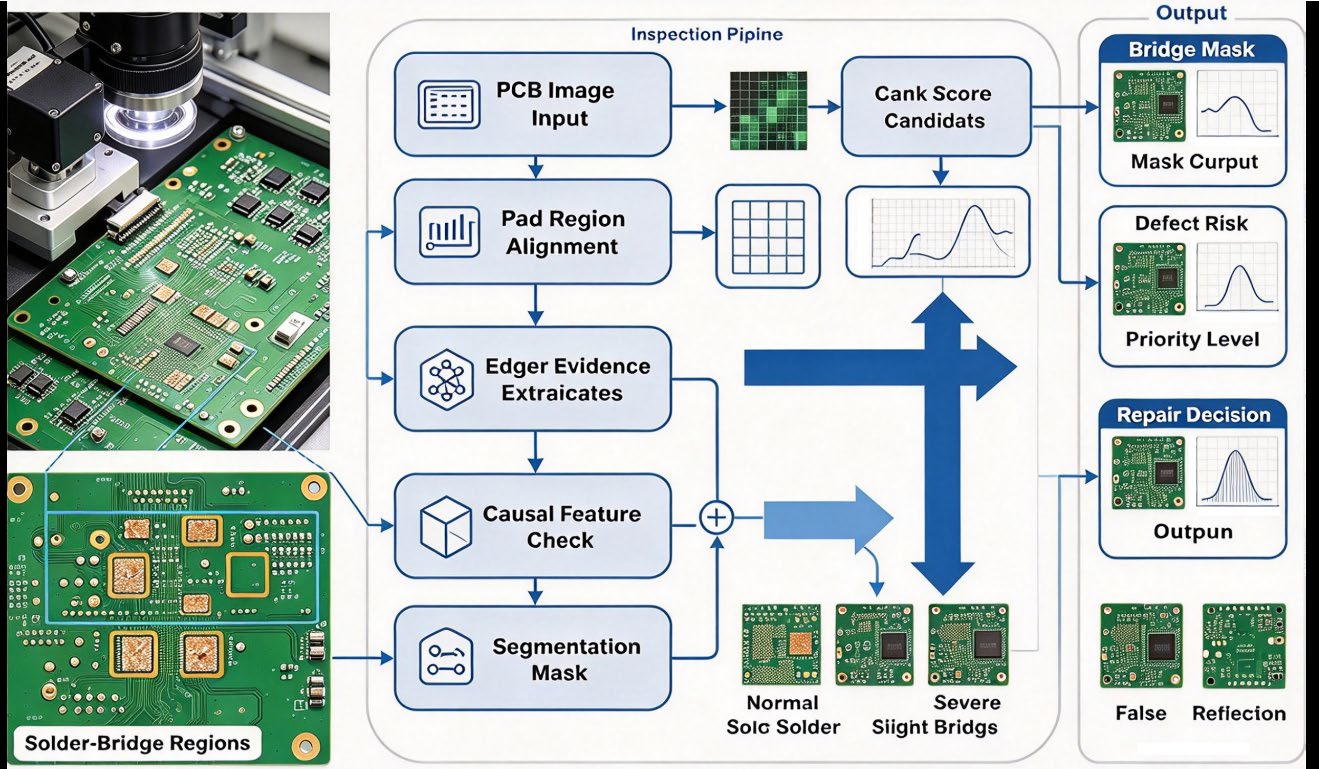
Solder bridging is a serious assembly defect in printed circuit board manufacturing because a small conductive connection between adjacent pads can cause electrical failure, rework and long-term reliability risk. This paper introduces an edge-aware CausalTFT model for PCB solder bridging segmentation in optical inspection. The method constructs an image window from pad-edge response, solder-region intensity, local continuity, component layout and image-quality indicators. Edge-aware representation improves the boundary separation among solder, pad and substrate, while a causal temporal fusion transformer backbone combines spatial evidence, short production-window context and source reliability. A causal gating branch reduces unstable correlations caused by reflection, flux residue, shadow, solder-mask colour variation and partial occlusion. The simulated dataset contains normal joints, weak bridges, severe bridges, reflection artefacts and paste-overflow cases. Experimental results show that mean intersection over union reaches 94.2%, bridge recall reaches 92.8% and boundary F1 reaches 89.6%, outperforming ordinary UNet, DeepLab- style and Transformer baselines. Confidence outputs and dominant-evidence records are used to separate true solder bridges from uncertain bright regions. For high-mix PCB assembly, the output also preserves pad-gap geometry, inspection-window reliability and package-level context so that review personnel can distinguish conductive bridge risk from imaging disturbance. The framework supports bridge mask prediction, bridge probability estimation, evidence traceability and review prioritisation for line-side PCB assembly inspection.
Details
License
Copyright (c) 2026 Ferhat İnan, Davut Gür

This work is licensed under a Creative Commons Attribution-NonCommercial-ShareAlike 4.0 International License.
