Diffusion Policy Transformer Model for Contact-Dense Robotic Polishing Trajectory Generation
Authors
Saif Al-Shamsi, Omar Al-Hashimi, Marwan Al-DarmakiFiles
Key Information
Journal
Published in Vol. 1 No. 1 (2022) of Applied Manufacturing Intelligence Journal .
The Applied Manufacturing Intelligence Journal (AMIJ) eISSN:3136-7658 is a peer-reviewed, international, open-access journal that serves as a dedicated platform for researchers, engineers, and practitioners working at the intersection of advanced manufacturing and artificial intelligence. The journal aims to accelerate the integration of intelligent algorithms, autonomous decision-making, and data-driven optimization in modern manufacturing environments.
AMIJ emphasizes practical relevance, empirical validation, and industrial impact. It welcomes contributions that demonstrate how AI, machine learning, cyber-physical systems (CPS), and smart control technologies are transforming manufacturing systems and processes.
About the JournalAbstract
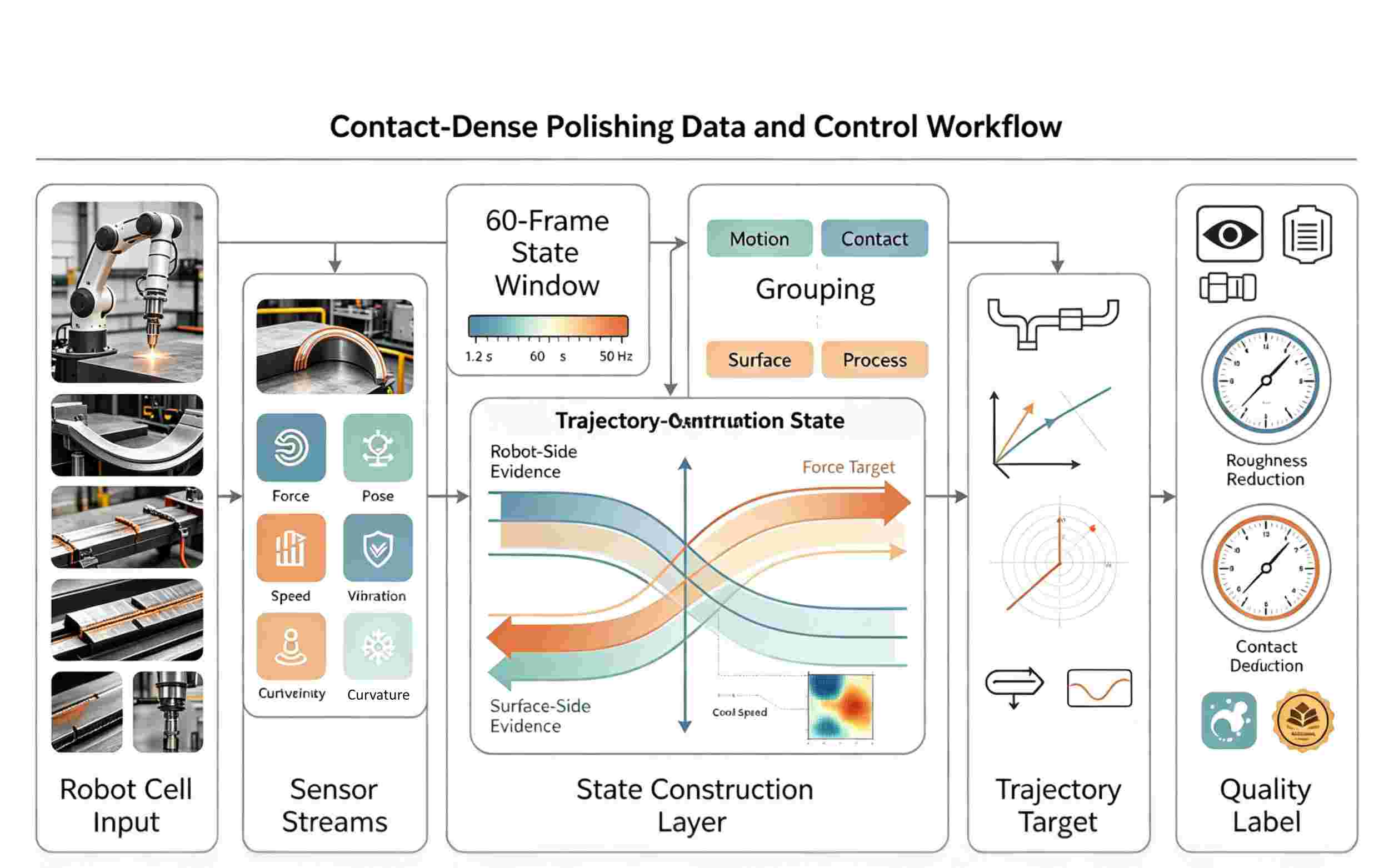
Creating a Diffusion Policy Transformer Model for the Generation of Contact-Dense Robotic Polishing Trajectories. During metal and composite surface finishing, the goal is to achieve a steady polishing route while the tool position, contact force, surface curvature, abrasive wear, and vibration response all vary at the same time. Robot joint position, end-effector pose, force-torque data, spindle speed, vibration signals, local surface geometry, and roughness labels are first used to construct a polishing-state window. A Transformer encoder preserves the temporal link between contact state, tool attitude, and surface-removal reaction, while a conditional diffusion strategy learns the distribution of possible trajectory segments. Excessive force, abrupt tool angle changes, and low-speed sticking are penalised by a contact-constraint module. The final policy generates a short-horizon trajectory for robot execution and human evaluation. The simulated dataset contains 24,000 trajectory segments for each of the nine robot work stations, six material surfaces, five polishing heads, and four curvature groups. The suggested model has decreased the mean path deviation to 1.18 mm, lowered the force RMSE to 2.81 N, improved surface-roughness reduction to 27.9%, and maintained a 42 ms median inference delay when compared to dynamic movement primitives, behaviour cloning, standard Transformer policy, and diffusion policy without contact constraints. Transformer memory stabilises extended contact sequences, diffusion sampling enhances multimodal trajectory selection, and explicit contact limitations lessen force overshoot at edges and weld-seams, according to ablation analysis.