Hoisting Path Optimization for Prefabricated Components Using a Causal-Guided Fusion TiDE-GNN Model
Authors
Konrad Wesołowski, Fabian Kołodziej, Radek GromekFiles
Key Information
Journal

Published in Vol. 5 No. 1 (2026) of Applied Manufacturing Intelligence Journal .
The Applied Manufacturing Intelligence Journal (AMIJ) eISSN:3136-7658 is a peer-reviewed, international, open-access journal that serves as a dedicated platform for researchers, engineers, and practitioners working at the intersection of advanced manufacturing and artificial intelligence. The journal aims to accelerate the integration of intelligent algorithms, autonomous decision-making, and data-driven optimization in modern manufacturing environments.
AMIJ emphasizes practical relevance, empirical validation, and industrial impact. It welcomes contributions that demonstrate how AI, machine learning, cyber-physical systems (CPS), and smart control technologies are transforming manufacturing systems and processes.
About the JournalAbstract
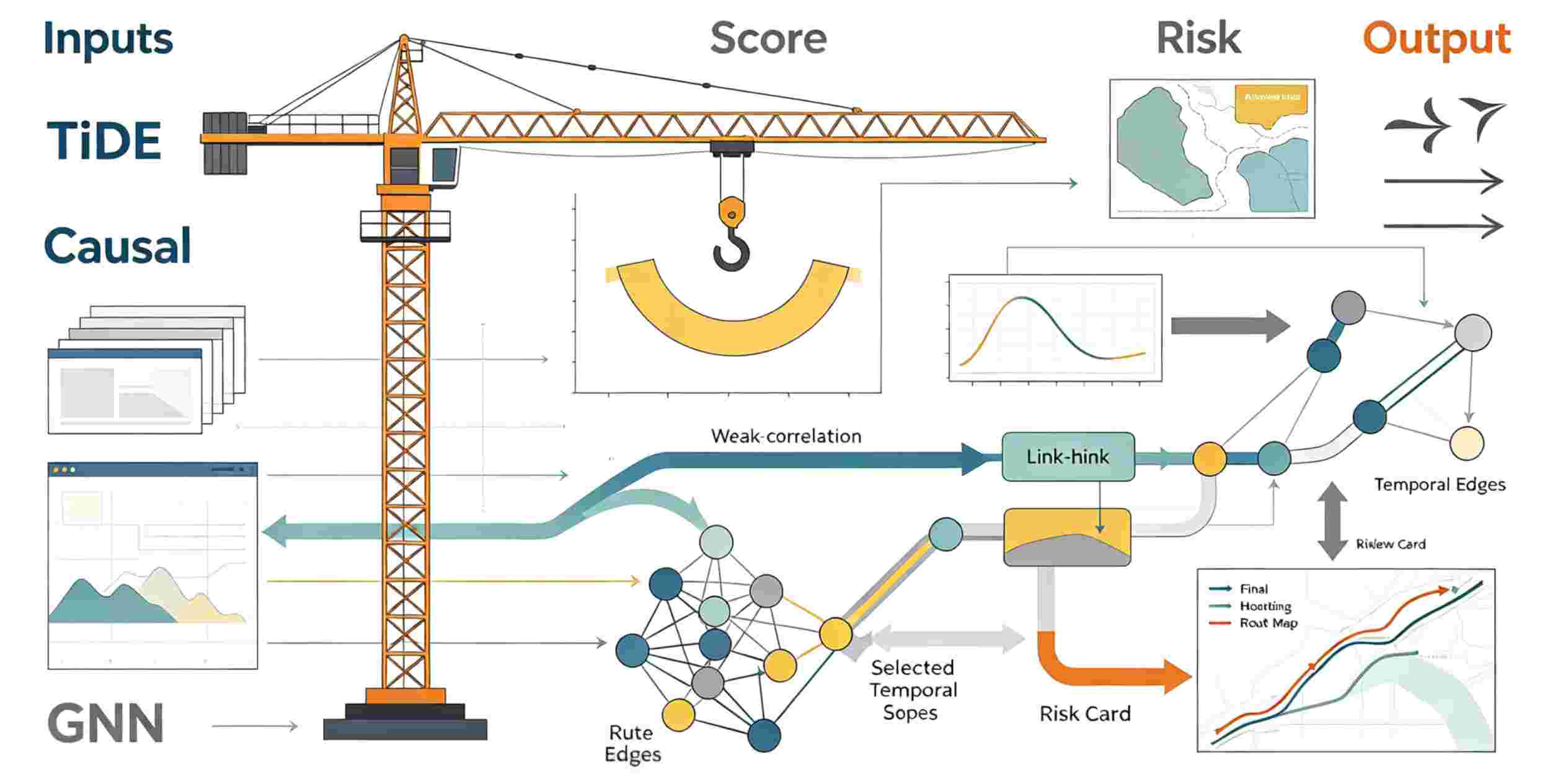
Because path feasibility is jointly determined by tower-crane reach, component weight, temporary storage, weather disruption, barrier movement, installation sequence, and surrounding construction activities, causal-guided graph learning is used to optimise hoisting paths for prefabricated components under dense site constraints. This work aims to build a TiDE-GNN model that can convert multi-source hoisting records into a risk-aware path decision, in contrast to a shortest-distance suggestion. 1,420 prefabricated components, 18,600 potential paths, 9 tower-crane operation zones, 36 installation areas, and 6 risk-region classifications make up the simulated dataset. Utilise a TiDE temporal encoder to record path-condition changes during lifting windows, model the components, cranes, barriers, weather, route nodes, and installation targets as a dynamic graph, and apply causal-guided fusion to lessen spurious dependence on background correlations like component weight or repeated storage positions. The experiment shows that the suggested model has a lower average route cost than traditional graph neural scoring, A* search, genetic planning, and rule-based BIM checking. The warning accuracy is now 91.2%, the near-collision frequency has decreased to 5.4%, and each candidate group's median inference latency is still 0.42 seconds. According to ablation results, there is a decrease in the safety discriminating of temporary barrier regions and an increase in needless route warnings in the absence of causal fusion. TiDE-GNN may enhance the hoisting path's efficiency and safety, assist prefabricated construction lifting decisions, and offer comprehensible route evidence for planner approval and human inspection.