Inventory State Reconstruction in Smart Warehouses Using a GraphGPS-VAE Model with Cross-Domain Fusion
Authors
Kristo Pärn, Gert BergFiles
Key Information
Journal

Published in Vol. 5 No. 1 (2026) of Applied Manufacturing Intelligence Journal .
The Applied Manufacturing Intelligence Journal (AMIJ) eISSN:3136-7658 is a peer-reviewed, international, open-access journal that serves as a dedicated platform for researchers, engineers, and practitioners working at the intersection of advanced manufacturing and artificial intelligence. The journal aims to accelerate the integration of intelligent algorithms, autonomous decision-making, and data-driven optimization in modern manufacturing environments.
AMIJ emphasizes practical relevance, empirical validation, and industrial impact. It welcomes contributions that demonstrate how AI, machine learning, cyber-physical systems (CPS), and smart control technologies are transforming manufacturing systems and processes.
About the JournalAbstract
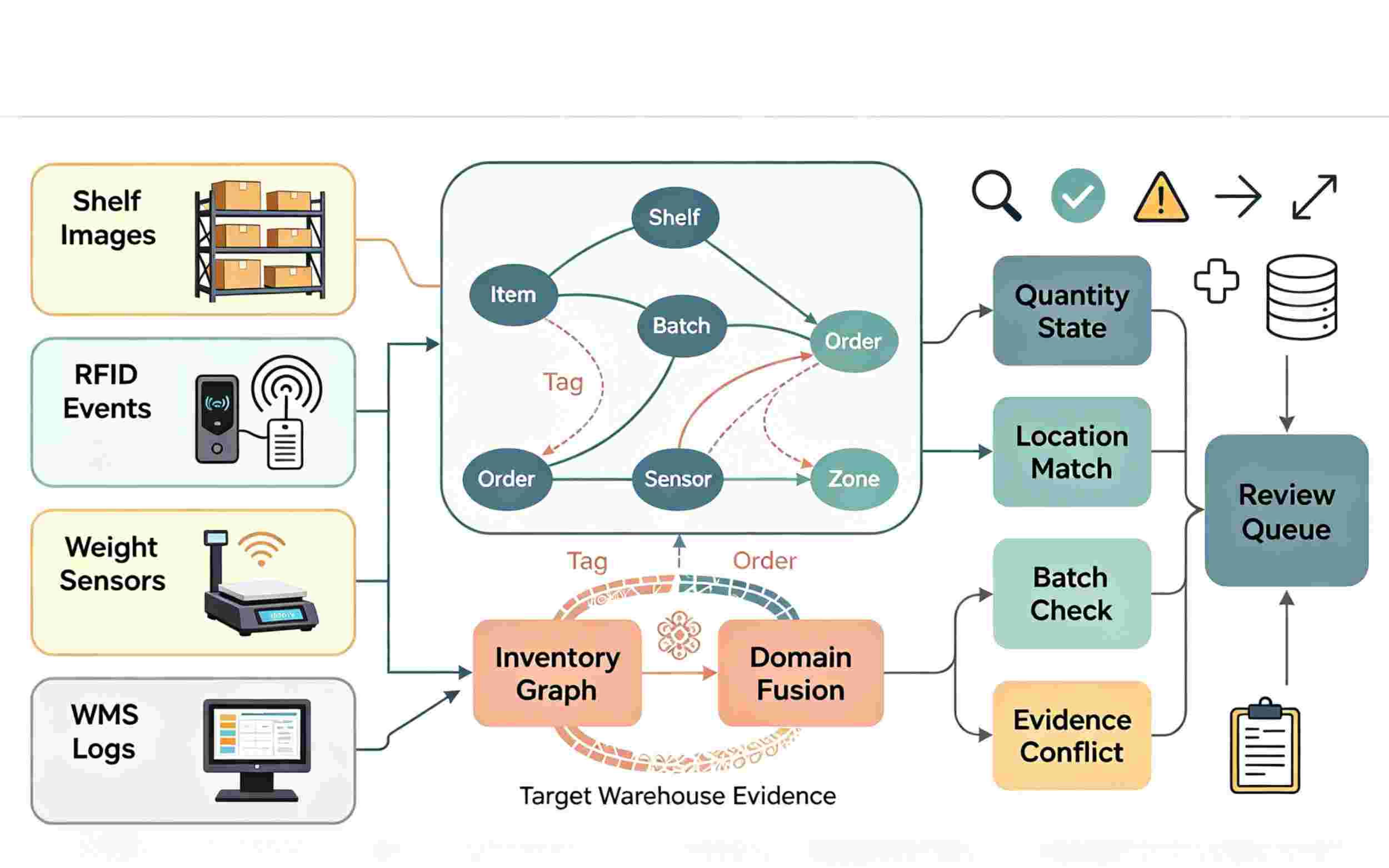
This study presents a GraphGPS-VAE model with cross-domain fusion for inventory-state reconstruction in smart warehouses. The task is to infer a reliable shelf-level state from RFID events, visible shelf images, weight-sensor records, warehouse-management logs, and picking records when these sources are incomplete or inconsistent. Shelf locations, stock-keeping units, inbound batches, outbound operations, and sensing devices are first organized as a heterogeneous shelf-item-sensor graph. The GraphGPS encoder combines local shelf adjacency with aisle-level and zone-level dependencies, while the VAE branch reconstructs expected quantity, location consistency, batch status, and sensor agreement. A cross-domain fusion module aligns transferable stock-flow patterns while preserving target-warehouse layout, turnover rhythm, and sensing residuals. The model is evaluated on a simulated dataset containing 14 warehouses, 132 storage zones, 48,000 shelf-state windows, 1.92 million sensing events, and six inventory-state labels. Compared with rule-based checking, isolated visual recognition, graph convolutional reconstruction, and VAE without domain fusion, the proposed method reduces quantity mean absolute error to 2.18 units, improves location-consistency accuracy to 92.7%, increases abnormal-state recall to 0.884, and reduces manual review load by 21.6%. These results suggest that graph-based cross-domain reconstruction can support exception tracing, replenishment review, and inventory auditing. The method is therefore positioned as decision support for warehouse staff rather than an automatic stock-account correction tool.