
Machine Tool Thermal Error Simulation with a Deformable DETR Model for Physics and Shop-Floor Perception Data
Authors
Konrad WesołowskiFiles
Key Information
Journal

Published in Vol. 5 No. 1 (2026) of Applied Manufacturing Intelligence Journal .
The Applied Manufacturing Intelligence Journal (AMIJ) eISSN:3136-7658 is a peer-reviewed, international, open-access journal that serves as a dedicated platform for researchers, engineers, and practitioners working at the intersection of advanced manufacturing and artificial intelligence. The journal aims to accelerate the integration of intelligent algorithms, autonomous decision-making, and data-driven optimization in modern manufacturing environments.
AMIJ emphasizes practical relevance, empirical validation, and industrial impact. It welcomes contributions that demonstrate how AI, machine learning, cyber-physical systems (CPS), and smart control technologies are transforming manufacturing systems and processes.
About the JournalAbstract
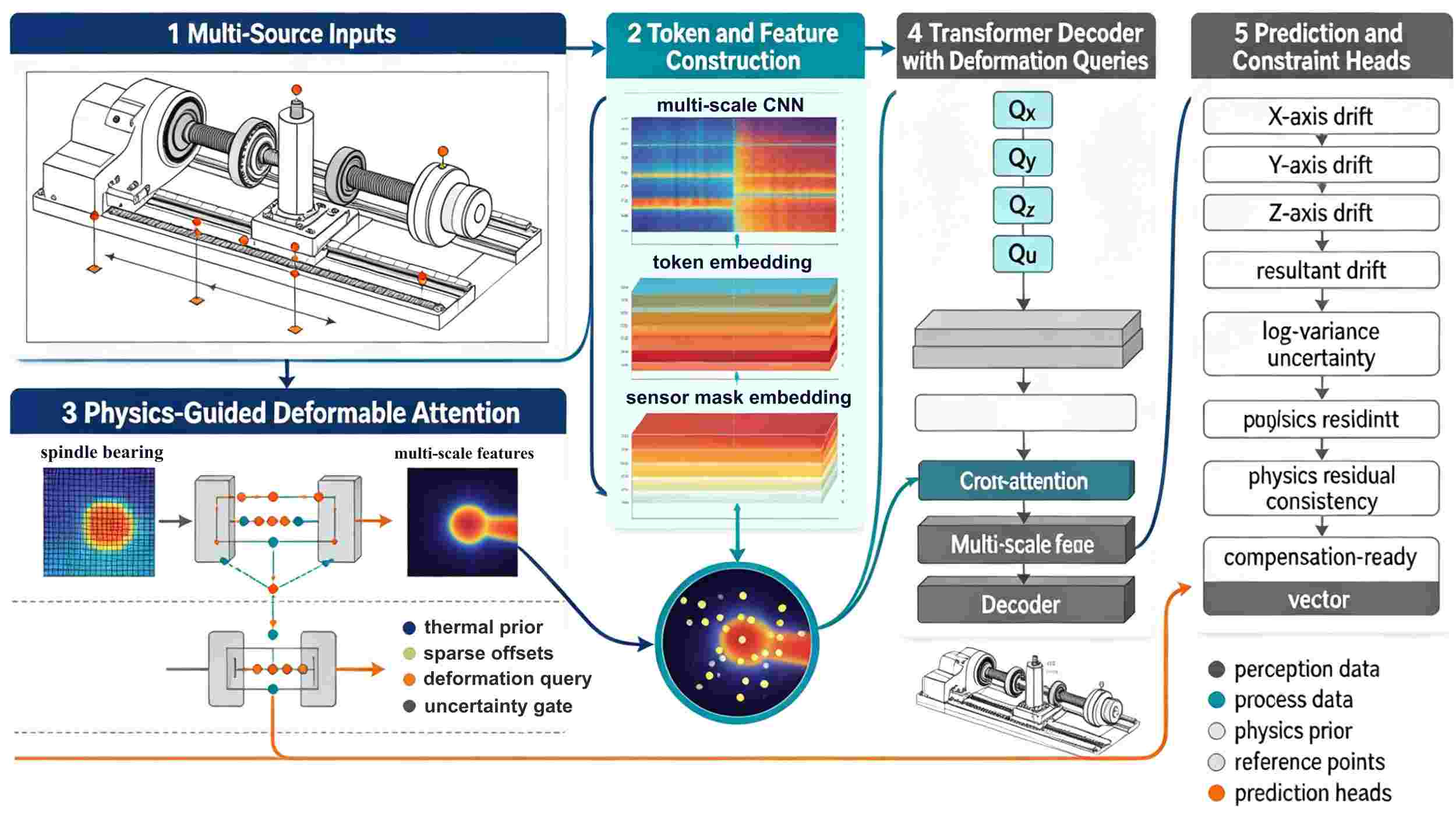
Thermal deformation remains a dominant source of accuracy loss in precision machine tools when long duty cycles, intermittent cutting, coolant regulation, and workshop air disturbance occur simultaneously. This paper proposes a physics- and shop-floor-perception-driven Deformable DETR model for thermal error simulation and reconstruction. The method couples a reduced thermal-structure simulator with synchronized controller variables, infrared temperature observations, ambient measurements, spindle-load records, and sparse displacement probes. Multi-scale deformable attention is used to sample only the most informative spatial-temperature and process-state locations, while a query decoder estimates tool-center-point drift, axis-dependent deformation, and uncertainty. A 62-h experimental campaign on a vertical machining center was organized into 18 operating regimes and 41,280 aligned samples. Compared with a polynomial thermal model, a long short-term memory network, and a conventional vision transformer, the proposed model reduced mean absolute tool-center-point error from 8.6, 6.1, and 4.7 micrometers to 3.2 micrometers, respectively. The 95th-percentile residual decreased to 7.9 micrometers, and the average inference time was 18.4 ms per sample. Ablation results further show that removing physics residual constraints increases error by 22.6%, whereas removing workshop perception channels increases error by 17.8%. The results indicate that deformable attention can provide an effective bridge between physics-based thermal simulation and noisy manufacturing perception data for online thermal-error compensation.
