
S4D Mixer Multisource Fusion for Carbon Fiber Tow Defect Recognition
Authors
Jindřich KopeckýFiles
Key Information
Journal

Published in Vol. 5 No. 4 (2026) of Applied Manufacturing Intelligence Journal .
The Applied Manufacturing Intelligence Journal (AMIJ) eISSN:3136-7658 is a peer-reviewed, international, open-access journal that serves as a dedicated platform for researchers, engineers, and practitioners working at the intersection of advanced manufacturing and artificial intelligence. The journal aims to accelerate the integration of intelligent algorithms, autonomous decision-making, and data-driven optimization in modern manufacturing environments.
AMIJ emphasizes practical relevance, empirical validation, and industrial impact. It welcomes contributions that demonstrate how AI, machine learning, cyber-physical systems (CPS), and smart control technologies are transforming manufacturing systems and processes.
About the JournalAbstract
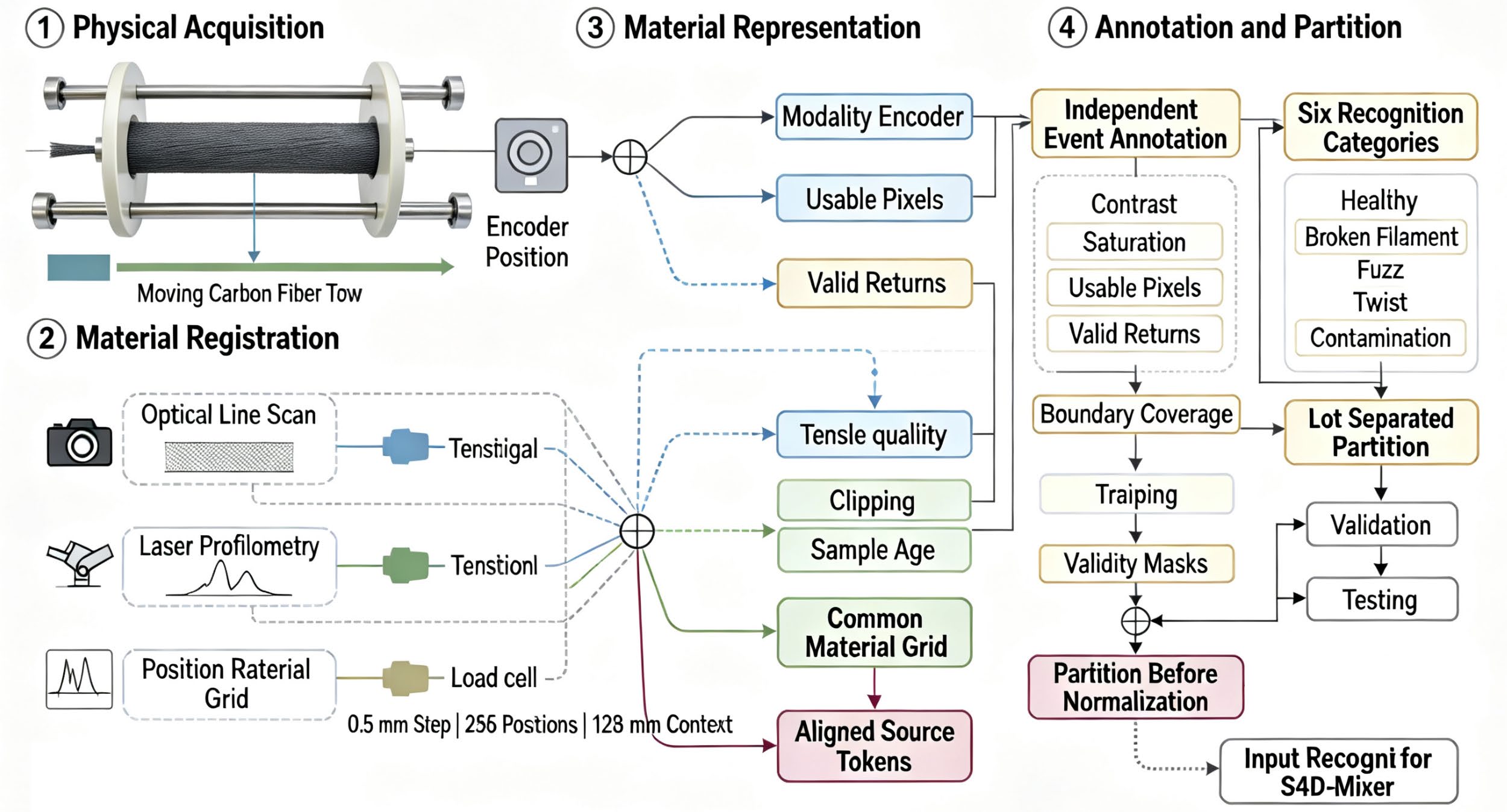
Accurate defect detection in carbon fiber tow requires an inspection system that can observe surface appearance, geometric displacement, and mechanical disturbance along the same moving material coordinate. This study proposes an S4D-Mixer multisource fusion model that aligns optical line scans, laser profilometry, and tension signals on an encoder-indexed grid, processes each source with diagonal state-space layers, and combines the resulting tokens through a reliability-aware gate and residual channel mixer. The model is designed to preserve local defect boundaries while retaining causal context across extended tow disturbances. A constructed benchmark with six tow states is used to examine recognition behavior, calibration, missing-source robustness, and latency assumptions. In the illustrative comparison, the complete model reaches 96.7% macro F1 and 96.67% accuracy, exceeds fixed fusion under degraded sensing by 4.0-7.2 percentage points, and keeps selective risk below 1.3% at 80% coverage. These values are not presented as production measurements; they provide a transparent numerical protocol for evaluating the proposed inspection design before physical trials. The results indicate that source-quality gating can reduce the influence of saturated images, missing profile returns, and tension spikes, while S4D processing supports consistent sequence-level recognition. The framework offers a practical route for future in-line carbon tow inspection once validated with independently collected production data, hardware timing measurements, and lot-separated annotation.
Details
License
Copyright (c) 2026 Jindřich Kopecký

This work is licensed under a Creative Commons Attribution-NonCommercial-ShareAlike 4.0 International License.
