Small-Sample Masked Graph Autoencoding for Collision-Risk Prediction in Underground Mine Locomotive Operations
Authors
Maria Kijewska, Marcel ŻakFiles
Key Information
Journal

Published in Vol. 5 No. 4 (2026) of Applied Manufacturing Intelligence Journal .
The Applied Manufacturing Intelligence Journal (AMIJ) eISSN:3136-7658 is a peer-reviewed, international, open-access journal that serves as a dedicated platform for researchers, engineers, and practitioners working at the intersection of advanced manufacturing and artificial intelligence. The journal aims to accelerate the integration of intelligent algorithms, autonomous decision-making, and data-driven optimization in modern manufacturing environments.
AMIJ emphasizes practical relevance, empirical validation, and industrial impact. It welcomes contributions that demonstrate how AI, machine learning, cyber-physical systems (CPS), and smart control technologies are transforming manufacturing systems and processes.
About the JournalAbstract
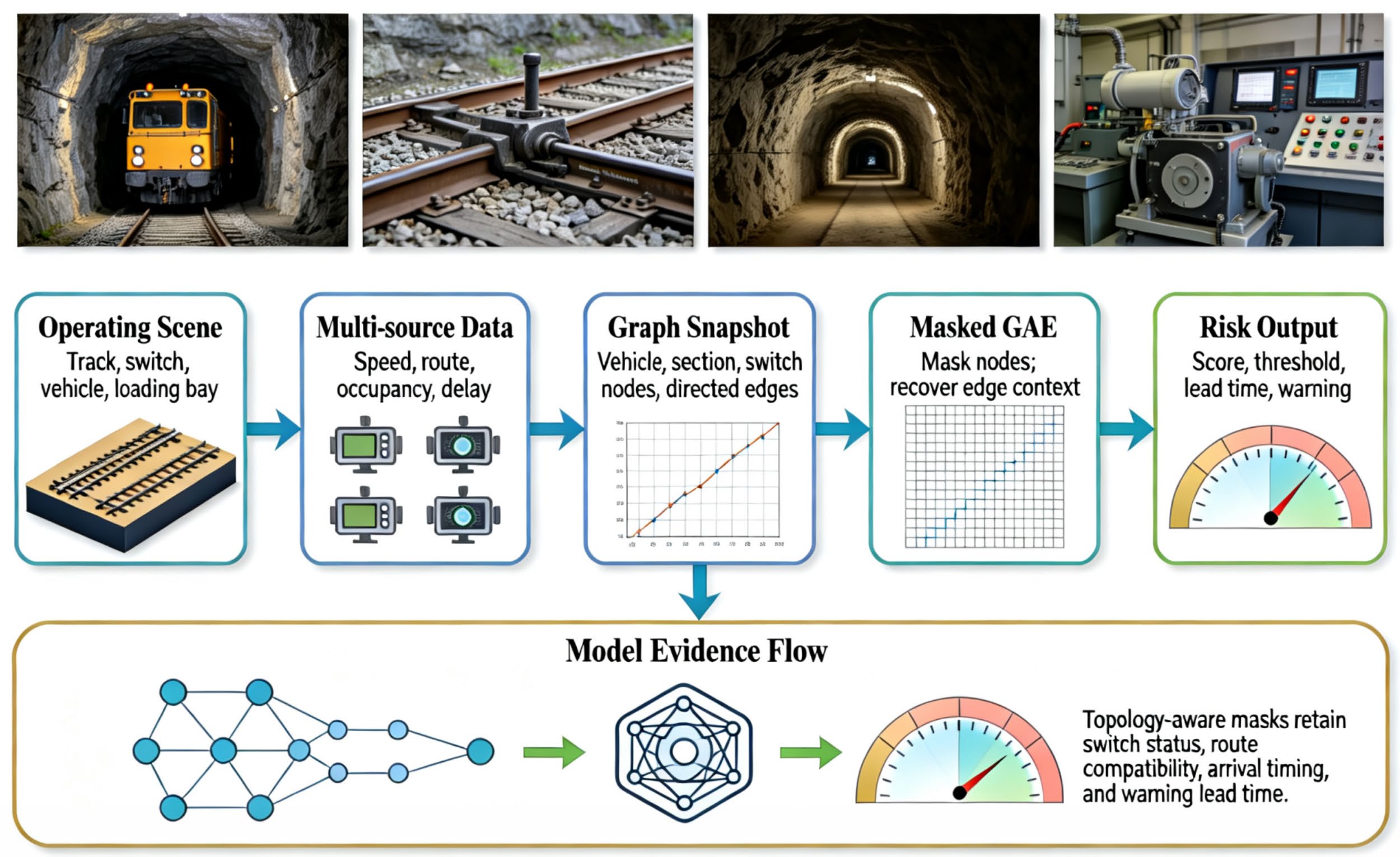
Collision-risk prediction for underground mine locomotives is difficult because verified near-conflict labels are scarce, telemetry is incomplete, and risk depends on interactions among vehicles, track sections, and switches. This study evaluates a small-sample Masked Graph Autoencoder (MGAE) that reconstructs masked node attributes and operational edge context before supervised risk prediction. A haulage-network dataset comprising 4,860 operating windows, 37 graph nodes, and 52 directed section edges was used. The evaluation considered labeled fractions of 5%, 10%, 20%, and 40%, with episode- aware partitioning and matched normal windows. At the 20% labeled condition, the proposed model attained an F1-score of 0.861, an area under the precision–recall curve of 0.884, balanced accuracy of 0.902, and a reported false-alarm rate of 7.3%. Its mean warning lead time was 18.9 s under the study’s event-boundary definition. At 5% labeled data, its F1-score was 0.742, compared with 0.628 for graph attention and 0.584 for the recurrent baseline. Removing edge masking reduced F1 from 0.861 to 0.802. These results indicate that topology-aware reconstruction is promising for the evaluated network and label protocol, while the single-network scope, limited number of independent risk events, and incomplete operational exposure measures restrict generalization. Multi-site, repeated-run, and end-to-end validation are required before deployment claims can be made.
Details
License
Copyright (c) 2026 Maria Kijewska, Marcel Żak

This work is licensed under a Creative Commons Attribution-NonCommercial-ShareAlike 4.0 International License.