A Few-Shot TimesNet-MoE Model for Occupancy Prediction in Smart Lighting
Authors
Octav Mănescu, Dumitru ZavoiFiles
Key Information
Journal

Published in Vol. 5 No. 3 (2026) of Applied Manufacturing Intelligence Journal .
The Applied Manufacturing Intelligence Journal (AMIJ) eISSN:3136-7658 is a peer-reviewed, international, open-access journal that serves as a dedicated platform for researchers, engineers, and practitioners working at the intersection of advanced manufacturing and artificial intelligence. The journal aims to accelerate the integration of intelligent algorithms, autonomous decision-making, and data-driven optimization in modern manufacturing environments.
AMIJ emphasizes practical relevance, empirical validation, and industrial impact. It welcomes contributions that demonstrate how AI, machine learning, cyber-physical systems (CPS), and smart control technologies are transforming manufacturing systems and processes.
About the JournalAbstract
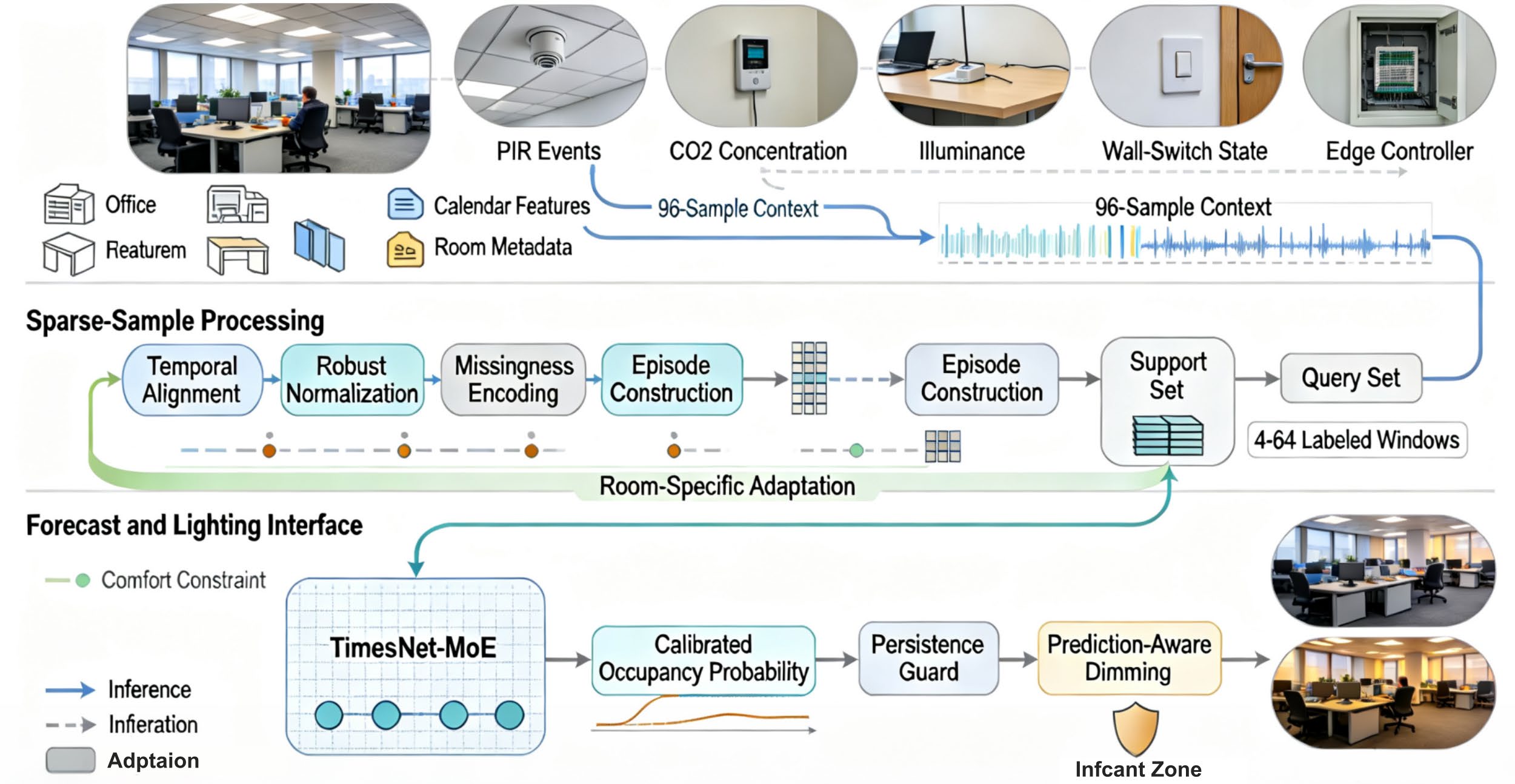
Newly commissioned smart-lighting spaces often provide limited labelled occupancy histories, while room routines and sensing responses vary across a building. This study presents a few-shot TimesNet-MoE framework that combines period- aware temporal encoding, context-dependent expert weighting, and calibrated occupancy probabilities. Passive infrared, carbon dioxide, illuminance, switch-state, and calendar signals are organized into support-query episodes. Four experts emphasize motion, scheduling, environmental persistence, and occupancy transitions, with a shared prediction head linking their representations to a lighting-control interface. Evaluation covers five room categories and support budgets from four to 64 labelled context windows. At 16 support samples and a 10 min horizon, the framework achieved macro-F1 of 0.85, compared with 0.79 for plain TimesNet, while occupancy-probability mean absolute error decreased from 0.151 to 0.121. In the support-budget experiment, macro-F1 reached 0.900 and probability error reached 0.104 at 64 samples. Separate horizon and cross-room experiments yielded macro-F1 of 0.824 at 30 min and transfer F1 of 0.84. At 20% missing observations, F1 remained 0.82, compared with 0.72 for TimesNet. Inference required 46 ms and 0.53 J under the reported profiling configuration. Room-level normalized lighting energy ranged from 0.67 to 0.90. A separate controller- aggressiveness sweep paired 17.3% energy savings with 94.2% comfort compliance. The reported comparisons indicate that period-aware expert weighting can improve sparse-supervision occupancy prediction, with deployment decisions requiring explicit consideration of inference cost, calibration, and transition-level comfort.
Details
License
Copyright (c) 2026 Octav Mănescu, Dumitru Zavoi

This work is licensed under a Creative Commons Attribution-NonCommercial-ShareAlike 4.0 International License.