Distributed Edge Model Update Scheduling for SwinV2 Adapter Models Based on Wireless Bandwidth and Drift Indicators
Authors
Tadas Mikalauskas, Deividas Remeika, Orestas GrigonFiles
Key Information
Journal

Published in Vol. 5 No. 3 (2026) of Applied Manufacturing Intelligence Journal .
The Applied Manufacturing Intelligence Journal (AMIJ) eISSN:3136-7658 is a peer-reviewed, international, open-access journal that serves as a dedicated platform for researchers, engineers, and practitioners working at the intersection of advanced manufacturing and artificial intelligence. The journal aims to accelerate the integration of intelligent algorithms, autonomous decision-making, and data-driven optimization in modern manufacturing environments.
AMIJ emphasizes practical relevance, empirical validation, and industrial impact. It welcomes contributions that demonstrate how AI, machine learning, cyber-physical systems (CPS), and smart control technologies are transforming manufacturing systems and processes.
About the JournalAbstract
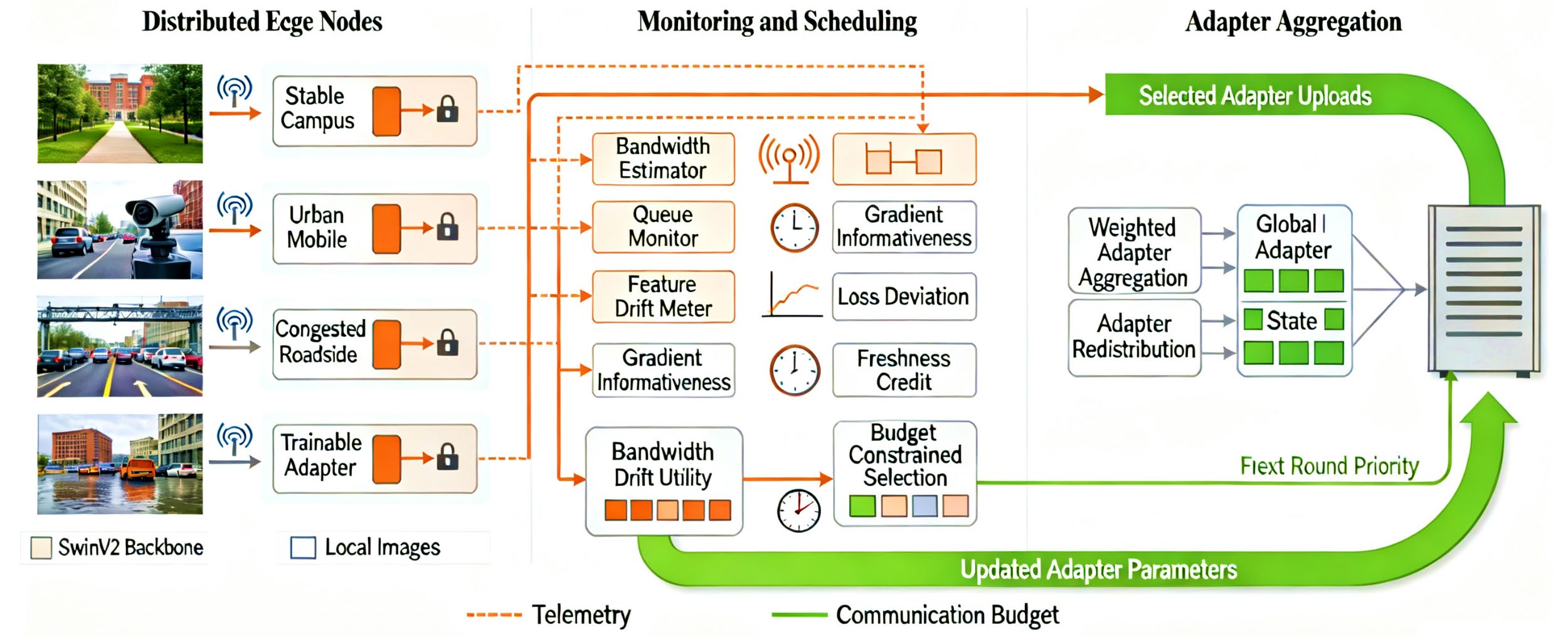
Distributed visual models require timely adaptation when scene distributions change, while fluctuating wireless capacity limits the availability of local updates. This paper develops a participant scheduling framework for SwinV2 Adapter models that combines bandwidth, queue delay, feature drift, validation loss deviation, gradient informativeness, and bounded freshness credit. A coordinator ranks local adapter updates under a communication budget and aggregates the admitted parameters through utility weighted contributions. The evaluation examines accuracy and communication efficiency across 24 edge nodes, four wireless regimes, and five drift categories. In the experimental comparison, final aggregate F1 is 89.3% for the proposed scheduler and 87.7% for periodic participation. Mean completion time decreases from 18.3 to 11.2 s, while the 95th percentile is 19.6 s. The energy distributions have median values of 42.5 and 62.0 J for the proposed and periodic policies, respectively. The proposed payload is 42.8% of the periodic reference, with median staleness of 1.9 rounds and a 95th percentile of 3.8 rounds. Component ablation results separate the roles of bandwidth feasibility and statistical urgency and identify their distinct effects on update latency and adaptation accuracy. The framework provides an interpretable formulation for assessing how communication allocation affects model freshness, participant representation, and adaptation quality in distributed wireless edge systems.
Details
License
Copyright (c) 2026 Tadas Mikalauskas, Deividas Remeika, Orestas Grigon

This work is licensed under a Creative Commons Attribution-NonCommercial-ShareAlike 4.0 International License.