Multi-Rate Mamba2-UNet for Factory Wearable Safety Event Detection
Authors
Indrek Jõhvi, Daan Eelmaa, Gunnar HõbeFiles
Key Information
Journal

Published in Vol. 5 No. 3 (2026) of Applied Manufacturing Intelligence Journal .
The Applied Manufacturing Intelligence Journal (AMIJ) eISSN:3136-7658 is a peer-reviewed, international, open-access journal that serves as a dedicated platform for researchers, engineers, and practitioners working at the intersection of advanced manufacturing and artificial intelligence. The journal aims to accelerate the integration of intelligent algorithms, autonomous decision-making, and data-driven optimization in modern manufacturing environments.
AMIJ emphasizes practical relevance, empirical validation, and industrial impact. It welcomes contributions that demonstrate how AI, machine learning, cyber-physical systems (CPS), and smart control technologies are transforming manufacturing systems and processes.
About the JournalAbstract
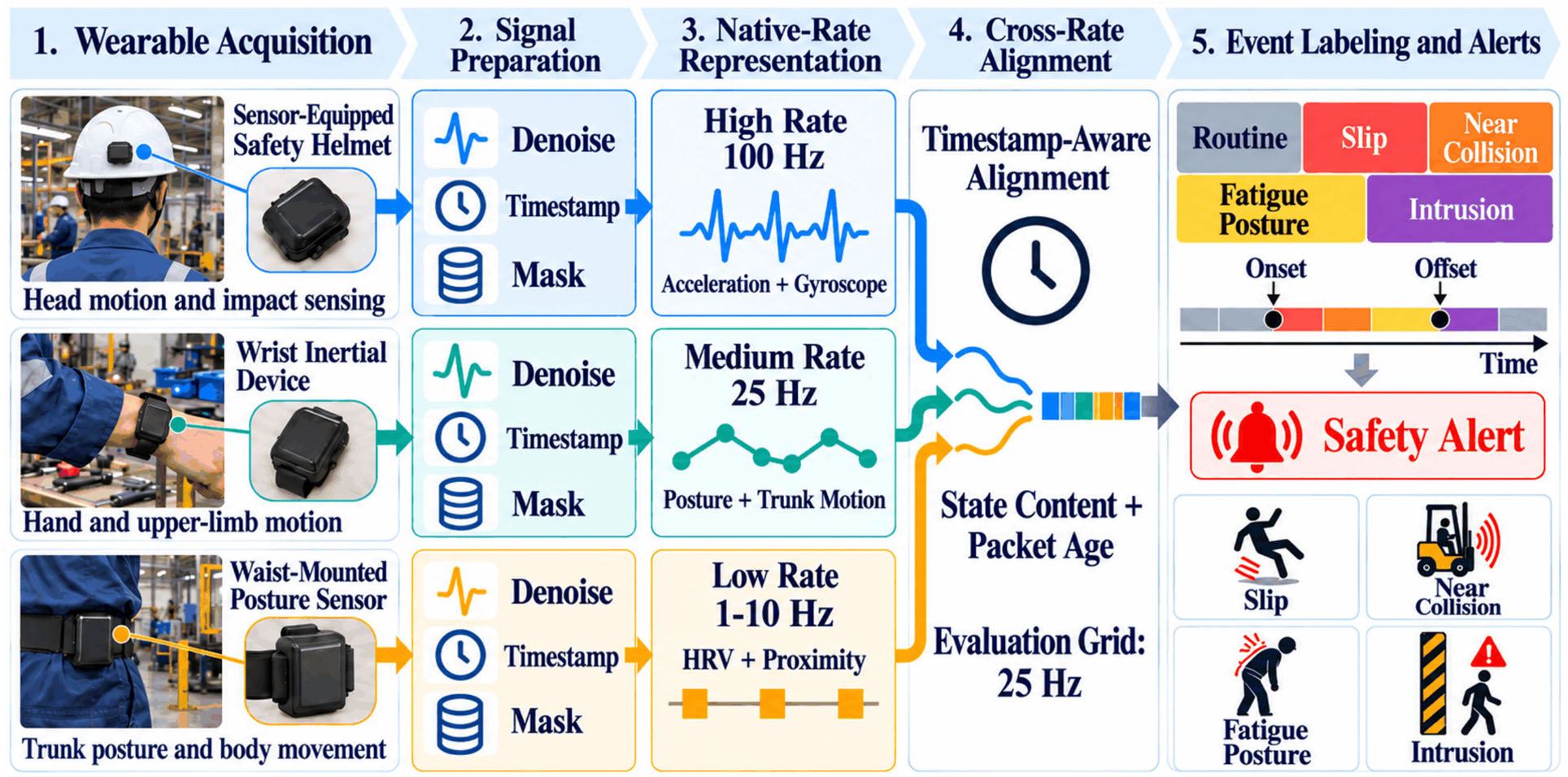
Factory wearable systems collect inertial, physiological, and proximity signals at different sampling rates, while many event detectors require a shared temporal grid. This study proposes a multi-rate Mamba2-UNet model for safety event detection in industrial wearable networks, integrating rapid inertial changes, gradual posture transitions, and intermittent proximity observations. The architecture combines rate-specific Mamba2 encoders, a cross-rate alignment gate, and a temporal UNet decoder to reconstruct frame-level event boundaries while retaining long-range context. The evaluation dataset comprises five channel groups operating at three acquisition rates and covers slips, near collisions, fatigue posture, and tool-zone intrusion. Against LSTM, temporal convolutional network, Transformer-UNet, and single-rate Mamba baselines, the proposed model achieves 94.8% event F1, 96.1% safety-critical recall, 31 ms median model inference latency, and 0.038 s boundary error on the main test split. Removing cross-rate alignment reduces F1 by 3.4 percentage points, while replacing Mamba2 blocks with convolutional encoders increases latency by 17 ms. Class-specific evaluation connects these differences to abrupt transitions, sustained posture changes, and sparse environmental observations. The architectural contribution is the integration of native-rate state retention with frame-level reconstruction. The reported comparisons describe the stated test split, and the computational timing concerns inference on an available input window. These results support further evaluation of rate-aware state space modeling for accurate and timely wearable safety monitoring.
Details
License
Copyright (c) 2026 Indrek Jõhvi, Daan Eelmaa, Gunnar Hõbe

This work is licensed under a Creative Commons Attribution-NonCommercial-ShareAlike 4.0 International License.