Edge-Aware KAN-GraphMixer Forecasting Model for Abnormality Identification in Intelligent Logistics Cold Boxes
Authors
Norbert Brzeziński, Oliwier Majchrzak, Patryk RybakFiles
Key Information
Journal

Published in Vol. 5 No. 3 (2026) of Applied Manufacturing Intelligence Journal .
The Applied Manufacturing Intelligence Journal (AMIJ) eISSN:3136-7658 is a peer-reviewed, international, open-access journal that serves as a dedicated platform for researchers, engineers, and practitioners working at the intersection of advanced manufacturing and artificial intelligence. The journal aims to accelerate the integration of intelligent algorithms, autonomous decision-making, and data-driven optimization in modern manufacturing environments.
AMIJ emphasizes practical relevance, empirical validation, and industrial impact. It welcomes contributions that demonstrate how AI, machine learning, cyber-physical systems (CPS), and smart control technologies are transforming manufacturing systems and processes.
About the JournalAbstract
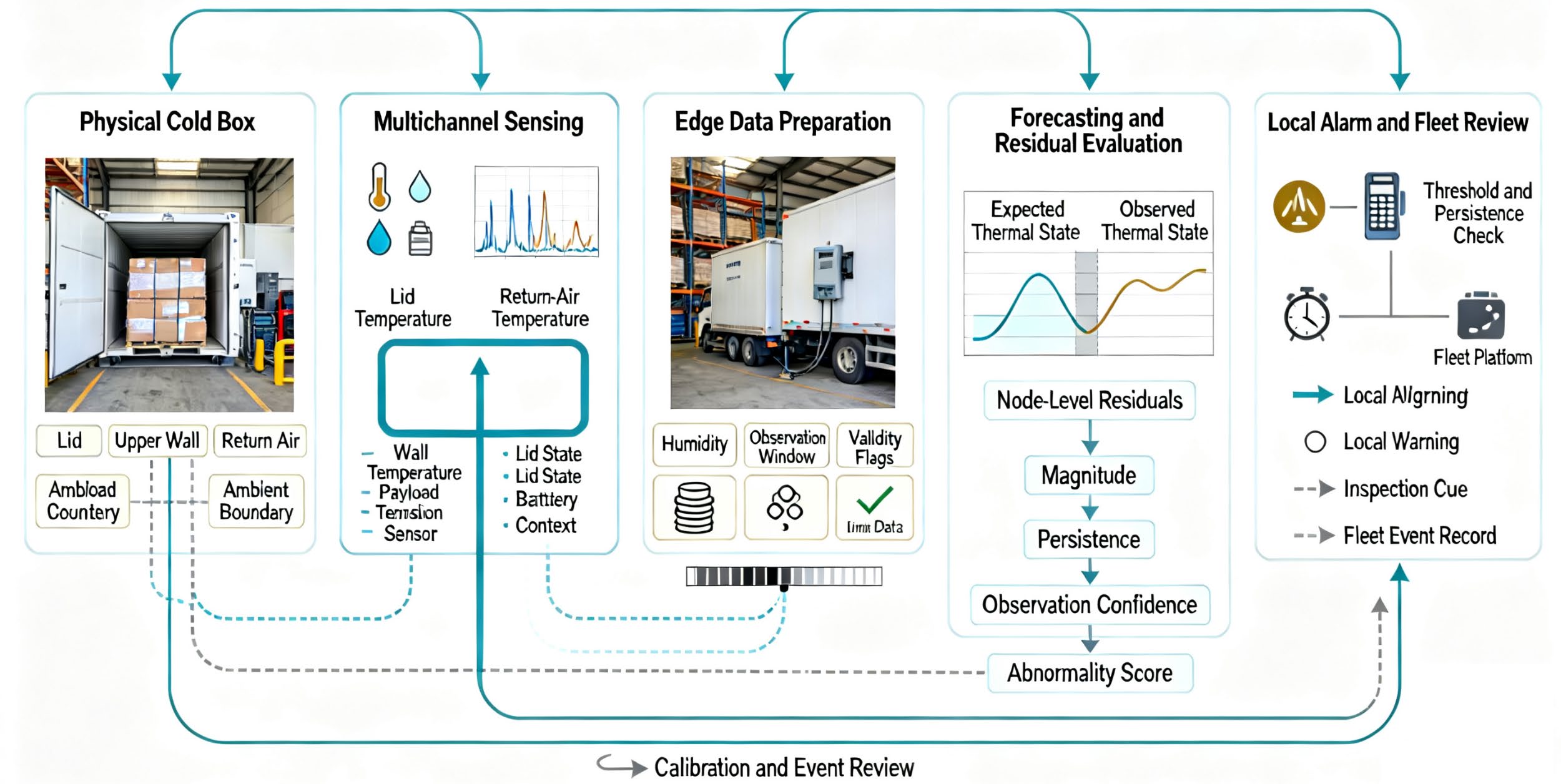
Abnormality identification in intelligent logistics cold boxes requires reliable interpretation of coupled sensor signals under transient handling, uneven thermal response, and intermittent communication. This study proposes an edge-aware KAN- GraphMixer forecasting model that combines nonlinear channel transformations with lightweight sensor-graph mixing. A Kolmogorov-Arnold network represents channel-specific response functions, while graph mixing propagates information among thermally related sensing locations. Multi-step forecasts are converted into node-level residuals, and abnormality decisions incorporate residual magnitude, persistence, and observation confidence. An illustrative evaluation configuration comprising 42,600 observation windows covers normal transport, short and prolonged door exposure, delayed pre-cooling, refrigeration interruption, and sensor drift. The reported configuration achieves a 15-min temperature forecasting mean absolute error of 0.286 °C and a root mean square error of 0.438 °C. Abnormality identification reaches 97.5% precision, 96.1% recall, and a 96.8% F1-score. Compared with the graph-mixing baseline, forecasting error decreases by approximately 10.1%, and F1-score increases by 2.4 percentage points. At a false alarm rate of 1.9%, the median warning lead time is 11.6 min. Local inference requires 8.7 ms per window, with a quantized parameter footprint of 0.84 MB. Component comparisons indicate that both nonlinear transformation and graph interaction contribute to performance, while packet loss and shared calibration reduce identification accuracy. The numerical findings describe a proof-of-concept configuration whose practical effectiveness requires independently collected operational records, reproducible training settings, and gateway profiling. They indicate potential for compact predictive monitoring within the stated sensing and calibration conditions.
Details
License
Copyright (c) 2026 Norbert Brzeziński, Oliwier Majchrzak, Patryk Rybak

This work is licensed under a Creative Commons Attribution-NonCommercial-ShareAlike 4.0 International License.