PPO-Lagrangian Model for Paper Roll Edge Defect Classification Based on High-Speed Line-Scan Texture Images
Authors
Florentin Botez, Marian KirițăFiles
Key Information
Journal

Published in Vol. 5 No. 2 (2026) of Applied Manufacturing Intelligence Journal .
The Applied Manufacturing Intelligence Journal (AMIJ) eISSN:3136-7658 is a peer-reviewed, international, open-access journal that serves as a dedicated platform for researchers, engineers, and practitioners working at the intersection of advanced manufacturing and artificial intelligence. The journal aims to accelerate the integration of intelligent algorithms, autonomous decision-making, and data-driven optimization in modern manufacturing environments.
AMIJ emphasizes practical relevance, empirical validation, and industrial impact. It welcomes contributions that demonstrate how AI, machine learning, cyber-physical systems (CPS), and smart control technologies are transforming manufacturing systems and processes.
About the JournalAbstract
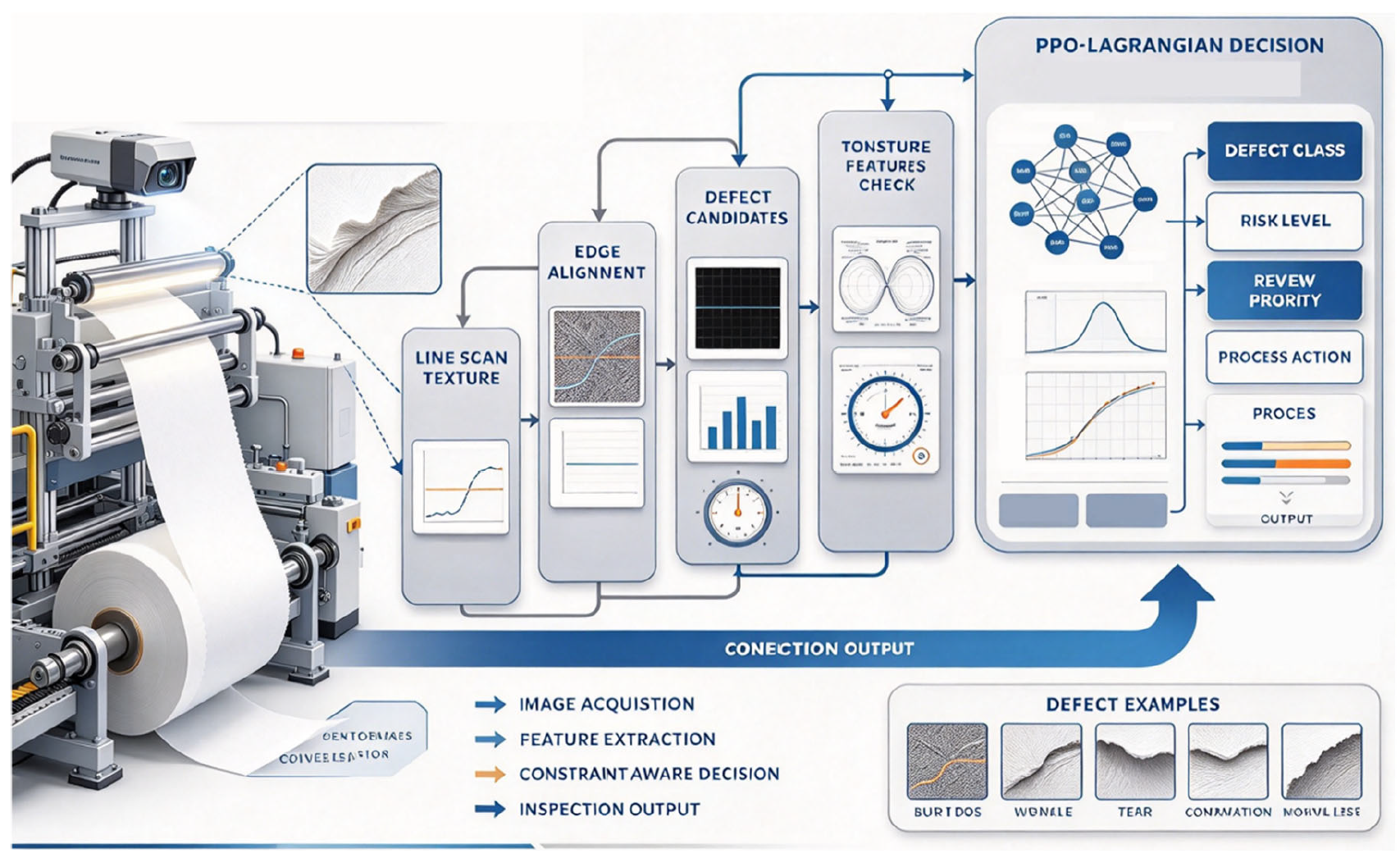
Edge defects of paper rolls reduce converting stability, damage winding quality and may impair subsequent printing or coating operations. High-speed line-scan imaging can capture long, continuous edge textures, but the resulting strips are affected by vibration, illumination fluctuation, paper-fibre variation, edge-position drift and motion blur. This paper proposes a PPO-Lagrangian model for paper roll edge defect classification using high-speed line-scan texture images. Edge-response maps, defect-region indicators, image-quality weights and process-state features are integrated into a texture window so that local texture evidence and acquisition reliability are evaluated together. A classification policy is trained to identify edge cracks, burrs, folds, fibre lift-off, contamination and normal texture changes, while a Lagrangian constraint regulates false alarms, missed serious defects and unstable review decisions. The framework returns defect class, confidence score, constraint state and alarm priority. Simulated experiments cover edge cracks, burrs, folds, fibre lift-off, contamination and normal texture changes. The proposed model achieves 93.7% overall classification accuracy, 91.4% severe-defect recall and a lower constraint-violation rate than ordinary convolutional and Transformer baselines. The constrained optimization also reduces unsafe decision patterns by separating high-risk edge defects from weak texture disturbances. These outputs support line-side inspection, review routing and production-level decision traceability for roll-to-roll paper manufacturing.
Details
License
Copyright (c) 2026 Florentin Botez, Marian Kiriță

This work is licensed under a Creative Commons Attribution-NonCommercial-ShareAlike 4.0 International License.