VMamba-Seg Model for Terrain Compliance Adaptation of Legged Robots Based on Foot Pressure and Depth Maps
Authors
Maria Kuchta, Natalia KurzawaFiles
Key Information
Journal

Published in Vol. 5 No. 2 (2026) of Applied Manufacturing Intelligence Journal .
The Applied Manufacturing Intelligence Journal (AMIJ) eISSN:3136-7658 is a peer-reviewed, international, open-access journal that serves as a dedicated platform for researchers, engineers, and practitioners working at the intersection of advanced manufacturing and artificial intelligence. The journal aims to accelerate the integration of intelligent algorithms, autonomous decision-making, and data-driven optimization in modern manufacturing environments.
AMIJ emphasizes practical relevance, empirical validation, and industrial impact. It welcomes contributions that demonstrate how AI, machine learning, cyber-physical systems (CPS), and smart control technologies are transforming manufacturing systems and processes.
About the JournalAbstract
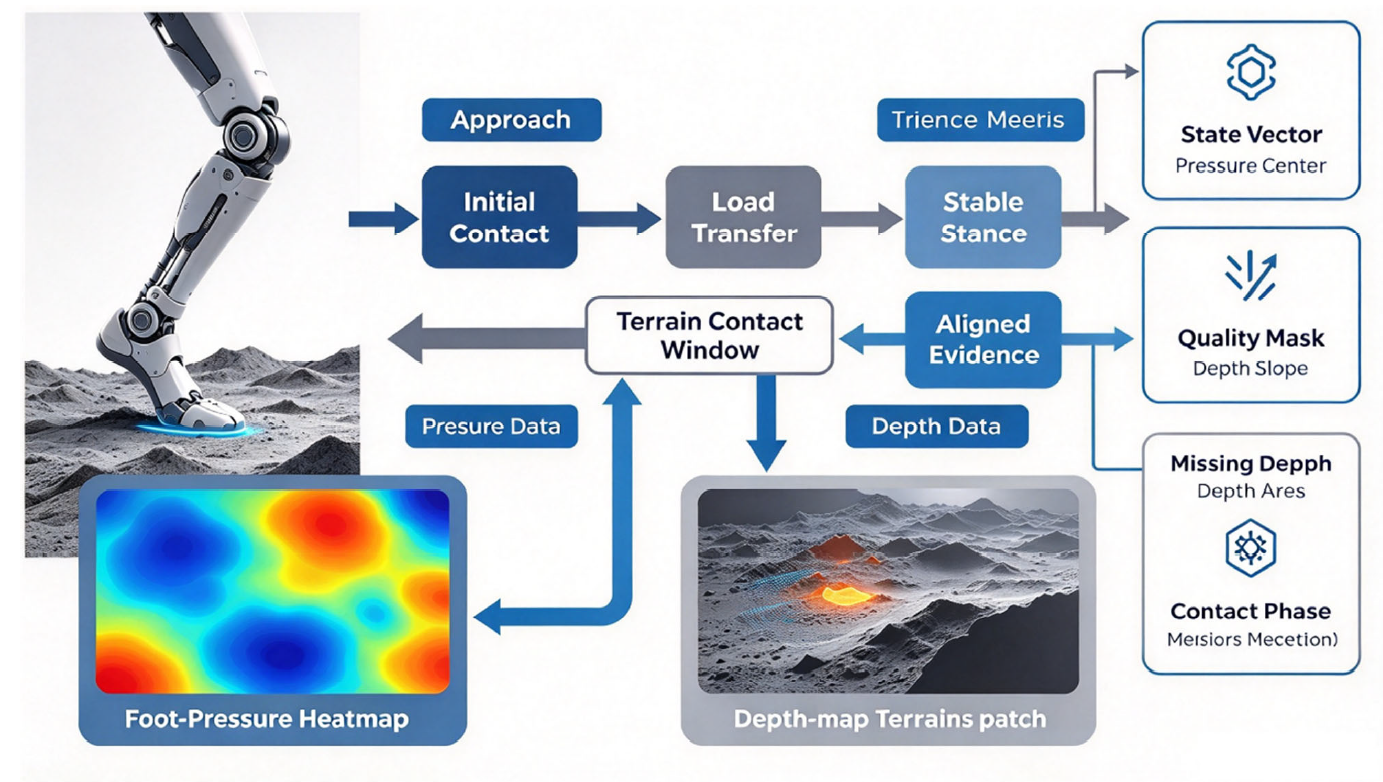
Legged robots require reliable terrain compliance adaptation for locomotion on hard floors, soft soil, gravel, stairs, wet surfaces and mixed ground. This paper proposes a VMamba-Seg model for terrain compliance adaptation based on foot pressure and depth maps. Plantar pressure sequences, depth-map patches, body attitude and foot-contact states are aligned into a terrain-contact window, where foot pressure provides ground-reaction evidence and depth maps provide geometric information before and during contact. VMamba models extended terrain-contact dependence through an efficient selective state-space update, while the segmentation branch extracts local depth boundaries, obstacle edges and support regions. The model outputs terrain class, compliance score, confidence and gait adaptation priority. A synthetic dataset of 4,360 terrain-contact windows is generated for rigid floor, carpet, gravel, soft soil, wet surface, step edge and mixed terrain. The proposed model achieves 92.8% terrain recognition accuracy, 89.6% macro-F1 and 84.7% soft- ground recall, outperforming CNN, LSTM, SegFormer and VMamba-only baselines. Robustness tests show that the model remains effective under noise, missing data and partial-terrain contact. Explanation results indicate that pressure evidence is more informative for soft-ground compliance, whereas depth-boundary evidence is more suitable for step- edge and obstacle-contact scenarios. Joint pressure-depth modelling can therefore improve terrain interpretation and support adaptive gait selection for legged robots.
Details
License
Copyright (c) 2026 Maria Kuchta, Natalia Kurzawa

This work is licensed under a Creative Commons Attribution-NonCommercial-ShareAlike 4.0 International License.