Explainable Res2Net-SE Model for Quality Estimation of Robotic Screw Fastening
Authors
Recep UrfalıFiles
Key Information
Journal

Published in Vol. 5 No. 2 (2026) of Applied Manufacturing Intelligence Journal .
The Applied Manufacturing Intelligence Journal (AMIJ) eISSN:3136-7658 is a peer-reviewed, international, open-access journal that serves as a dedicated platform for researchers, engineers, and practitioners working at the intersection of advanced manufacturing and artificial intelligence. The journal aims to accelerate the integration of intelligent algorithms, autonomous decision-making, and data-driven optimization in modern manufacturing environments.
AMIJ emphasizes practical relevance, empirical validation, and industrial impact. It welcomes contributions that demonstrate how AI, machine learning, cyber-physical systems (CPS), and smart control technologies are transforming manufacturing systems and processes.
About the JournalAbstract
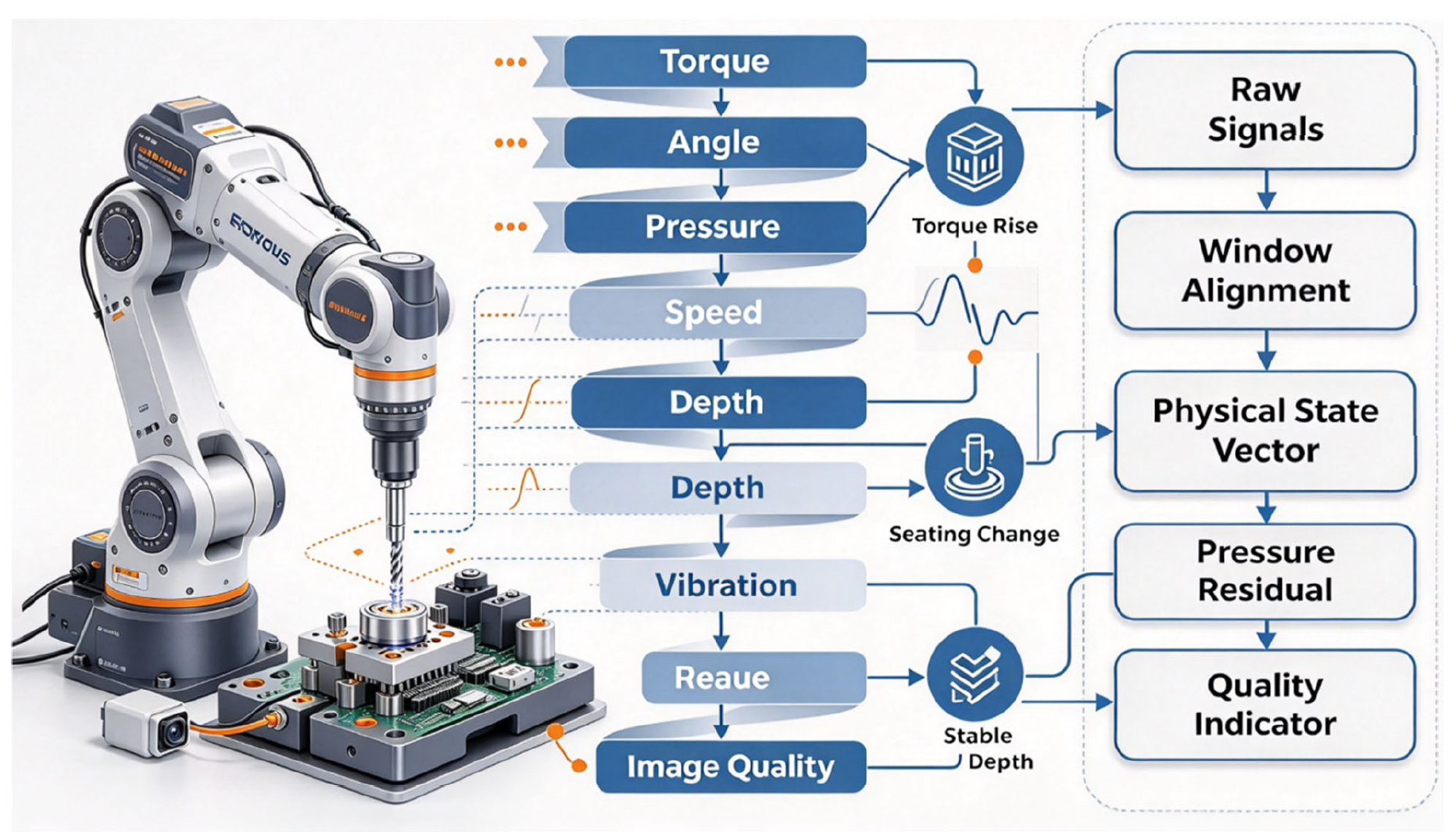
Reliable quality estimation for robotic screw fastening is required to prevent loosening, thread damage, seal failure and late-stage product rejection caused by a single fastening error. This paper presents an explainable Res2Net-SE model for screw-fastening quality prediction based on torque-angle curves, axial pressure, spindle speed, depth displacement and visual inspection indicators. The fastening window is aligned at the torque-rise and seating stages, and multi-scale process features are used to represent peak torque, tightening slope, pressure stability, residual vibration and terminal depth. Res2Net blocks learn short-term impulses and gradual fastening trends within the same residual structure, while squeeze-and-excitation weighting enhances the signal channels that provide the most reliable evidence. The model outputs a quality score, confidence value, dominant evidence channel and review priority. A simulated robotic assembly dataset of 4,080 fastening windows was generated for normal fastening, under-tightening, over-tightening, thread slip, tilted screw entry and low-confidence mixed cases. The proposed model achieved 93.4% accuracy and 90.7% macro-F1, outperforming CNN, LSTM, Transformer and ResNet baselines. Torque noise and pressure drift still reduce recall for thread-slip and under-tightening cases. The results show that torque-angle data are more indicative of over-tightening, whereas pressure-depth data are closely associated with tilted entry and incomplete seating. Interpretable multi-scale feature learning can therefore support fastening quality assessment, rework prioritization and traceable robotic assembly inspection.
Details
License
Copyright (c) 2026 Recep Urfalı

This work is licensed under a Creative Commons Attribution-NonCommercial-ShareAlike 4.0 International License.