Physics-Guided Autoformer-GAT Prediction Model for Contact Force Regulation of Aerial Manipulators
Authors
Kristian Sokol, Alen PavićFiles
Key Information
Journal

Published in Vol. 5 No. 2 (2026) of Applied Manufacturing Intelligence Journal .
The Applied Manufacturing Intelligence Journal (AMIJ) eISSN:3136-7658 is a peer-reviewed, international, open-access journal that serves as a dedicated platform for researchers, engineers, and practitioners working at the intersection of advanced manufacturing and artificial intelligence. The journal aims to accelerate the integration of intelligent algorithms, autonomous decision-making, and data-driven optimization in modern manufacturing environments.
AMIJ emphasizes practical relevance, empirical validation, and industrial impact. It welcomes contributions that demonstrate how AI, machine learning, cyber-physical systems (CPS), and smart control technologies are transforming manufacturing systems and processes.
About the JournalAbstract
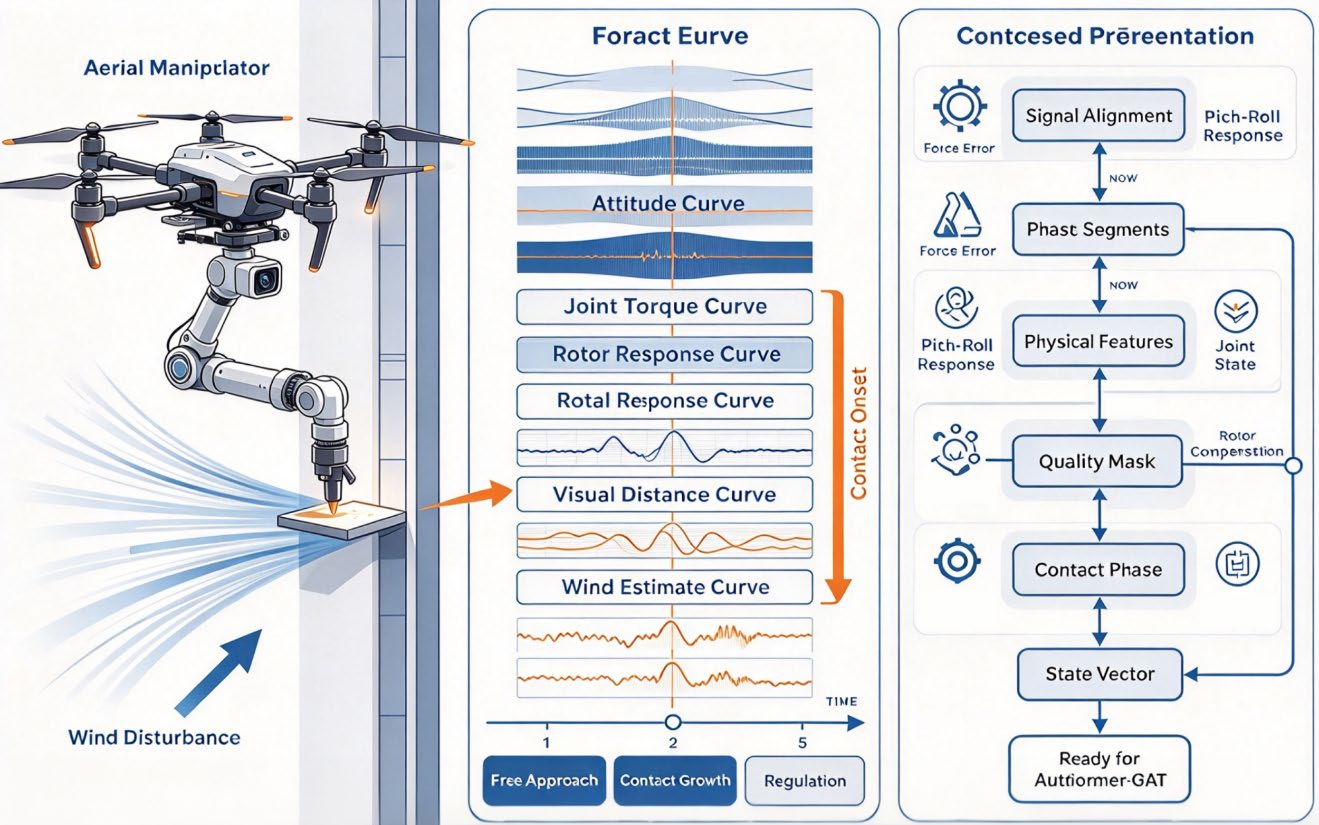
Aerial manipulators are increasingly applied to contact inspection, pushing, cleaning and maintenance of high-altitude structures, yet contact-force regulation remains difficult because rotor disturbance, manipulator motion, surface stiffness and wind load interact within the same underactuated system. This paper proposes a Physics-Guided Autoformer-GAT prediction model for contact force regulation of aerial manipulators. Force, attitude, joint, rotor, visual and wind-related signals are aligned into short contact windows, and Autoformer decomposition is used to separate slow interaction trends from short-term force fluctuations. Graph attention then models coupling among the aerial platform, manipulator joints, end-effector and environment, while physical guidance constrains continuous contact at a fixed location and limits unrealistic force-rate variation. A synthetic dataset of 3,400 contact windows was generated to represent free approach, soft contact, stable contact, boundary contact, force overshoot and loss of contact. The proposed model achieved 92.1% contact-state accuracy and 87.9% macro-F1, and it reduced force-prediction error by 15.4% relative to the best previous baseline. Robustness tests under wind, sensor noise and force-sensor dropout showed that confidence decreased before the predicted contact state became unstable. These results indicate that physics-guided temporal decomposition and graph-based coupling representation can improve short-horizon contact-force prediction while providing interpretable evidence for supervisory regulation of aerial manipulation.
Details
License
Copyright (c) 2026 Kristian Sokol, Alen Pavić

This work is licensed under a Creative Commons Attribution-NonCommercial-ShareAlike 4.0 International License.