ConvNeXtV2 DCNv4 Model with Robust Learning for Geometric Error Mapping of Machine Tools
Authors
Argyris Karaiskos, Zafeiris Iordanou, Stavroula KaramanliFiles
Key Information
Journal

Published in Vol. 5 No. 2 (2026) of Applied Manufacturing Intelligence Journal .
The Applied Manufacturing Intelligence Journal (AMIJ) eISSN:3136-7658 is a peer-reviewed, international, open-access journal that serves as a dedicated platform for researchers, engineers, and practitioners working at the intersection of advanced manufacturing and artificial intelligence. The journal aims to accelerate the integration of intelligent algorithms, autonomous decision-making, and data-driven optimization in modern manufacturing environments.
AMIJ emphasizes practical relevance, empirical validation, and industrial impact. It welcomes contributions that demonstrate how AI, machine learning, cyber-physical systems (CPS), and smart control technologies are transforming manufacturing systems and processes.
About the JournalAbstract
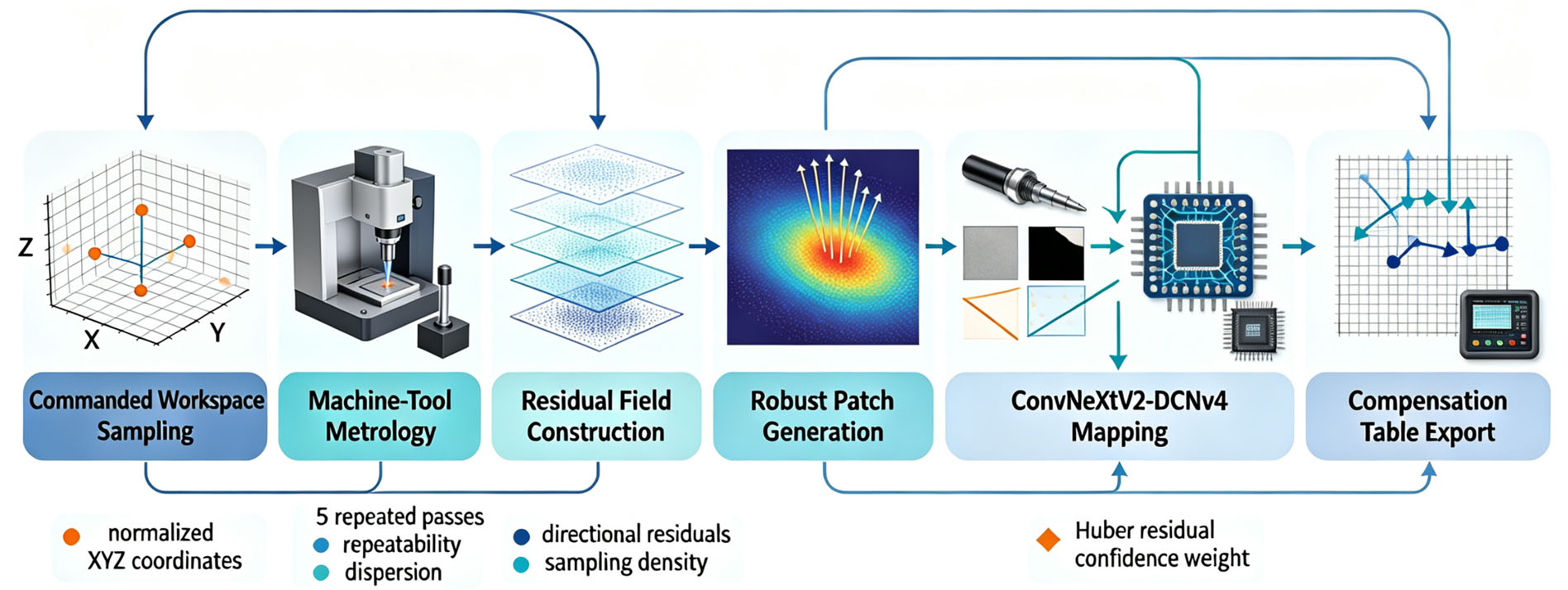
Geometric error mapping remains a limiting step in the accuracy improvement of multi-axis machine tools because sparse metrology samples, local structural nonlinearity, and measurement contamination are difficult to handle with conventional parametric compensation models. This paper proposes a robust ConvNeXtV2-DCNv4 network for volumetric geometric error mapping, where large-kernel ConvNeXtV2 stages capture long-range workspace dependencies and DCNv4 deformable convolution adapts the sampling pattern to nonuniform error gradients near travel reversals and coupled axis transitions. A robust learning objective combining Huber regression, consistency regularization, and residual reweighting is introduced to reduce sensitivity to outliers produced by probe jitter, fixture compliance, and laser interferometer interruptions. Experiments are constructed on a three-axis vertical machining center with 4,860 spatial samples, five repeated measurement passes, and controlled noise and outlier settings. The proposed method reduces the mean absolute mapping error from 8.74 micrometers for a polynomial baseline and 5.63 micrometers for a standard ConvNeXtV2 model to 3.91 micrometers, while the 95th percentile error decreases to 8.82 micrometers. Under 12 percent injected outliers, the model preserves an R2 value of 0.941 and limits compensation residual drift to 2.16 micrometers. The results indicate that deformable spatial learning and robust optimization can provide a practical error field estimator for machine-tool compensation when the measured workspace is locally irregular and only moderately dense. The main contribution is the integration of adaptive deformable sampling and robust residual reweighting into a compensation-oriented geometric error mapper for moderately sparse machine-tool measurements.
Details
License
Copyright (c) 2026 Argyris Karaiskos, Zafeiris Iordanou, Stavroula Karamanli

This work is licensed under a Creative Commons Attribution-NonCommercial-ShareAlike 4.0 International License.