DLinear KAN Model for Ore Crusher Liner Wear Estimation Based on Motor Power and Vibration History
Authors
Miloslav Sládek, Dušan RychlýFiles
Key Information
Journal

Published in Vol. 5 No. 1 (2026) of Applied Manufacturing Intelligence Journal .
The Applied Manufacturing Intelligence Journal (AMIJ) eISSN:3136-7658 is a peer-reviewed, international, open-access journal that serves as a dedicated platform for researchers, engineers, and practitioners working at the intersection of advanced manufacturing and artificial intelligence. The journal aims to accelerate the integration of intelligent algorithms, autonomous decision-making, and data-driven optimization in modern manufacturing environments.
AMIJ emphasizes practical relevance, empirical validation, and industrial impact. It welcomes contributions that demonstrate how AI, machine learning, cyber-physical systems (CPS), and smart control technologies are transforming manufacturing systems and processes.
About the JournalAbstract
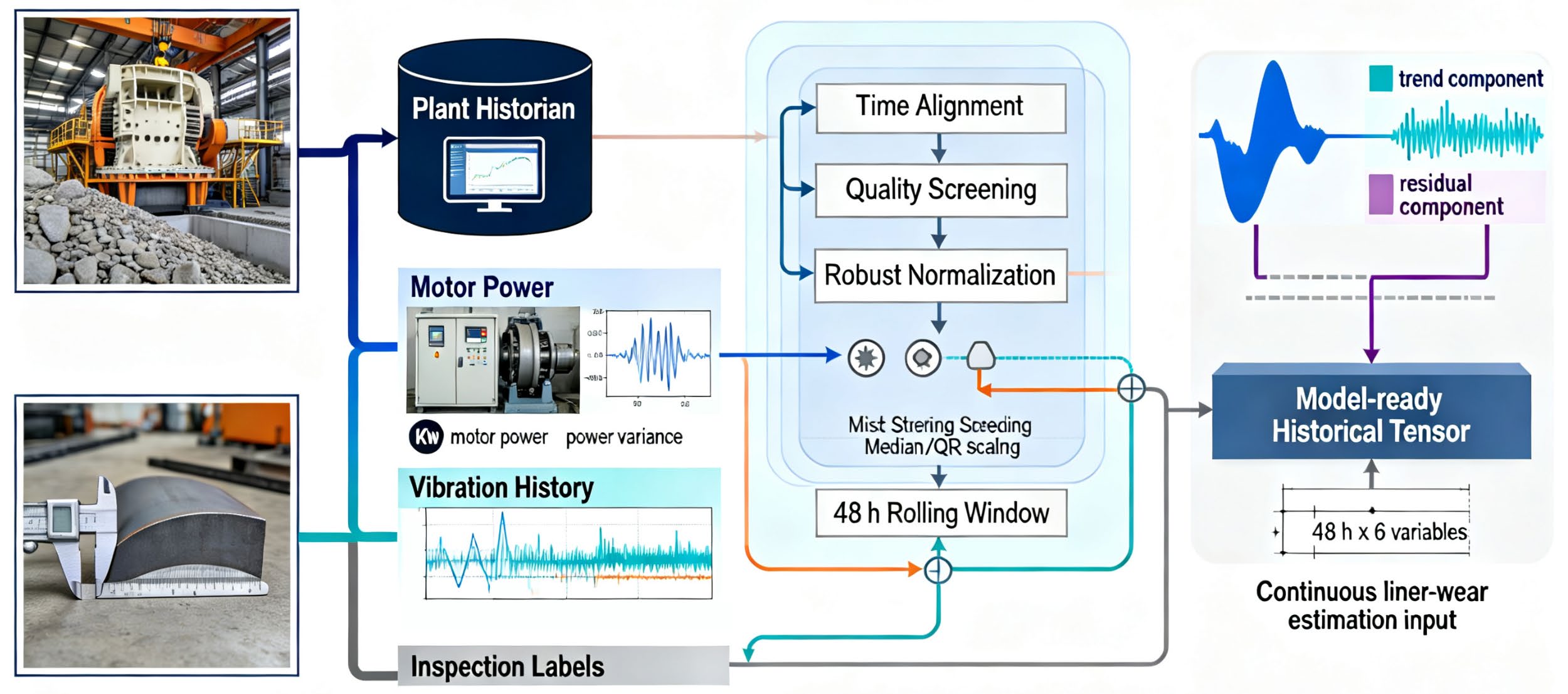
Wear of the ore crusher liner alters the crushing-chamber profile and can change energy demand, vibration transmission, and product-size consistency. This study develops a DLinear-KAN estimator that uses 48 h histories of motor power, power variance, vibration root-mean-square value, envelope kurtosis, high-frequency band energy, and a load descriptor to estimate liner wear. The DLinear path retains slowly varying operating information, whereas the KAN path represents nonlinear residual interactions before the two embeddings are fused by a regression head. A constructed single-campaign evaluation contains 1,248 hourly records, six synchronized variables, and 14 inspection-style checkpoints spanning 2.1– 24.7 mm of wear. Using a chronological 70/10/20 training, validation, and test partition, the proposed model achieved a mean absolute error of 1.42 mm, a root means square error of 1.86 mm, and an R2 value of 0.946. At an illustrative 18 mm warning boundary, the threshold error was 4.1% of all test windows. These results support the use of fused electrical and vibration histories as advisory evidence for inspection planning; they do not establish a universal replacement threshold or cross-site deployment performance. The study therefore provides a transparent demonstration of trend-residual fusion under sparse inspection-style labels and identifies the need for validation across liners, crushers, and operating conditions.
Details
License
Copyright (c) 2026 Miloslav Sládek, Dušan Rychlý

This work is licensed under a Creative Commons Attribution-NonCommercial-ShareAlike 4.0 International License.